Brandão Eduardo, Romero Sebastián, da Silva Maria Almerice Lopes, Santos Fred Luciano Neves
National Reference Service for Filariasis, Aggeu Magalhães Institute (Fiocruz-PE), Recife, Pernambuco, Brazil.
Faculty of Medical Sciences, National University of Rosario, Rosario, Santa Fe, Argentina.
Infect Dis Poverty. 2017 Nov 3;6(1):154. doi: 10.1186/s40249-017-0369-0.
Neglected tropical diseases (NTDs) prevail in conditions of poverty and contribute to the maintenance of social inequality. Out of the NTDs prioritized by the Brazilian Ministry of Health, four parasitic infections require mandatory notification: acute Chagas disease, leishmaniasis, malaria, and schistosomiasis. Data on the behaviour of these NTDs in the young population are currently limited. This study seeks to analyse the epidemiological aspects of these parasitic infections in children and adolescents in Brazil.
A retrospective exploratory ecological study was conducted. A spatial analysis of the cases reported between 2009 and 2013 in individuals aged between 0 and 19 years that were notified through the Health Notification Aggravation Information System (SINAN) was performed.
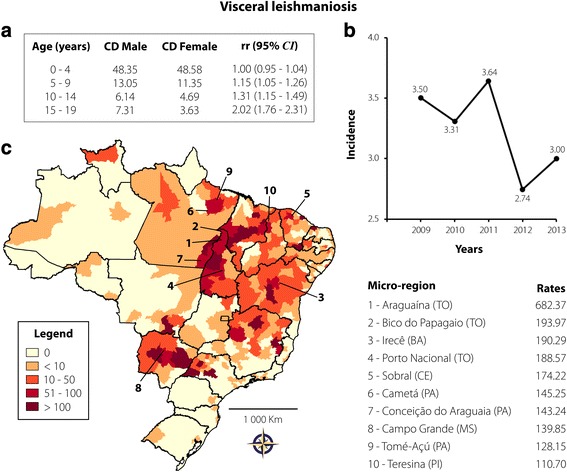
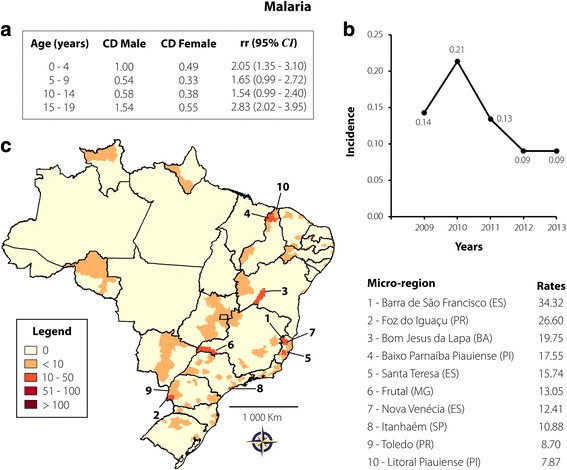
In total, 64,567 cases of cutaneous and visceral leishmaniasis, malaria, schistosomiasis, and acute Chagas disease were recorded in the SINAN database, representing a rate of 20.15 cases per 100,000 inhabitants. The average age of the cases was 12.2 years and 62.32% were male. Four hundred and three deaths related to these obligatorily reported parasites were recorded, indicating a case fatality rate of 0.62%. Visceral leishmaniasis and acute Chagas disease had the highest rates of lethality. A heterogeneous spatial distribution of the studied parasites was observed.
The number of cases and the lethality rate described in this study show that these diseases still represent a serious problem for public health in Brazil. This points to the need to encourage new research and the reformulation of social, economic, and public health policies aimed at ensuring better health and living conditions for all individuals, especially those among the populations considered vulnerable, as is the case of the young.
被忽视的热带病在贫困环境中普遍存在,并加剧了社会不平等。在巴西卫生部确定的优先被忽视的热带病中,有四种寄生虫感染需要强制报告:急性恰加斯病、利什曼病、疟疾和血吸虫病。目前,关于这些被忽视的热带病在年轻人群中的发病情况的数据有限。本研究旨在分析巴西儿童和青少年中这些寄生虫感染的流行病学特征。
进行了一项回顾性探索性生态研究。对2009年至2013年期间通过健康通报加重信息系统(SINAN)报告的0至19岁个体的病例进行了空间分析。
SINAN数据库共记录了64567例皮肤和内脏利什曼病、疟疾、血吸虫病及急性恰加斯病病例,发病率为每10万居民20.15例。病例的平均年龄为12.2岁,男性占62.32%。记录了403例与这些强制报告的寄生虫相关的死亡病例,病死率为0.62%。内脏利什曼病和急性恰加斯病的致死率最高。观察到所研究寄生虫的空间分布不均。
本研究中描述的病例数量和致死率表明,这些疾病仍然是巴西公共卫生面临的严重问题。这表明需要鼓励开展新的研究,并重新制定社会、经济和公共卫生政策,以确保所有人,尤其是被视为弱势群体的年轻人,能有更好的健康和生活条件。