Novak Peter
Department of Neurology, Brigham and Women's Faulkner Hospital, Harvard Medical School , Boston, MA , USA.
Front Aging Neurosci. 2016 Feb 16;8:22. doi: 10.3389/fnagi.2016.00022. eCollection 2016.
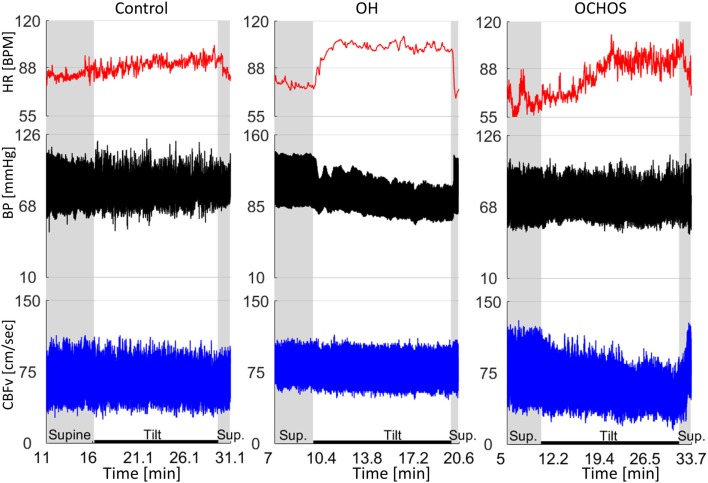
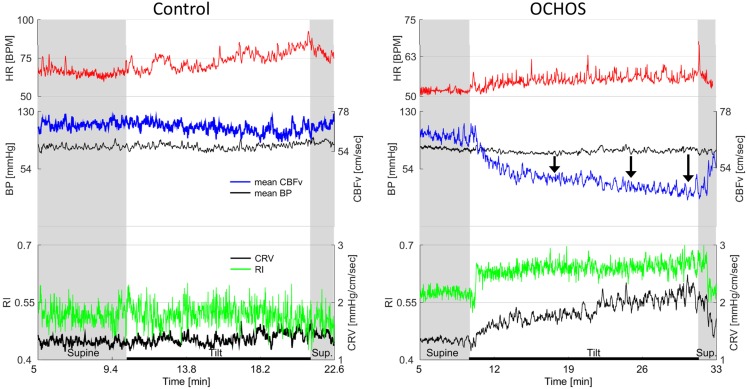
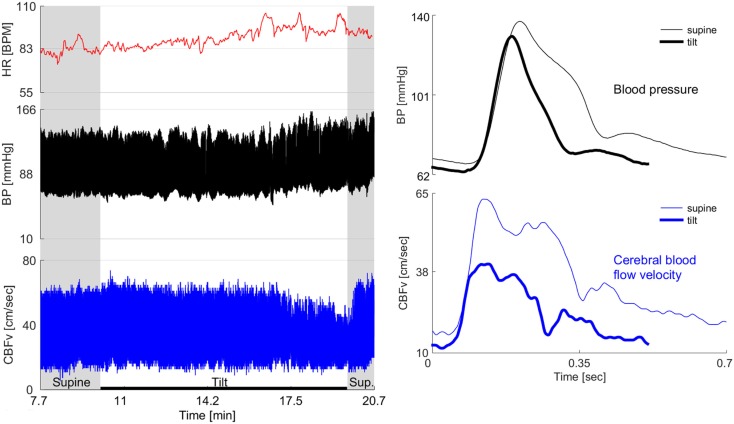
Orthostatic dizziness without orthostatic hypotension is common but underlying pathophysiology is poorly understood. This study describes orthostatic cerebral hypoperfusion syndrome (OCHOs). OCHOs is defined by (1) abnormal orthostatic drop of cerebral blood flow velocity (CBFv) during the tilt test and (2) absence of orthostatic hypotension, arrhythmia, vascular abnormalities, or other causes of abnormal orthostatic CBFv.
This retrospective study included patients referred for evaluation of unexplained orthostatic dizziness. Patients underwent standardized autonomic testing, including 10 min of tilt test. The following signals were monitored: heart rate, end tidal CO2, blood pressure, and CBFv from the middle cerebral artery using transcranial Doppler. Patients were screened for OCHOs. Patients who fulfilled the OCHOs criteria were compared to age- and gender-matched controls.
From 1279 screened patients, 102 patients (60/42 women/men, age 51.1 ± 14.9, range 19-84 years) fulfilled criteria of OCHOs. There was no difference in baseline supine hemodynamic variables between OCHOs and the control group. During the tilt, mean CBFv decreased 24.1 ± 8.2% in OCHOs versus 4.2 ± 5.6% in controls (p < 0.0001) without orthostatic hypotension in both groups. Supine mean blood pressure (OCHOs/controls, 90.5 ± 10.6/91.1 ± 9.4 mmHg, p = 0.62) remained unchanged during the tilt (90.4 ± 9.7/92.1 ± 9.6 mmHg, p = 0.2). End tidal CO2 and heart rate responses to the tilt were normal and equal in both groups.
OCHOs is a novel syndrome of low orthostatic CBFv. Two main pathophysiological mechanisms are proposed, including active cerebral vasoconstriction and passive increase of peripheral venous compliance. OCHOs may be a common cause of orthostatic dizziness.
无直立性低血压的直立性头晕很常见,但其潜在的病理生理学机制尚不清楚。本研究描述了直立性脑灌注不足综合征(OCHOs)。OCHOs的定义为:(1)在倾斜试验期间脑血流速度(CBFv)出现异常的直立性下降;(2)不存在直立性低血压、心律失常、血管异常或其他导致直立性CBFv异常的原因。
这项回顾性研究纳入了因不明原因的直立性头晕而接受评估的患者。患者接受了标准化的自主神经测试,包括10分钟的倾斜试验。监测以下信号:心率、呼气末二氧化碳分压、血压以及使用经颅多普勒测量大脑中动脉的CBFv。对患者进行OCHOs筛查。将符合OCHOs标准的患者与年龄和性别匹配的对照组进行比较。
在1279名接受筛查的患者中,有102名患者(60名女性/42名男性,年龄51.1±14.9岁,范围19 - 84岁)符合OCHOs标准。OCHOs组和对照组之间的基线仰卧位血流动力学变量没有差异。在倾斜过程中,OCHOs组的平均CBFv下降了24.1±8.2%,而对照组下降了4.2±5.6%(p<0.0001),两组均无直立性低血压。仰卧位平均血压(OCHOs/对照组,90.5±10.6/91.1±9.4mmHg,p = 0.62)在倾斜过程中保持不变(90.4±9.7/92.1±9.6mmHg,p = 0.2)。两组对倾斜试验的呼气末二氧化碳分压和心率反应均正常且相等。
OCHOs是一种新的直立性CBFv降低的综合征。提出了两种主要的病理生理机制,包括主动的脑血管收缩和外周静脉顺应性的被动增加。OCHOs可能是直立性头晕的常见原因。