
血管迷走性晕厥年轻患者站立时的脑氧合反应
Cerebral Oxygenation Responses to Standing in Young Patients with Vasovagal Syncope.
作者信息
Pérez-Denia Laura, Claffey Paul, O'Reilly Ailbhe, Delgado-Ortet Maria, Rice Ciara, Kenny Rose Anne, Finucane Ciarán
机构信息
School of Medicine, Trinity College Dublin, D02 K6K6 Dublin, Ireland.
Mercer's Institute for Successful Ageing, St. James's Hospital Dublin, D08 TYF3 Dublin, Ireland.
出版信息
J Clin Med. 2023 Jun 21;12(13):4202. doi: 10.3390/jcm12134202.
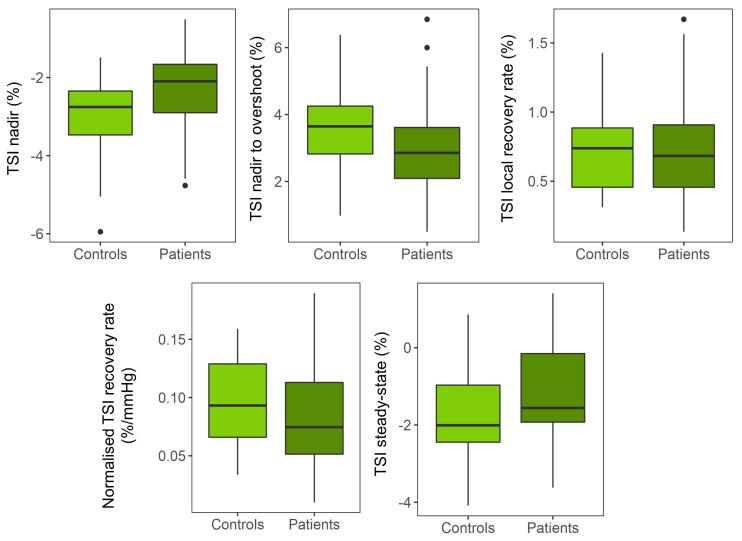
Vasovagal syncope (VVS) is common in young adults and is attributed to cerebral hypoperfusion. However, during active stand (AS) testing, only peripheral and not cerebral hemodynamic responses are measured. We sought to determine whether cerebral oxygenation responses to an AS test were altered in young VVS patients when compared to the young healthy controls. A sample of young healthy adults and consecutive VVS patients attending a Falls and Syncope unit was recruited. Continuous beat-to-beat blood pressure (BP), heart rate, near-infrared spectroscopy (NIRS)-derived tissue saturation index (TSI), and changes in concentration of oxygenated/deoxygenated Δ[OHb]/Δ[HHb] hemoglobin were measured. BP and NIRS-derived features included nadir, peak, overshoot, trough, recovery rate, normalized recovery rate, and steady-state. Multivariate linear regression was used to adjust for confounders and BP. In total, 13 controls and 27 VVS patients were recruited. While no significant differences were observed in the TSI and Δ[OHb], there was a significantly smaller Δ[HHb] peak-to-trough and faster Δ[HHb] recovery rate in VVS patients, independent of BP. A higher BP steady-state was observed in patients but did not remain significant after multiple comparison correction. Young VVS patients demonstrated a similar cerebral circulatory response with signs of altered peripheral circulation with respect to the controls, potentially due to a hyper-reactive autonomic nervous system. This study sets the grounds for future investigations to understand the role of cerebral regulation during standing in VVS.
血管迷走性晕厥(VVS)在年轻人中很常见,其原因是脑灌注不足。然而,在主动站立(AS)测试期间,仅测量外周而非脑血流动力学反应。我们试图确定与年轻健康对照相比,年轻VVS患者对AS测试的脑氧合反应是否发生改变。招募了一组年轻健康成年人以及在跌倒与晕厥科就诊的连续VVS患者。测量连续逐搏血压(BP)、心率、近红外光谱(NIRS)得出的组织饱和度指数(TSI)以及氧合/脱氧血红蛋白浓度变化Δ[OHb]/Δ[HHb]。BP和NIRS得出的特征包括最低点、峰值、过冲、谷值、恢复率、标准化恢复率和稳态。使用多元线性回归来调整混杂因素和BP。总共招募了13名对照和27名VVS患者。虽然在TSI和Δ[OHb]方面未观察到显著差异,但VVS患者的Δ[HHb]峰谷值明显较小,且Δ[HHb]恢复率更快,与BP无关。在患者中观察到较高的BP稳态,但在多重比较校正后不再显著。与对照组相比,年轻VVS患者表现出类似的脑循环反应,但外周循环有改变的迹象,这可能是由于自主神经系统反应过度所致。本研究为未来了解站立期间脑调节在VVS中的作用的研究奠定了基础。


 Zotero 插件