Holmer Emil, Heimann Mikael, Rudner Mary
Linnaeus Centre HEAD, Swedish Institute for Disability Research, Department of Behavioural Sciences and Learning, Linköping University Linköping, Sweden.
Swedish Institute for Disability Research and Division of Psychology, Department of Behavioural Sciences and Learning, Linköping University Linköping, Sweden.
Front Psychol. 2016 Feb 16;7:107. doi: 10.3389/fpsyg.2016.00107. eCollection 2016.
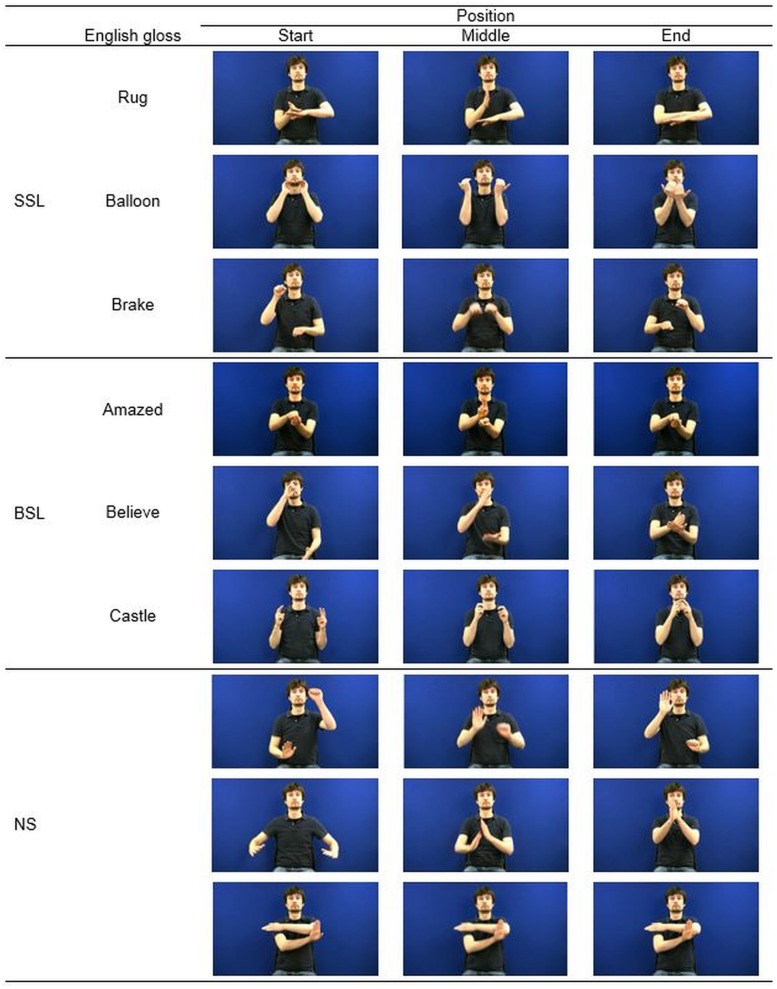
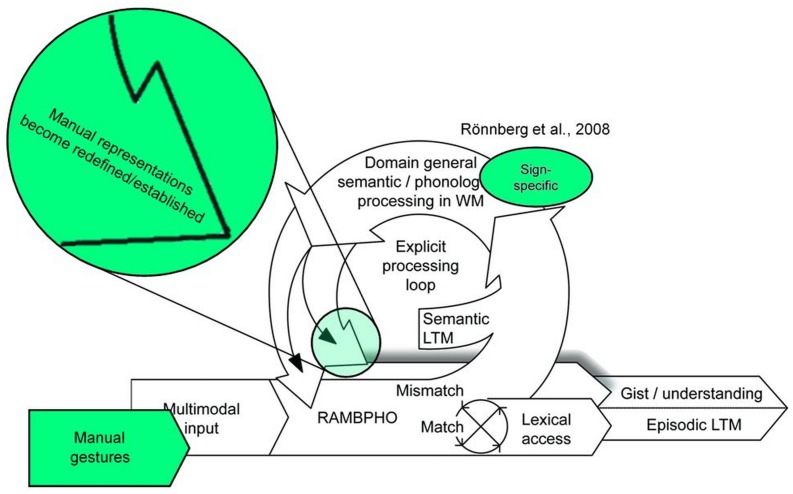
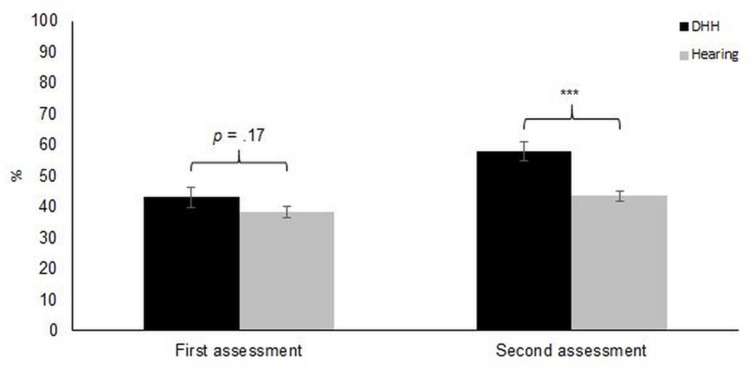
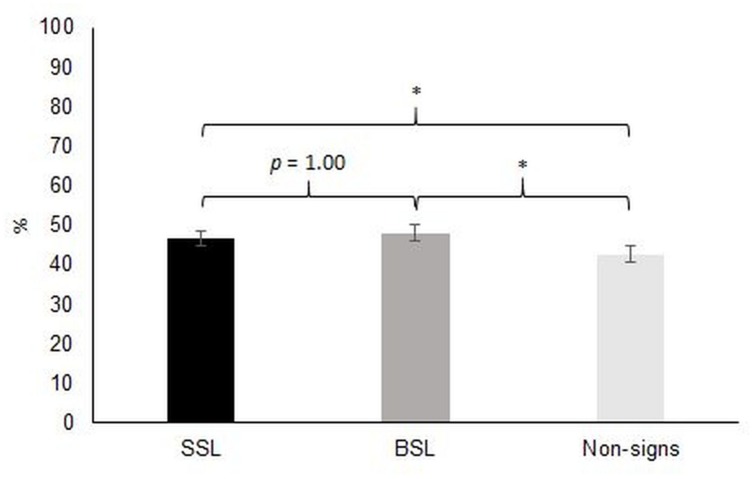
Imitation and language processing are closely connected. According to the Ease of Language Understanding (ELU) model (Rönnberg et al., 2013) pre-existing mental representation of lexical items facilitates language understanding. Thus, imitation of manual gestures is likely to be enhanced by experience of sign language. We tested this by eliciting imitation of manual gestures from deaf and hard-of-hearing (DHH) signing and hearing non-signing children at a similar level of language and cognitive development. We predicted that the DHH signing children would be better at imitating gestures lexicalized in their own sign language (Swedish Sign Language, SSL) than unfamiliar British Sign Language (BSL) signs, and that both groups would be better at imitating lexical signs (SSL and BSL) than non-signs. We also predicted that the hearing non-signing children would perform worse than DHH signing children with all types of gestures the first time (T1) we elicited imitation, but that the performance gap between groups would be reduced when imitation was elicited a second time (T2). Finally, we predicted that imitation performance on both occasions would be associated with linguistic skills, especially in the manual modality. A split-plot repeated measures ANOVA demonstrated that DHH signers imitated manual gestures with greater precision than non-signing children when imitation was elicited the second but not the first time. Manual gestures were easier to imitate for both groups when they were lexicalized than when they were not; but there was no difference in performance between familiar and unfamiliar gestures. For both groups, language skills at T1 predicted imitation at T2. Specifically, for DHH children, word reading skills, comprehension and phonological awareness of sign language predicted imitation at T2. For the hearing participants, language comprehension predicted imitation at T2, even after the effects of working memory capacity and motor skills were taken into account. These results demonstrate that experience of sign language enhances the ability to imitate manual gestures once representations have been established, and suggest that the inherent motor patterns of lexical manual gestures are better suited for representation than those of non-signs. This set of findings prompts a developmental version of the ELU model, D-ELU.
模仿与语言处理密切相关。根据语言理解易度(ELU)模型(伦贝里等人,2013年),词汇项目预先存在的心理表征有助于语言理解。因此,手语经验可能会增强对手势的模仿。我们通过让语言和认知发展水平相近的失聪及重听(DHH)手语儿童和听力正常的非手语儿童模仿手势来对此进行测试。我们预测,DHH手语儿童在模仿他们自己的手语(瑞典手语,SSL)中词汇化的手势时,会比不熟悉的英国手语(BSL)手势表现得更好,并且两组在模仿词汇化手势(SSL和BSL)时都会比模仿非手势表现得更好。我们还预测,在我们首次(T1)引发模仿时,听力正常的非手语儿童在所有类型的手势模仿上的表现会比DHH手语儿童差,但在第二次(T2)引发模仿时,两组之间的表现差距会缩小。最后,我们预测在这两种情况下的模仿表现都将与语言技能相关,尤其是在手动方式方面。一项裂区重复测量方差分析表明,在第二次而非第一次引发模仿时,DHH手语使用者模仿手势的精确度高于非手语儿童。对于两组来说,手势词汇化时比未词汇化时更容易模仿;但熟悉和不熟悉的手势在表现上没有差异。对于两组来说,T1时的语言技能可预测T2时的模仿。具体而言,对于DHH儿童,手语的单词阅读技能、理解能力和语音意识可预测T2时的模仿。对于听力参与者,即使在考虑了工作记忆容量和运动技能的影响之后,语言理解能力仍可预测T2时的模仿。这些结果表明,一旦建立了表征,手语经验会增强模仿手势的能力,并表明词汇化手势的固有运动模式比非手势的运动模式更适合表征。这一系列发现促使了ELU模型的发展版本,即D - ELU。