Silbermann Rebecca, Roodman G David
Department of Medicine, Division of Hematology/Oncology, Indiana University School of Medicine, Indianapolis, IN, USA.
J Bone Oncol. 2013 Apr 18;2(2):59-69. doi: 10.1016/j.jbo.2013.04.001. eCollection 2013 Jun.
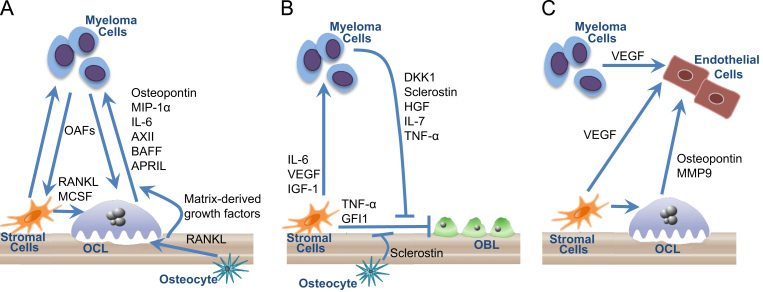
Multiple myeloma bone disease is marked by severe dysfunction of both bone formation and resorption and serves as a model for understanding the regulation of osteoblasts (OBL) and osteoclasts (OCL) in cancer. Myeloma bone lesions are purely osteolytic and are associated with severe and debilitating bone pain, pathologic fractures, hypercalcemia, and spinal cord compression, as well as increased mortality. Interactions within the bone marrow microenvironment in myeloma are responsible for the abnormal bone remodeling in myeloma bone disease. Myeloma cells drive bone destruction that increases tumor growth, directly stimulates the OCL formation, and induces cells in the marrow microenvironment to produce factors that drive OCL formation and suppress OBL formation. Factors produced by marrow stromal cells and OCL promote tumor growth through direct action on myeloma cells and by increasing angiogenesis. Current therapies targeting MMBD focus on preventing osteoclastic bone destruction; however regulators of OBL inhibition in MMBD have also been identified, and targeted agents with a potential anabolic effect in MMBD are under investigation. This review will discuss the mechanisms responsible for MMBD and therapeutic approaches currently in use and in development for the management of MMBD.
多发性骨髓瘤骨病的特征是骨形成和骨吸收均严重功能失调,是理解癌症中破骨细胞(OCL)和成骨细胞(OBL)调节机制的一个模型。骨髓瘤骨病变完全是溶骨性的,与严重且使人衰弱的骨痛、病理性骨折、高钙血症、脊髓压迫以及死亡率增加相关。骨髓瘤骨髓微环境中的相互作用导致了骨髓瘤骨病中的异常骨重塑。骨髓瘤细胞驱动骨质破坏,这会增加肿瘤生长、直接刺激破骨细胞形成,并诱导骨髓微环境中的细胞产生驱动破骨细胞形成和抑制成骨细胞形成的因子。骨髓基质细胞和破骨细胞产生的因子通过直接作用于骨髓瘤细胞并增加血管生成来促进肿瘤生长。目前针对多发性骨髓瘤骨病的治疗重点在于预防破骨细胞性骨质破坏;然而,多发性骨髓瘤骨病中抑制成骨细胞的调节因子也已被确定,并且正在研究对多发性骨髓瘤骨病具有潜在合成代谢作用的靶向药物。本综述将讨论多发性骨髓瘤骨病的发病机制以及目前用于治疗和正在研发的治疗方法。