Schouten Tijn M, Koini Marisa, de Vos Frank, Seiler Stephan, van der Grond Jeroen, Lechner Anita, Hafkemeijer Anne, Möller Christiane, Schmidt Reinhold, de Rooij Mark, Rombouts Serge A R B
Institute of Psychology, Leiden University, The Netherlands; Department of Radiology, Leiden University, The Netherlands; Leiden Institute for Brain and Cognition, The Netherlands.
Department of Neurology, Medical University of Graz, Austria.
Neuroimage Clin. 2016 Jan 9;11:46-51. doi: 10.1016/j.nicl.2016.01.002. eCollection 2016.
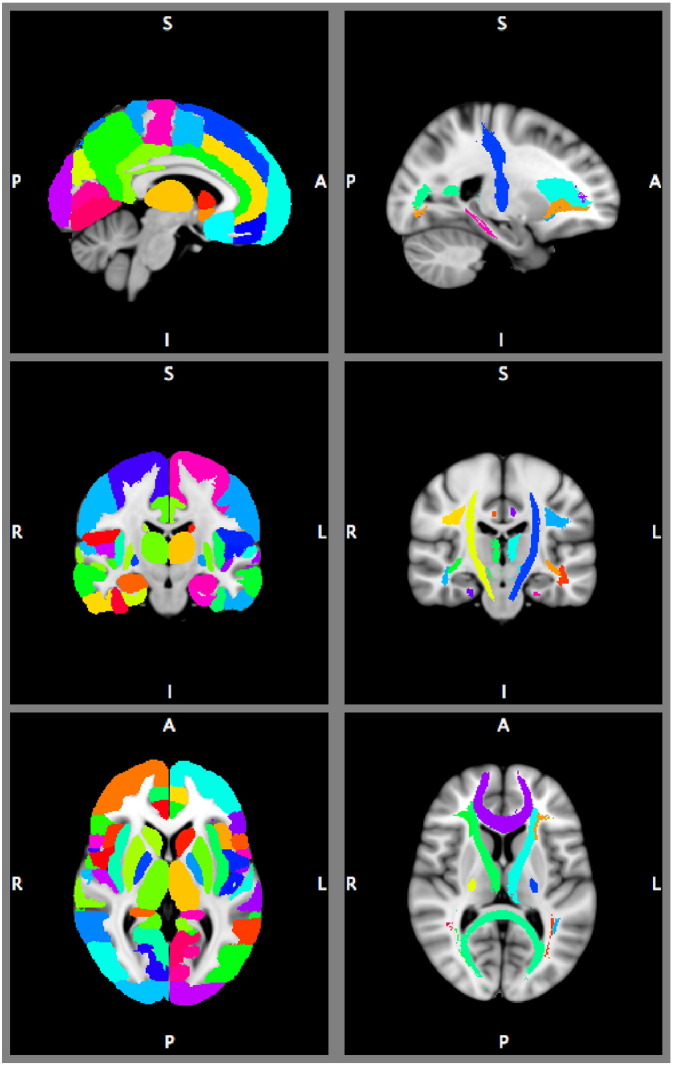
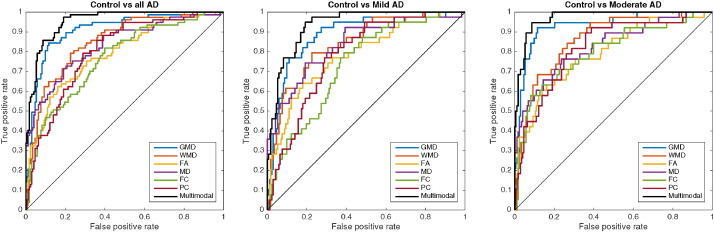
Magnetic resonance imaging (MRI) is sensitive to structural and functional changes in the brain caused by Alzheimer's disease (AD), and can therefore be used to help in diagnosing the disease. Improving classification of AD patients based on MRI scans might help to identify AD earlier in the disease's progress, which may be key in developing treatments for AD. In this study we used an elastic net classifier based on several measures derived from the MRI scans of mild to moderate AD patients (N = 77) from the prospective registry on dementia study and controls (N = 173) from the Austrian Stroke Prevention Family Study. We based our classification on measures from anatomical MRI, diffusion weighted MRI and resting state functional MRI. Our unimodal classification performance ranged from an area under the curve (AUC) of 0.760 (full correlations between functional networks) to 0.909 (grey matter density). When combining measures from multiple modalities in a stepwise manner, the classification performance improved to an AUC of 0.952. This optimal combination consisted of grey matter density, white matter density, fractional anisotropy, mean diffusivity, and sparse partial correlations between functional networks. Classification performance for mild AD as well as moderate AD also improved when using this multimodal combination. We conclude that different MRI modalities provide complementary information for classifying AD. Moreover, combining multiple modalities can substantially improve classification performance over unimodal classification.
磁共振成像(MRI)对阿尔茨海默病(AD)引起的大脑结构和功能变化敏感,因此可用于辅助诊断该疾病。基于MRI扫描改善AD患者的分类,可能有助于在疾病进展过程中更早地识别AD,这可能是开发AD治疗方法的关键。在本研究中,我们使用了一种弹性网络分类器,该分类器基于来自痴呆症前瞻性登记研究中轻度至中度AD患者(N = 77)的MRI扫描以及奥地利中风预防家庭研究中的对照组(N = 173)得出的多项指标。我们的分类基于解剖学MRI、扩散加权MRI和静息态功能MRI的指标。我们的单模态分类性能范围从曲线下面积(AUC)为0.760(功能网络之间的完全相关性)到0.909(灰质密度)。当以逐步方式组合来自多个模态的指标时,分类性能提高到AUC为0.952。这种最佳组合包括灰质密度、白质密度、分数各向异性、平均扩散率以及功能网络之间的稀疏偏相关性。使用这种多模态组合时,轻度AD和中度AD的分类性能也有所提高。我们得出结论,不同的MRI模态为AD分类提供了互补信息。此外,与单模态分类相比,组合多个模态可以显著提高分类性能。