Alm Kylie H, Soldan Anja, Pettigrew Corinne, Faria Andreia V, Hou Xirui, Lu Hanzhang, Moghekar Abhay, Mori Susumu, Albert Marilyn, Bakker Arnold
Department of Psychiatry and Behavioral Sciences, Johns Hopkins University School of Medicine, Baltimore, MD, United States.
Department of Neurology, Johns Hopkins University School of Medicine, Baltimore, MD, United States.
Front Aging Neurosci. 2022 Jul 12;14:951076. doi: 10.3389/fnagi.2022.951076. eCollection 2022.
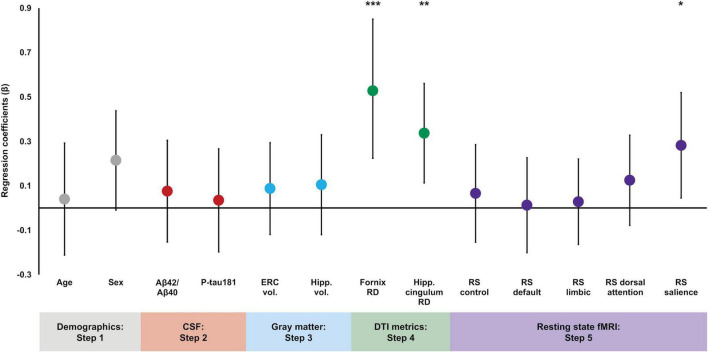
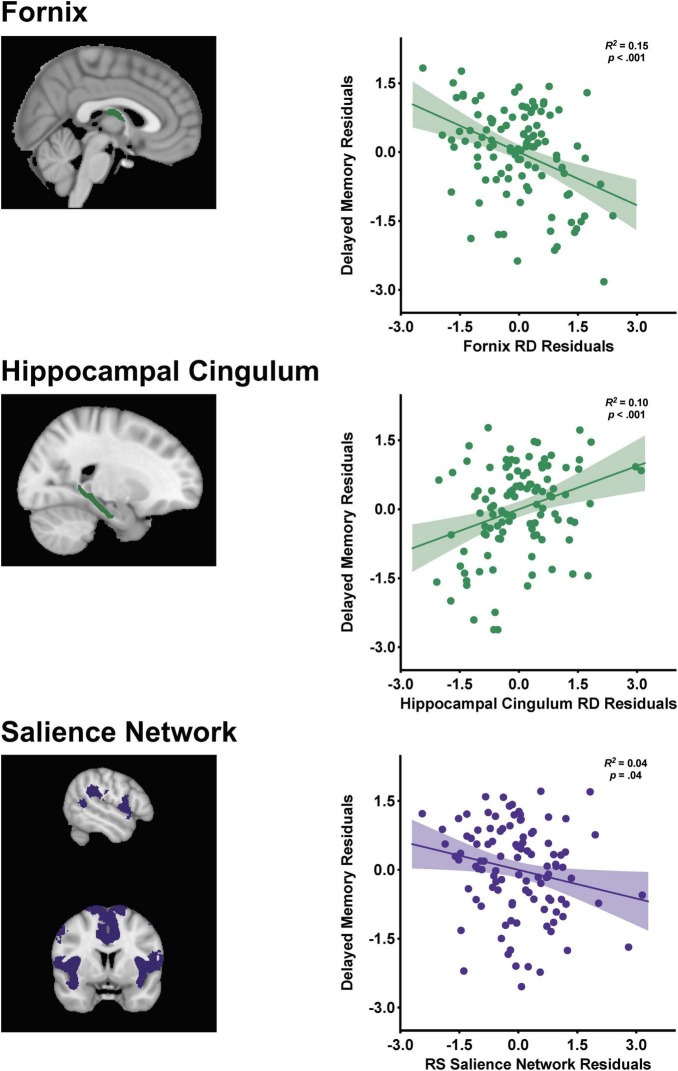
In this study, we examined the independent contributions of structural and functional connectivity markers to individual differences in episodic memory performance in 107 cognitively normal older adults from the BIOCARD study. Structural connectivity, defined by the diffusion tensor imaging (DTI) measure of radial diffusivity (RD), was obtained from two medial temporal lobe white matter tracts: the fornix and hippocampal cingulum, while functional connectivity markers were derived from network-based resting state functional magnetic resonance imaging (rsfMRI) of five large-scale brain networks: the control, default, limbic, dorsal attention, and salience/ventral attention networks. Hierarchical and stepwise linear regression methods were utilized to directly compare the relative contributions of the connectivity modalities to individual variability in a composite delayed episodic memory score, while also accounting for age, sex, cerebrospinal fluid (CSF) biomarkers of amyloid and tau pathology (i.e., Aβ/Aβ and p-tau), and gray matter volumes of the entorhinal cortex and hippocampus. Results revealed that fornix RD, hippocampal cingulum RD, and salience network functional connectivity were each significant independent predictors of memory performance, while CSF markers and gray matter volumes were not. Moreover, in the stepwise model, the addition of sex, fornix RD, hippocampal cingulum RD, and salience network functional connectivity each significantly improved the overall predictive value of the model. These findings demonstrate that both DTI and rsfMRI connectivity measures uniquely contributed to the model and that the combination of structural and functional connectivity markers best accounted for individual variability in episodic memory function in cognitively normal older adults.
在本研究中,我们在来自BIOCARD研究的107名认知正常的老年人中,检验了结构和功能连接性标记物对情景记忆表现个体差异的独立贡献。结构连接性由径向扩散率(RD)的扩散张量成像(DTI)测量值定义,取自两条内侧颞叶白质束:穹窿和海马扣带,而功能连接性标记物则来自五个大规模脑网络基于网络的静息态功能磁共振成像(rsfMRI):控制网络、默认网络、边缘系统网络、背侧注意网络和突显/腹侧注意网络。采用分层和逐步线性回归方法,直接比较连接性模式对复合延迟情景记忆分数个体变异性的相对贡献,同时考虑年龄、性别、淀粉样蛋白和tau病理学的脑脊液(CSF)生物标志物(即Aβ/Aβ和p-tau),以及内嗅皮质和海马的灰质体积。结果显示,穹窿RD、海马扣带RD和突显网络功能连接性均为记忆表现的显著独立预测因子,而CSF标记物和灰质体积则不是。此外,在逐步模型中,加入性别、穹窿RD、海马扣带RD和突显网络功能连接性均显著提高了模型的整体预测价值。这些发现表明,DTI和rsfMRI连接性测量值对模型均有独特贡献,并且结构和功能连接性标记物的组合最能解释认知正常老年人情景记忆功能的个体变异性。