Crocoll Christoph, Mirza Nadia, Reichelt Michael, Gershenzon Jonathan, Halkier Barbara Ann
DNRF Center DynaMo, Department of Plant and Environmental Sciences, Faculty of Science, University of Copenhagen, Frederiksberg, Denmark; Copenhagen Plant Science Center, Department of Plant and Environmental Sciences, Faculty of Science, University of Copenhagen, Frederiksberg, Denmark.
Department of Biochemistry, Max Planck Institute for Chemical Ecology , Jena , Germany.
Front Bioeng Biotechnol. 2016 Feb 16;4:14. doi: 10.3389/fbioe.2016.00014. eCollection 2016.
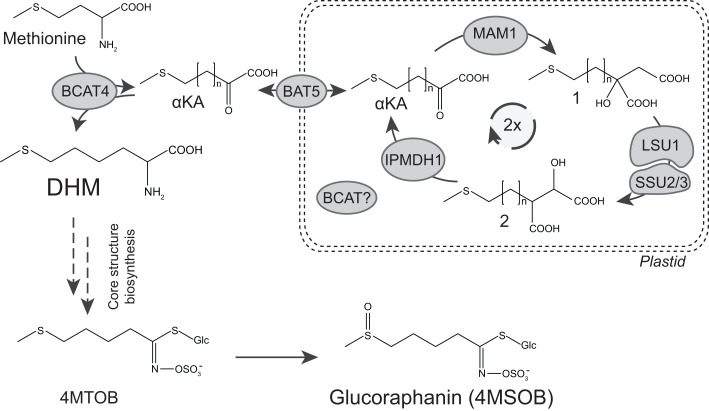
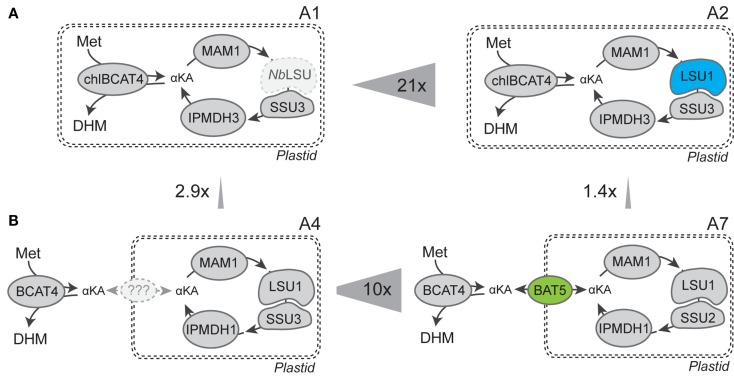
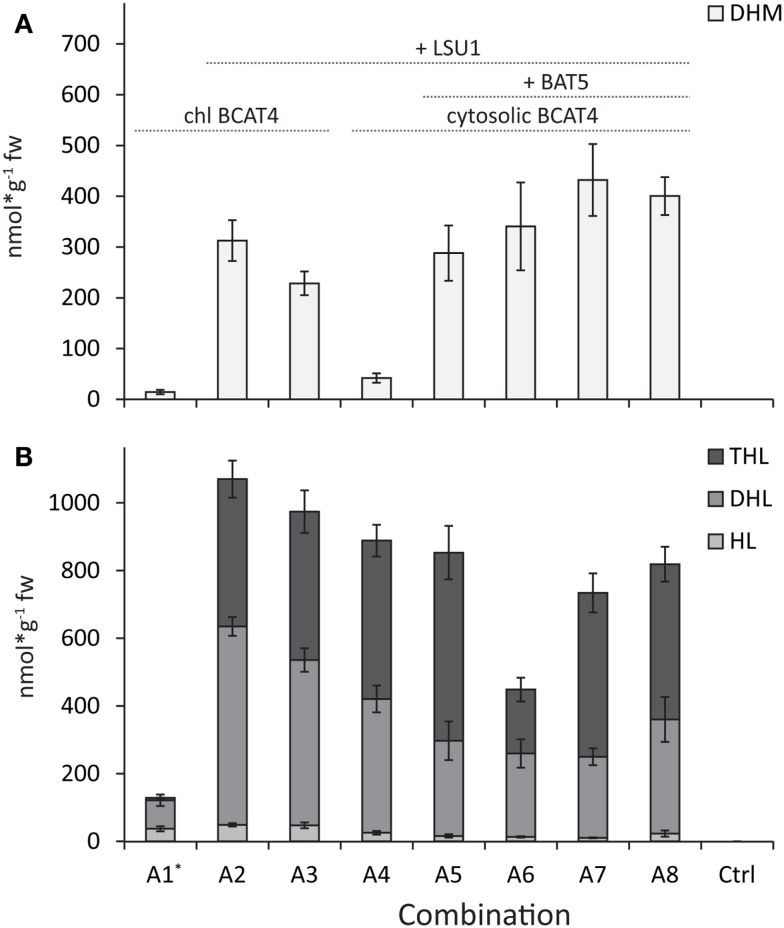
Glucosinolates are natural products characteristic of the Brassicales order, which include vegetables such as cabbages and the model plant Arabidopsis thaliana. Glucoraphanin is the major glucosinolate in broccoli and associated with the health-promoting effects of broccoli consumption. Toward our goal of creating a rich source of glucoraphanin for dietary supplements, we have previously reported the feasibility of engineering glucoraphanin in Nicotiana benthamiana through transient expression of glucoraphanin biosynthetic genes from A. thaliana (Mikkelsen et al., 2010). As side-products, we obtained fivefold to eightfold higher levels of chain-elongated leucine-derived glucosinolates, not found in the native plant. Here, we investigated two different strategies to improve engineering of the methionine chain elongation part of the glucoraphanin pathway in N. benthamiana: (1) coexpression of the large subunit (LSU1) of the heterodimeric isopropylmalate isomerase and (2) coexpression of BAT5 transporter for efficient transfer of intermediates across the chloroplast membrane. We succeeded in raising dihomomethionine (DHM) levels to a maximum of 432 nmol g(-1) fresh weight that is equivalent to a ninefold increase compared to the highest production of this intermediate, as previously reported (Mikkelsen et al., 2010). The increased DHM production without increasing leucine-derived side-product levels provides new metabolic engineering strategies for improved glucoraphanin production in a heterologous host.
硫代葡萄糖苷是十字花目植物特有的天然产物,十字花目包括卷心菜等蔬菜以及模式植物拟南芥。萝卜硫苷是西兰花中的主要硫代葡萄糖苷,与食用西兰花对健康的促进作用有关。为了实现为膳食补充剂创造丰富萝卜硫苷来源的目标,我们之前报道了通过瞬时表达来自拟南芥的萝卜硫苷生物合成基因,在本氏烟草中工程化生产萝卜硫苷的可行性(米凯尔森等人,2010年)。作为副产物,我们获得了比天然植物中高出五到八倍的链延长型亮氨酸衍生硫代葡萄糖苷。在此,我们研究了两种不同策略,以改进本氏烟草中萝卜硫苷途径中甲硫氨酸链延长部分的工程化:(1)共表达异二聚体异丙基苹果酸异构酶的大亚基(LSU1),以及(2)共表达BAT5转运蛋白,以促进中间体有效跨叶绿体膜转运。我们成功将二高蛋氨酸(DHM)水平提高到最高432 nmol g(-1)鲜重,与之前报道的该中间体最高产量相比,相当于增加了九倍(米凯尔森等人,2010年)。在不增加亮氨酸衍生副产物水平的情况下提高DHM产量,为在异源宿主中改进萝卜硫苷生产提供了新的代谢工程策略。