Nozadze Ivliane, Tsiklauri Nana, Gurtskaia Gulnaz, Tsagareli Merab G
Laboratory of Pain and Analgesia, Beritashvili Center for Experimental Biomedicine, Tbilisi, Georgia.
Data Brief. 2016 Jan 13;6:668-73. doi: 10.1016/j.dib.2015.12.055. eCollection 2016 Mar.
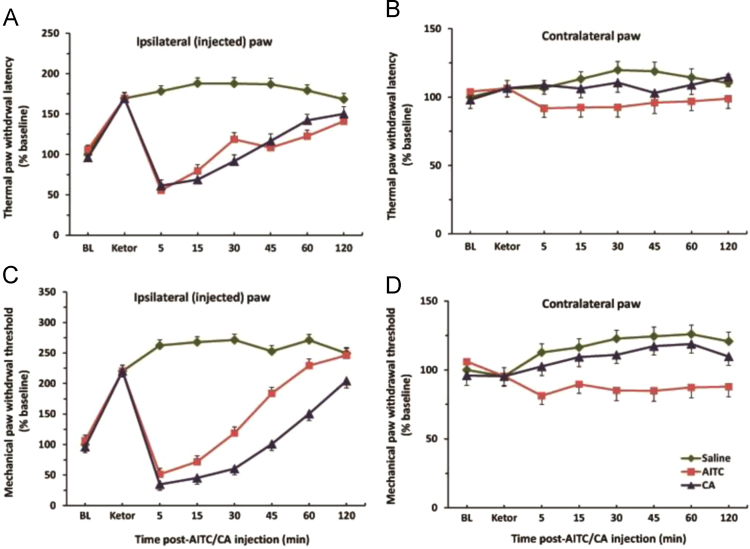
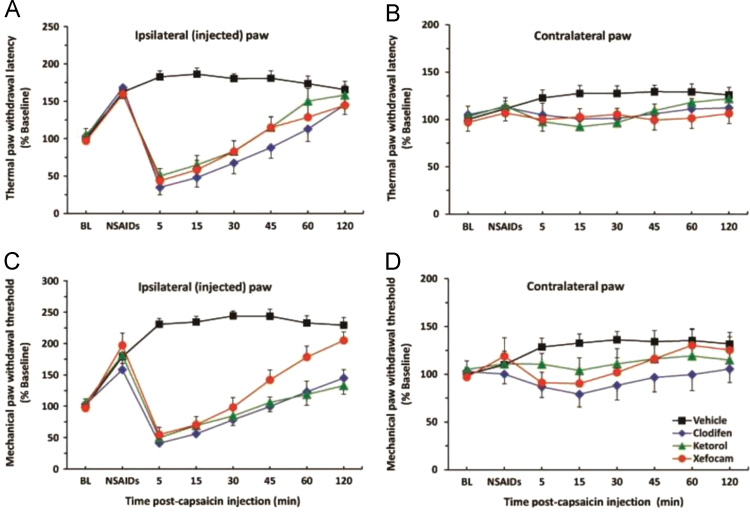
Transient receptor potential (TRP) cation channels have been extensively investigated as targets for analgesic drug discovery. Because some non-steroidal anti-inflammatory drugs (NSAIDs) are structural analogs of prostaglandins (mediators of inflammation) and NSAIDs attenuate heat nociception and mechanical allodynia in models of inflammatory and neuropathic pain, we examined three widely used NSAIDs (diclofenac, ketorolac, and xefocam) on the activation of TRPA1 and TRPV1 channels using thermal paw withdrawal (Hargreaves) test and mechanical paw withdrawal (von Frey) test in male rats. Thermal withdrawal latencies and mechanical thresholds for both hind paws were obtained with 5, 15, 30, 45, 60, and 120 min intraplantar post-injection of TRPA1 agonizts, allyl isothiocyanate (AITC) (a natural compound of mustard oil) and cinnamaldehyde (CA), and TRPV1 agonist capsaicin or vehicle. Twenty minutes prior to the start of the experiment with TRP agonizts, diclofenac, ketorolac or xefocam were pre-injected in the same hindpaw and animals were examined by these two tests. After pretreatment of all three NSAIDs in the ipsilateral (injected) hindpaw that produced strong antinociceptive effects, AITC, CA, and capsaicin caused significant decreases in latency of the thermal withdrawal reflex compared with vehicle or the contralateral hindpaw. The same findings were observed for the paw withdrawal threshold. In approximately 30 min the effects of CA, AITC, and capsaicin returned to baseline. The data are different from our previous evidence, where TRPA1 agonizts AITC and CA and TRPV1 agonist capsaicin produced hyperalgesia for nearly 2 h and resulted in facilitation of these withdrawal reflexes (Tsagareli et al., 2010, 2013). Thus, our data showing that NSAIDs suppress thermal and mechanical hyperalgesia following TRP activation could presumably due to inactivation or desensitization of TRPA1 and TRPV1 channels by NSAIDs.
瞬时受体电位(TRP)阳离子通道作为镇痛药研发的靶点已得到广泛研究。由于一些非甾体抗炎药(NSAIDs)是前列腺素(炎症介质)的结构类似物,且NSAIDs在炎症性疼痛和神经性疼痛模型中可减轻热痛觉过敏和机械性异常性疼痛,因此我们在雄性大鼠中使用热足退缩(哈格里夫斯)试验和机械足退缩(von Frey)试验,研究了三种广泛使用的NSAIDs(双氯芬酸、酮咯酸和昔福康)对TRPA1和TRPV1通道激活的影响。在足底注射TRPA1激动剂异硫氰酸烯丙酯(AITC)(芥子油的天然成分)和肉桂醛(CA)以及TRPV1激动剂辣椒素或赋形剂后5、15、30、45、60和120分钟,获取双后足的热退缩潜伏期和机械阈值。在开始使用TRP激动剂进行实验前20分钟,将双氯芬酸、酮咯酸或昔福康预先注射到同一只后足中,然后通过这两种试验对动物进行检查。在同侧(注射)后足中预先使用所有三种NSAIDs产生强烈的抗伤害感受作用后,与赋形剂或对侧后足相比,AITC、CA和辣椒素导致热退缩反射潜伏期显著缩短。足退缩阈值也观察到相同的结果。在大约30分钟内,CA、AITC和辣椒素对热退缩反射潜伏期和足退缩阈值的影响恢复到基线水平。这些数据与我们之前的证据不同,之前TRPA1激动剂AITC和CA以及TRPV1激动剂辣椒素会产生近2小时的痛觉过敏,并导致这些退缩反射增强(Tsagareli等人,2010年、2013年)。因此,我们的数据表明NSAIDs在TRP激活后抑制热和机械性痛觉过敏,这可能是由于NSAIDs使TRPA1和TRPV1通道失活或脱敏所致。