York Dona, Baker Jeanne, Holder Patrick G, Jones Lesley C, Drake Penelope M, Barfield Robyn M, Bleck Gregory T, Rabuka David
Catalent Pharma Solutions, 726 Heartland Trail, Madison, WI, 53717, USA.
Catalent Pharma Solutions, 5703 Hollis Street, Emeryville, CA, 94608, USA.
BMC Biotechnol. 2016 Feb 24;16:23. doi: 10.1186/s12896-016-0254-0.
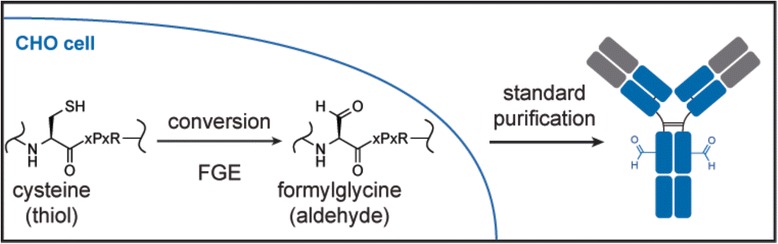
The ability to site-specifically conjugate a protein to a payload of interest (e.g., a fluorophore, small molecule pharmacophore, oligonucleotide, or other protein) has found widespread application in basic research and drug development. For example, antibody-drug conjugates represent a class of biotherapeutics that couple the targeting specificity of an antibody with the chemotherapeutic potency of a small molecule drug. While first generation antibody-drug conjugates (ADCs) used random conjugation approaches, next-generation ADCs are employing site-specific conjugation. A facile way to generate site-specific protein conjugates is via the aldehyde tag technology, where a five amino acid consensus sequence (CXPXR) is genetically encoded into the protein of interest at the desired location. During protein expression, the Cys residue within this consensus sequence can be recognized by ectopically-expressed formylglycine generating enzyme (FGE), which converts the Cys to a formylglycine (fGly) residue. The latter bears an aldehyde functional group that serves as a chemical handle for subsequent conjugation.
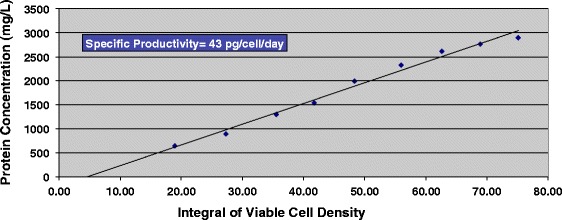
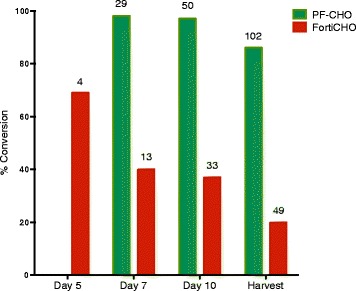
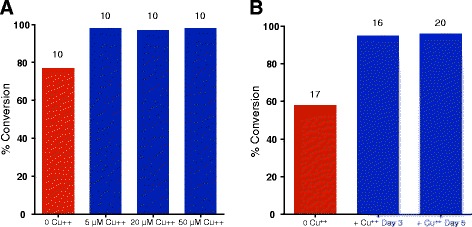
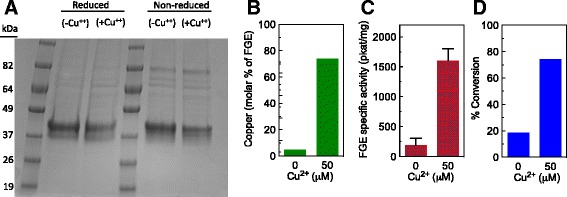
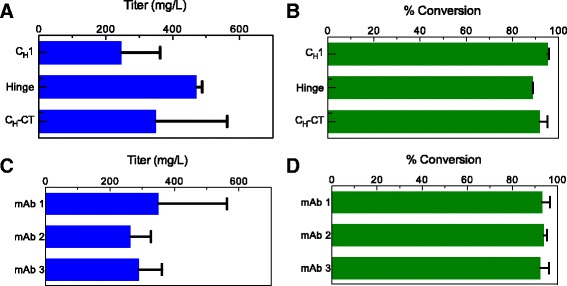
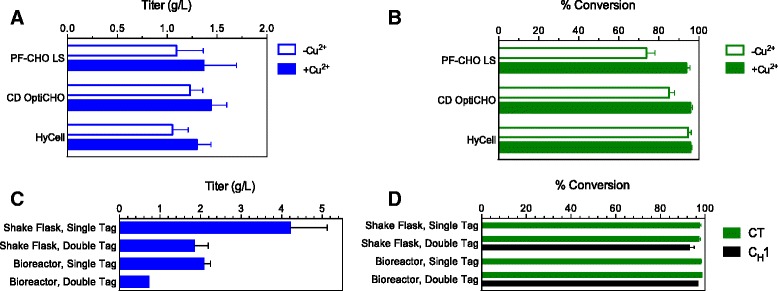
The yield of Cys conversion to fGly during protein production can be variable and is highly dependent on culture conditions. We set out to achieve consistently high yields by modulating culture conditions to maximize FGE activity within the cell. We recently showed that FGE is a copper-dependent oxidase that binds copper in a stoichiometric fashion and uses it to activate oxygen, driving enzymatic turnover. Building upon that work, here we show that by supplementing cell culture media with copper we can routinely reach high yields of highly converted protein. We demonstrate that cells incorporate copper from the media into FGE, which results in increased specific activity of the enzyme. The amount of copper required is compatible with large scale cell culture, as demonstrated in fed-batch cell cultures with antibody titers of 5 g · L(-1), specific cellular production rates of 75 pg · cell(-1) · d(-1), and fGly conversion yields of 95-98 %.
We describe a process with a high yield of site-specific formylglycine (fGly) generation during monoclonal antibody production in CHO cells. The conversion of Cys to fGly depends upon the activity of FGE, which can be ensured by supplementing the culture media with 50 uM copper(II) sulfate.
将蛋白质与目标负载(例如荧光团、小分子药效基团、寡核苷酸或其他蛋白质)进行位点特异性偶联的能力在基础研究和药物开发中得到了广泛应用。例如,抗体药物偶联物是一类生物治疗药物,它将抗体的靶向特异性与小分子药物的化疗效力相结合。第一代抗体药物偶联物(ADC)采用随机偶联方法,而新一代ADC则采用位点特异性偶联。生成位点特异性蛋白质偶联物的一种简便方法是通过醛标签技术,其中一个五氨基酸共有序列(CXPXR)在所需位置被基因编码到目标蛋白质中。在蛋白质表达过程中,该共有序列中的半胱氨酸(Cys)残基可被异位表达的甲酰甘氨酸生成酶(FGE)识别,FGE将Cys转化为甲酰甘氨酸(fGly)残基。后者带有一个醛官能团,可作为后续偶联的化学手柄。
在蛋白质生产过程中,Cys向fGly的转化率可能会有所不同,并且高度依赖于培养条件。我们着手通过调节培养条件来实现始终如一的高产量,以最大化细胞内的FGE活性。我们最近表明,FGE是一种铜依赖性氧化酶,它以化学计量方式结合铜并利用它来激活氧气,驱动酶促周转。基于这项工作,我们在此表明,通过在细胞培养基中补充铜,我们可以常规地获得高产量的高度转化蛋白质。我们证明细胞将培养基中的铜整合到FGE中,这导致酶的比活性增加。所需的铜量与大规模细胞培养兼容,如在抗体滴度为5 g·L⁻¹、特定细胞生产率为75 pg·细胞⁻¹·d⁻¹且fGly转化率为95 - 98%的补料分批细胞培养中所证明的那样。
我们描述了一种在CHO细胞生产单克隆抗体过程中高产位点特异性甲酰甘氨酸(fGly)的方法。Cys向fGly的转化取决于FGE的活性,通过在培养基中补充50 μM硫酸铜可以确保这一点。