Campbell Mhairi, Thomson Hilary, Fenton Candida, Gibson Marcia
MRC/CSO Social and Public Health Sciences Unit, University of Glasgow, 200 Renfield Street, Glasgow, G2 3QB, UK.
BMC Public Health. 2016 Feb 25;16:188. doi: 10.1186/s12889-016-2880-9.
Lone parents and their children experience higher than average levels of adverse health and social outcomes, much of which are explained by high rates of poverty. Many high income countries have attempted to address high poverty rates by introducing employment requirements for lone parents in receipt of welfare benefits. However, there is evidence that employment may not reduce poverty or improve the health of lone parents and their children.
We conducted a systematic review of qualitative studies reporting lone parents' accounts of participation in welfare to work (WtW), to identify explanations and possible mechanisms for the impacts of WtW on health and wellbeing. Twenty one bibliographic databases were searched. Two reviewers independently screened references and assessed study quality. Studies from any high income country that met the criteria of focussing on lone parents, mandatory WtW interventions, and health or wellbeing were included. Thematic synthesis was used to investigate analytic themes between studies.
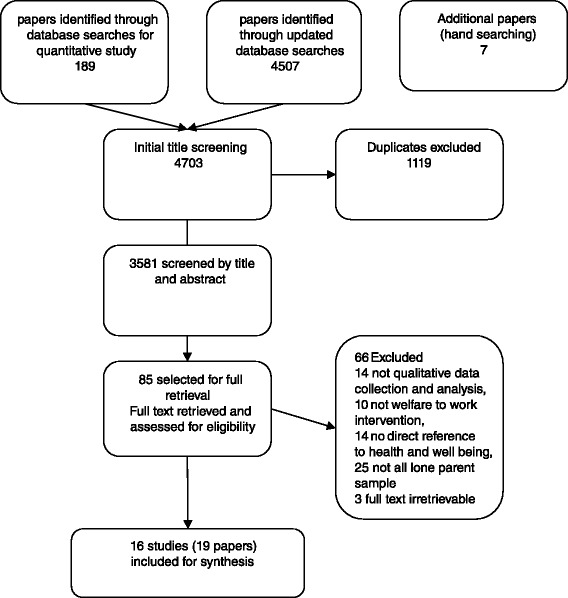
Screening of the 4703 identified papers and quality assessment resulted in the inclusion of 16 qualitative studies of WtW in five high income countries, USA, Canada, UK, Australia, and New Zealand, covering a variety of welfare regimes. Our synthesis found that WtW requirements often conflicted with child care responsibilities. Available employment was often poorly paid and precarious. Adverse health impacts, such as increased stress, fatigue, and depression were commonly reported, though employment and appropriate training was linked to increased self-worth for some. WtW appeared to influence health through the pathways of conflict and control, analytical themes which emerged during synthesis. WtW reduced control over the nature of employment and care of children. Access to social support allowed some lone parents to manage the conflict associated with employment, and to increase control over their circumstances, with potentially beneficial health impacts.
WtW can result in increased conflict and reduced control, which may lead to negative impacts on mental health. Availability of social support may mediate the negative health impacts of WtW.
单亲父母及其子女面临着高于平均水平的不良健康和社会问题,其中许多问题可归因于高贫困率。许多高收入国家试图通过对领取福利金的单亲父母提出就业要求来解决高贫困率问题。然而,有证据表明就业可能无法减少贫困或改善单亲父母及其子女的健康状况。
我们对定性研究进行了系统综述,这些研究报告了单亲父母参与从福利到工作(WtW)计划的情况,以确定WtW对健康和幸福产生影响的解释及可能机制。检索了21个书目数据库。两名评审员独立筛选参考文献并评估研究质量。纳入了来自任何高收入国家且符合关注单亲父母、强制性WtW干预措施以及健康或幸福标准的研究。采用主题综合法来研究各研究之间的分析主题。
对4703篇已识别论文的筛选和质量评估导致纳入了来自美国、加拿大、英国、澳大利亚和新西兰这五个高收入国家的16项关于WtW的定性研究,涵盖了各种福利制度。我们的综合分析发现,WtW要求常常与育儿责任相冲突。现有的工作往往薪资微薄且不稳定。常见有不良健康影响的报告,如压力增加、疲劳和抑郁,不过就业和适当培训与一些人的自我价值提升有关。WtW似乎通过冲突和控制途径影响健康,这是综合分析过程中出现的分析主题。WtW减少了对就业性质和子女照料的控制。获得社会支持使一些单亲父母能够应对与就业相关的冲突,并增强对自身处境的控制,从而可能对健康产生有益影响。
WtW可能导致冲突增加和控制减少,进而可能对心理健康产生负面影响。社会支持的可获得性可能会调节WtW对健康的负面影响。