Muldoon Sarah Feldt, Bridgeford Eric W, Bassett Danielle S
Department of Bioengineering, University of Pennsylvania, Philadelphia, PA 19104 USA.
US Army Research Laboratory, Aberdeen Proving Ground, MD 21005, USA.
Sci Rep. 2016 Feb 25;6:22057. doi: 10.1038/srep22057.
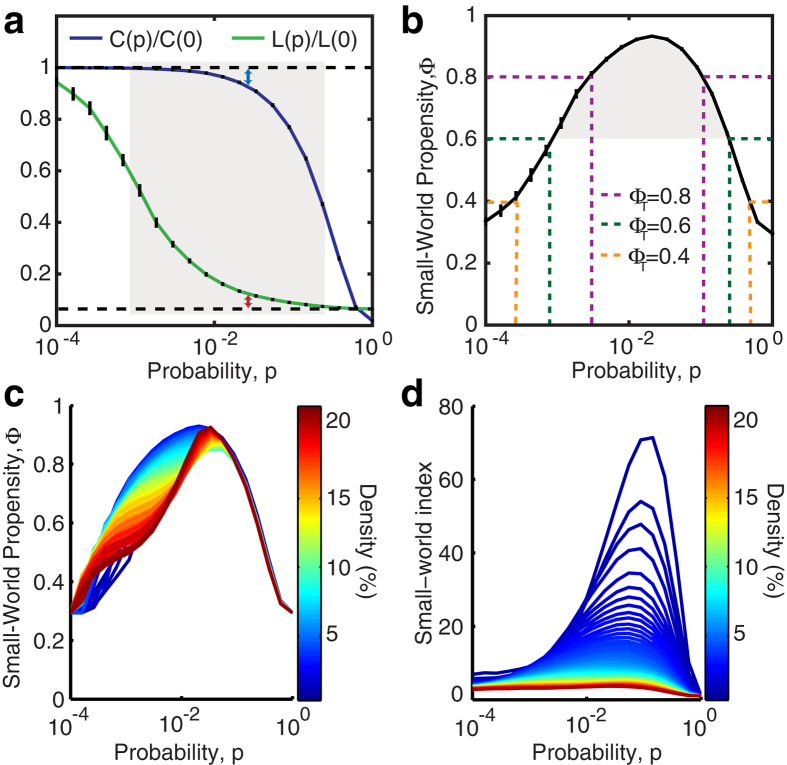
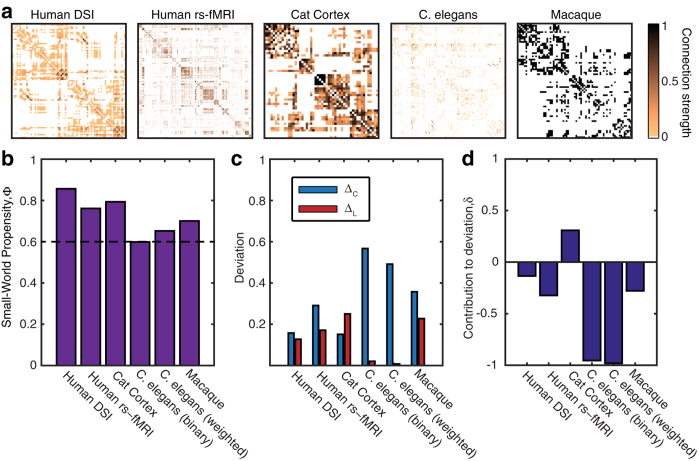
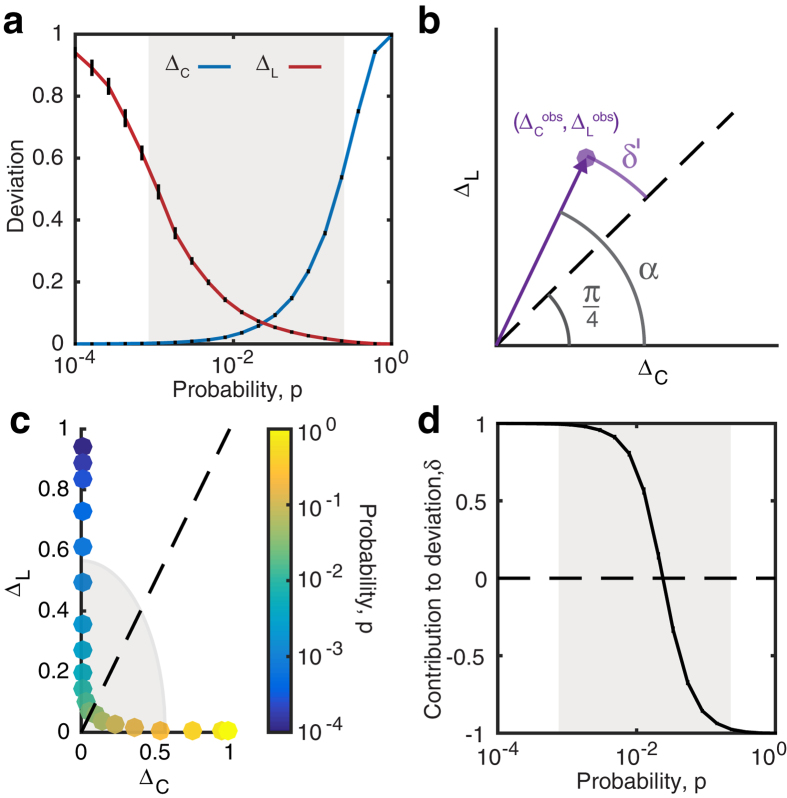
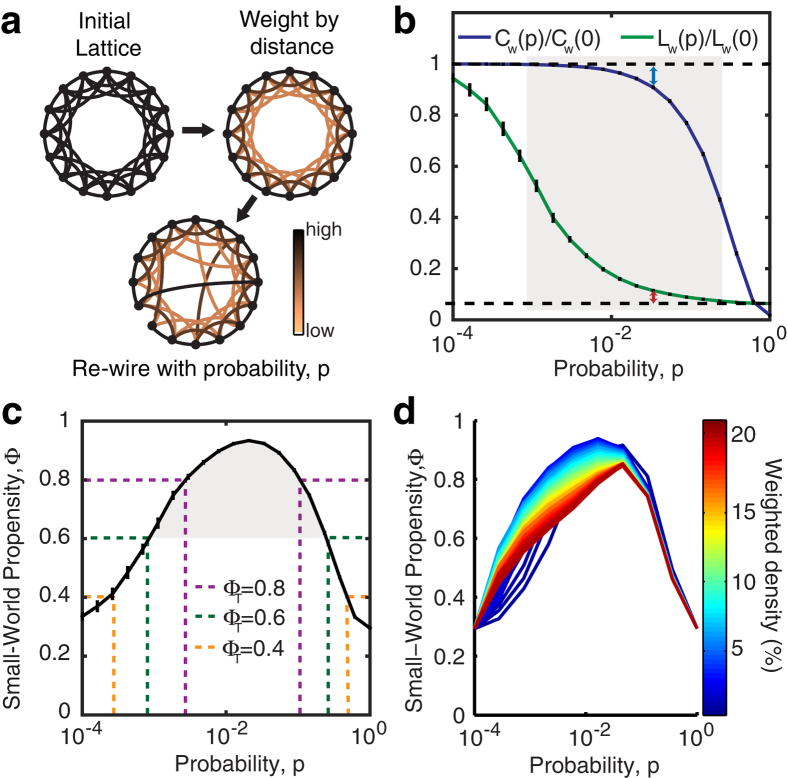
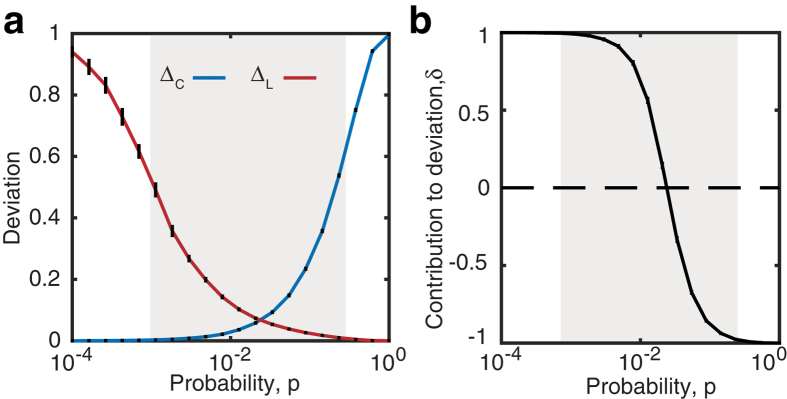
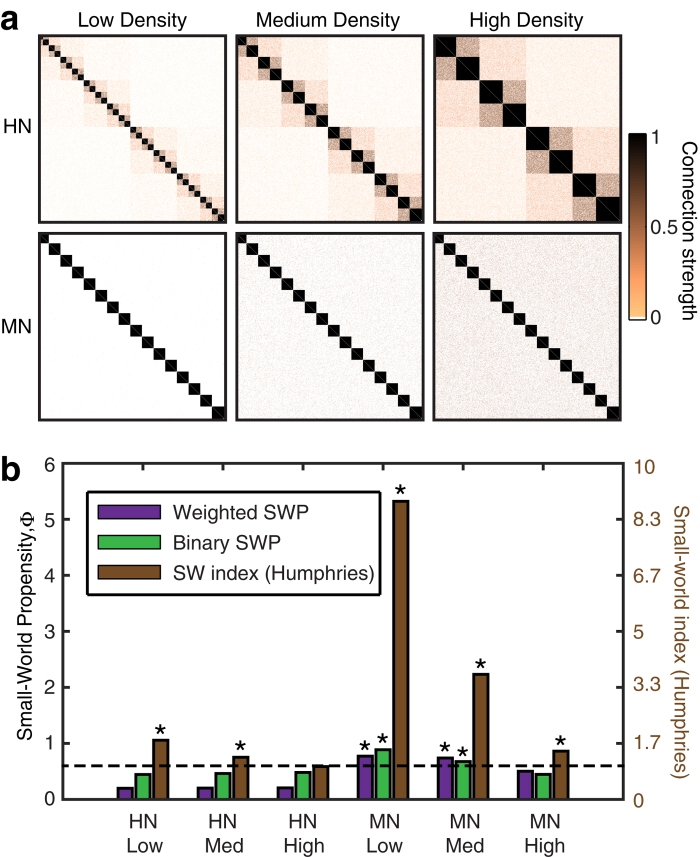
Quantitative descriptions of network structure can provide fundamental insights into the function of interconnected complex systems. Small-world structure, diagnosed by high local clustering yet short average path length between any two nodes, promotes information flow in coupled systems, a key function that can differ across conditions or between groups. However, current techniques to quantify small-worldness are density dependent and neglect important features such as the strength of network connections, limiting their application in real-world systems. Here, we address both limitations with a novel metric called the Small-World Propensity (SWP). In its binary instantiation, the SWP provides an unbiased assessment of small-world structure in networks of varying densities. We extend this concept to the case of weighted brain networks by developing (i) a standardized procedure for generating weighted small-world networks, (ii) a weighted extension of the SWP, and (iii) a method for mapping observed brain network data onto the theoretical model. In applying these techniques to compare real-world brain networks, we uncover the surprising fact that the canonical biological small-world network, the C. elegans neuronal network, has strikingly low SWP. These metrics, models, and maps form a coherent toolbox for the assessment and comparison of architectural properties in brain networks.
对网络结构的定量描述能够为理解相互连接的复杂系统的功能提供基本见解。小世界结构通过高局部聚类性以及任意两个节点之间较短的平均路径长度来诊断,它促进了耦合系统中的信息流,这一关键功能在不同条件或不同群体之间可能会有所不同。然而,当前量化小世界性质的技术依赖于密度,并且忽略了诸如网络连接强度等重要特征,限制了它们在现实世界系统中的应用。在此,我们用一种名为小世界倾向(SWP)的新指标解决了这两个局限性。在其二进制实例中,SWP为不同密度网络中的小世界结构提供了无偏评估。我们通过开发(i)生成加权小世界网络的标准化程序、(ii)SWP的加权扩展以及(iii)将观察到的脑网络数据映射到理论模型的方法,将这一概念扩展到加权脑网络的情况。在应用这些技术比较现实世界的脑网络时,我们发现了一个惊人的事实,即典型的生物小世界网络——秀丽隐杆线虫神经元网络,其SWP极低。这些指标、模型和映射构成了一个连贯的工具箱,用于评估和比较脑网络的结构特性。