Mamidi Ranganath, Gresham Kenneth S, Verma Sujeet, Stelzer Julian E
Department of Physiology and Biophysics, School of Medicine, Case Western Reserve University Cleveland, OH, USA.
Department of Horticultural Science, Institute of Food and Agricultural Sciences Gulf Coast Research and Education Center, University of Florida Wimauma, FL, USA.
Front Physiol. 2016 Feb 15;7:38. doi: 10.3389/fphys.2016.00038. eCollection 2016.
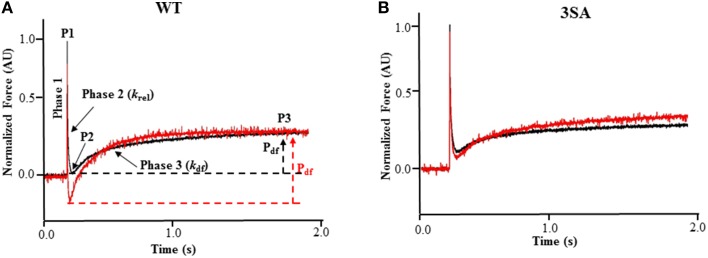
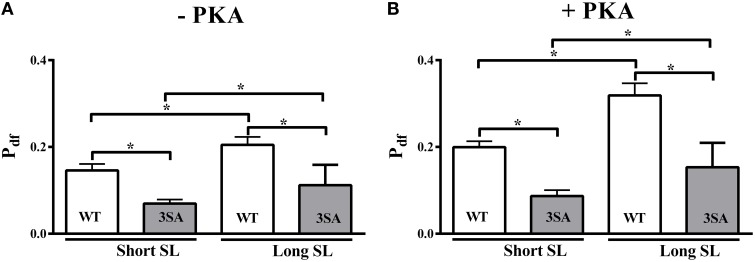
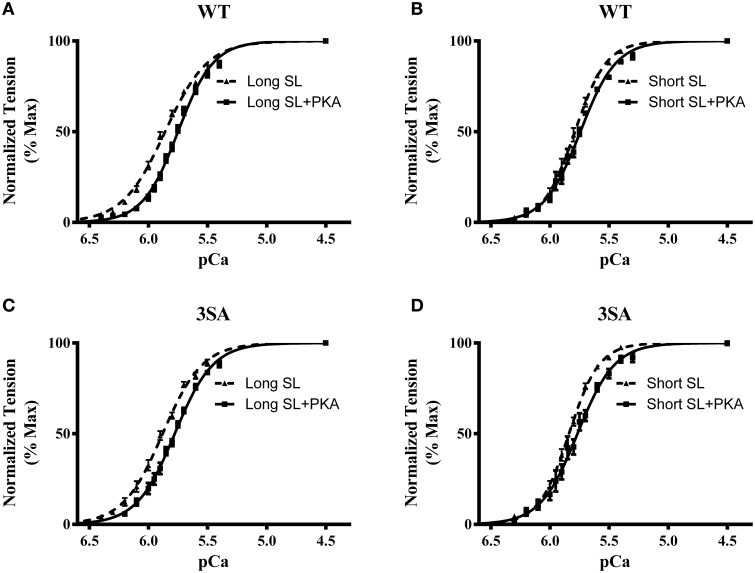
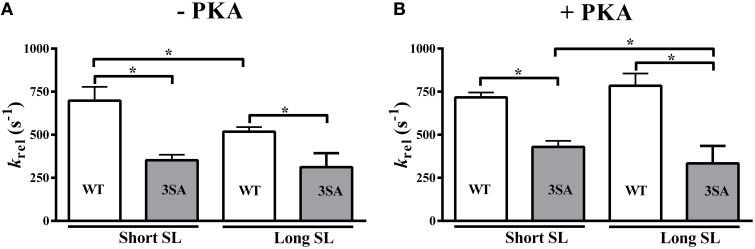
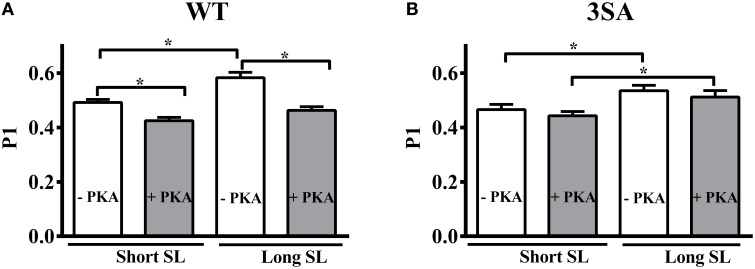
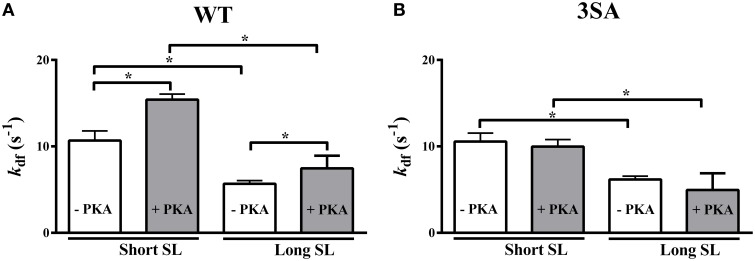
Cardiac myosin binding protein-C (cMyBP-C) phosphorylation is an important regulator of contractile function, however, its contributions to length-dependent changes in cross-bridge (XB) kinetics is unknown. Therefore, we performed mechanical experiments to quantify contractile function in detergent-skinned ventricular preparations isolated from wild-type (WT) hearts, and hearts expressing non-phosphorylatable cMyBP-C [Ser to Ala substitutions at residues Ser273, Ser282, and Ser302 (i.e., 3SA)], at sarcomere length (SL) 1.9 μm or 2.1μm, prior and following protein kinase A (PKA) treatment. Steady-state force generation measurements revealed a blunting in the length-dependent increase in myofilament Ca(2+)-sensitivity of force generation (pCa50) following an increase in SL in 3SA skinned myocardium compared to WT skinned myocardium. Dynamic XB behavior was assessed at submaximal Ca(2+)-activations by imposing an acute rapid stretch of 2% of initial muscle length, and measuring both the magnitudes and rates of resultant phases of force decay due to strain-induced XB detachment and delayed force rise due to recruitment of additional XBs with increased SL (i.e., stretch activation). The magnitude (P2) and rate of XB detachment (k rel) following stretch was significantly reduced in 3SA skinned myocardium compared to WT skinned myocardium at short and long SL, and prior to and following PKA treatment. Furthermore, the length-dependent acceleration of k rel due to decreased SL that was observed in WT skinned myocardium was abolished in 3SA skinned myocardium. PKA treatment accelerated the rate of XB recruitment (k df) following stretch at both SL's in WT but not in 3SA skinned myocardium. The amplitude of the enhancement in force generation above initial pre-stretch steady-state levels (P3) was not different between WT and 3SA skinned myocardium at any condition measured. However, the magnitude of the entire delayed force phase which can dip below initial pre-stretch steady-state levels (Pdf) was significantly lower in 3SA skinned myocardium under all conditions, in part due to a reduced magnitude of XB detachment (P2) in 3SA skinned myocardium compared to WT skinned myocardium. These findings demonstrate that cMyBP-C phospho-ablation regulates SL- and PKA-mediated effects on XB kinetics in the myocardium, which would be expected to contribute to the regulation of the Frank-Starling mechanism.
心肌肌球蛋白结合蛋白C(cMyBP-C)磷酸化是收缩功能的重要调节因子,然而,其对横桥(XB)动力学中长度依赖性变化的作用尚不清楚。因此,我们进行了力学实验,以量化从野生型(WT)心脏以及表达不可磷酸化cMyBP-C[Ser273、Ser282和Ser302位点的丝氨酸被丙氨酸取代(即3SA)]的心脏分离出的去垢剂处理的心室标本在肌节长度(SL)为1.9μm或2.1μm时,在蛋白激酶A(PKA)处理前后的收缩功能。稳态力产生测量显示,与WT去垢剂处理的心肌相比,3SA去垢剂处理的心肌在SL增加后,肌丝对Ca(2+)敏感性产生力(pCa50)的长度依赖性增加减弱。通过施加初始肌肉长度2%的急性快速拉伸,并测量由于应变诱导的XB脱离导致的力衰减的大小和速率以及由于SL增加(即拉伸激活)导致的额外XB募集引起的延迟力上升,在次最大Ca(2+)激活下评估动态XB行为。在短和长SL以及PKA处理前后,与WT去垢剂处理的心肌相比,3SA去垢剂处理的心肌在拉伸后XB脱离的大小(P2)和速率(k rel)显著降低。此外,在WT去垢剂处理的心肌中观察到的由于SL降低导致的k rel的长度依赖性加速在3SA去垢剂处理的心肌中消失。PKA处理加速了WT去垢剂处理的心肌在两个SL下拉伸后XB募集的速率(k df),但在3SA去垢剂处理的心肌中未加速。在任何测量条件下,WT和3SA去垢剂处理的心肌在初始预拉伸稳态水平之上产生力的增强幅度(P3)没有差异。然而,在所有条件下,3SA去垢剂处理的心肌中整个延迟力相的大小(Pdf)可低于初始预拉伸稳态水平,部分原因是与WT去垢剂处理的心肌相比,3SA去垢剂处理的心肌中XB脱离的大小(P2)降低。这些发现表明,cMyBP-C磷酸化缺失调节了SL和PKA介导的对心肌XB动力学的影响,这有望有助于Frank-Starling机制的调节。