Krepischi A C V, Maschietto M, Ferreira E N, Silva A G, Costa S S, da Cunha I W, Barros B D F, Grundy P E, Rosenberg C, Carraro D M
International Research Center, AC Camargo Cancer Center, São Paulo, Brazil.
Institute of Biosciences, University of São Paulo, São Paulo, Brazil.
Mol Cytogenet. 2016 Feb 24;9:20. doi: 10.1186/s13039-016-0227-y. eCollection 2016.
Wilms tumor (WT) has a not completely elucidated pathogenesis. DNA copy number alterations (CNAs) are common in cancer, and often define key pathogenic events. The aim of this work was to investigate CNAs in order to disclose new candidate genes for Wilms tumorigenesis.
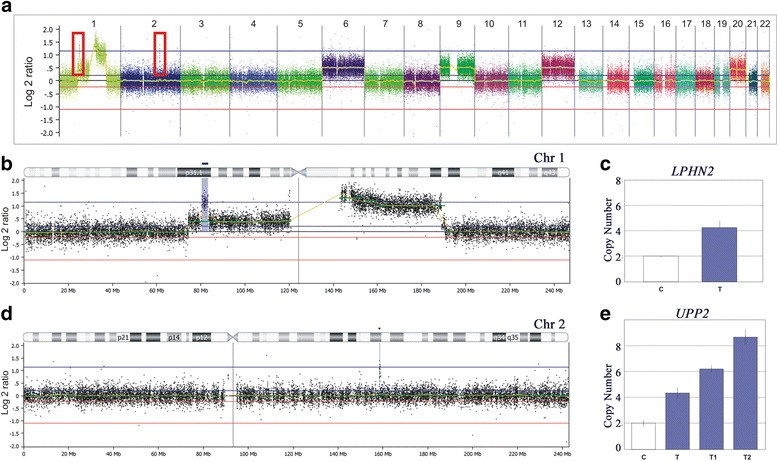
Array-CGH of 50 primary WTs without pre-chemotherapy revealed a few recurrent CNAs not previously reported, such as 7q and 20q gains, and 7p loss. Genomic amplifications were exclusively detected in 3 cases of WTs that later relapsed, which also exhibited an increased frequency of gains affecting a 16.2 Mb 1q21.1-q23.2 region, losses at 11p, 11q distal, and 16q, and WT1 deletions. Conversely, aneuploidies of chromosomes 13 and 19 were found only in WTs without further relapse. The 1q21.1-q23.2 gain associated with WT relapse harbours genes such as CHD1L, CRABP2, GJA8, MEX3A and MLLT11 that were found to be over-expressed in WTs. In addition, down-regulation of genes encompassed by focal deletions highlighted new potential tumor suppressors such as CNKSR1, MAN1C1, PAQR7 (1p36), TWIST1, SOSTDC1 (7p14.1-p12.2), BBOX and FIBIN (11p13), and PLCG2 (16q).
This study confirmed the presence of CNAs previously related to WT and characterized new CNAs found only in few cases. The later were found in higher frequency in relapsed cases, suggesting that they could be associated with WT progression.
肾母细胞瘤(WT)的发病机制尚未完全阐明。DNA拷贝数改变(CNA)在癌症中很常见,并且常常定义关键的致病事件。本研究旨在调查CNA,以揭示肾母细胞瘤发生的新候选基因。
对50例未经化疗的原发性WT进行的阵列比较基因组杂交(Array-CGH)显示了一些先前未报道的复发性CNA,如7q和20q增益以及7p缺失。仅在3例后来复发的WT病例中检测到基因组扩增,这些病例还表现出影响16.2 Mb的1q21.1-q23.2区域的增益频率增加、11p、11q远端和16q缺失以及WT1缺失。相反,仅在未进一步复发的WT中发现了13号和19号染色体的非整倍体。与WT复发相关的1q21.1-q23.2增益区域包含CHD1L、CRABP2、GJA8、MEX3A和MLLT11等基因,这些基因在WT中被发现过度表达。此外,局灶性缺失所包含基因的下调突出了新的潜在肿瘤抑制因子,如CNKSR1、MAN1C1、PAQR7(1p36)、TWIST1、SOSTDC1(7p14.1-p12.2)、BBOX和FIBIN(11p13)以及PLCG2(16q)。
本研究证实了先前与WT相关的CNA的存在,并对仅在少数病例中发现的新CNA进行了特征描述。后者在复发病例中出现的频率更高,表明它们可能与WT进展有关。