Halstead J, Keenan A M, Chapman G J, Redmond A C
Leeds Institute of Rheumatic and Musculoskeletal Medicine, University of Leeds, 2nd Floor, Chapel Allerton Hospital, Harehills Lane, Leeds, LS7 4SA UK.
Leeds Institute of Rheumatic and Musculoskeletal Medicine, University of Leeds, 2nd Floor, Chapel Allerton Hospital, Harehills Lane, Leeds, LS7 4SA UK ; NIHR Leeds Musculoskeletal Biomedical Research Unit, Leeds Teaching Hospitals Trust, Leeds, UK ; Arthritis Research UK Experimental Arthritis Centre, Leeds, UK.
J Foot Ankle Res. 2016 Feb 24;9:7. doi: 10.1186/s13047-016-0138-5. eCollection 2016.
The majority of multi-segment kinematic foot studies have been limited to barefoot conditions, because shod conditions have the potential for confounding surface-mounted markers. The aim of this study was to investigate whether a shoe modified with a webbed upper can accommodate multi-segment foot marker sets without compromising kinematic measurements under barefoot and shod conditions.
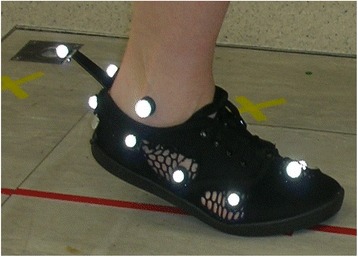
Thirty participants (15 controls and 15 participants with midfoot pain) underwent gait analysis in two conditions; barefoot and wearing a shoe (shod) in a random order. The shod condition employed a modified shoe (rubber plimsoll) with a webbed upper, allowing skin mounted reflective markers to be visualised through slits in the webbed material. Three dimensional foot kinematics were captured using the Oxford multi-segment foot model whilst participants walked at a self-selected speed.
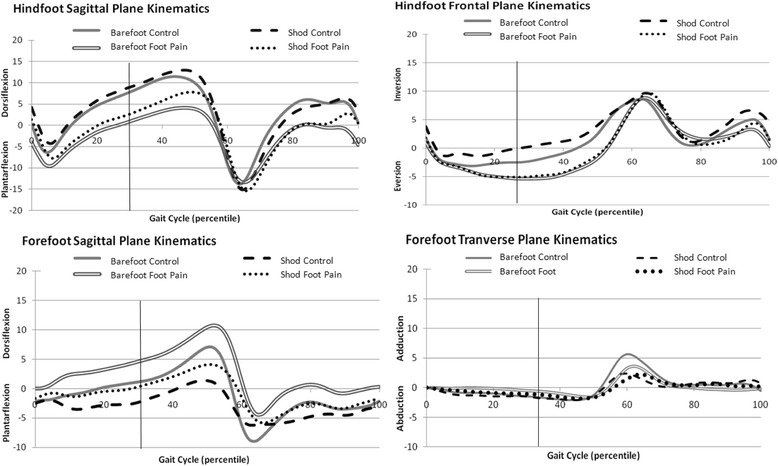
The foot pain group showed greater hindfoot eversion and less hindfoot dorsiflexion than controls in the barefoot condition and these differences were maintained when measured in the shod condition. Differences between the foot pain and control participants were also observed for walking speed in the barefoot and in the shod conditions. No significant differences between foot pain and control groups were demonstrated at the forefoot in either condition.
Subtle differences between pain and control groups, which were found during barefoot walking are retained when wearing the modified shoe. The novel properties of the modified shoe offers a potential solution for the use of passive infrared based motion analysis for shod applications, for instance to investigate the kinematic effect of foot orthoses.
大多数多节段足部运动学研究仅限于赤足条件,因为穿鞋条件可能会干扰表面安装的标记物。本研究的目的是调查一种鞋面带有网状结构的改良鞋,在赤足和穿鞋条件下,能否容纳多节段足部标记物组而不影响运动学测量。
30名参与者(15名对照组和15名中足疼痛患者)在两种条件下进行步态分析;赤足和随机顺序穿着一种鞋(穿鞋)。穿鞋条件采用一种鞋面带有网状结构的改良鞋(橡胶轻便鞋),使皮肤安装的反光标记物能够通过网状材料的缝隙被看到。当参与者以自选速度行走时,使用牛津多节段足部模型捕捉三维足部运动学数据。
在赤足条件下,足部疼痛组比对照组表现出更大的后足外翻和更小的后足背屈,在穿鞋条件下测量时这些差异依然存在。在赤足和穿鞋条件下,足部疼痛组和对照组参与者在步行速度上也存在差异。在两种条件下,前足在足部疼痛组和对照组之间均未显示出显著差异。
在赤足行走时发现的疼痛组和对照组之间的细微差异,在穿着改良鞋时依然存在。改良鞋的新特性为基于被动红外的运动分析在穿鞋应用中的使用提供了一种潜在解决方案,例如用于研究足部矫形器的运动学效果。