Gislason Magnus K, Ingvarsson Páll, Gargiulo Paolo, Yngvason Stefán, Guðmundsdóttir Vilborg, Knútsdóttir Sigrún, Helgason Þórður
(1) Institute of Biomedical and Neural Engineering (BNE), Reykjavik University , Iceland.
(2) Department of Rehabilitation, Landspitali , Reykjavik, Iceland.
Eur J Transl Myol. 2015 Apr 7;24(3):2187. doi: 10.4081/ejtm.2014.2187. eCollection 2014 Sep 23.
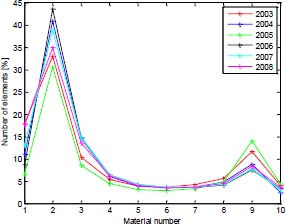
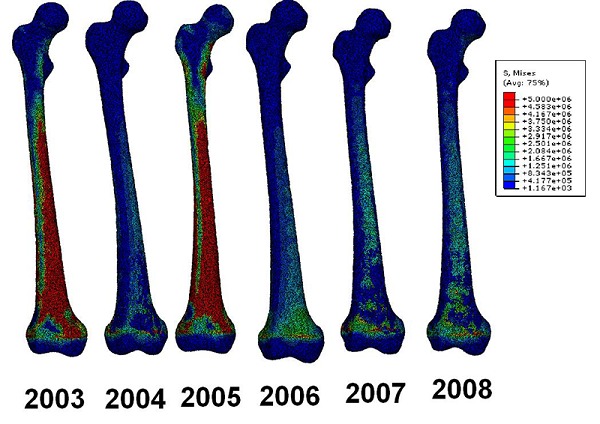
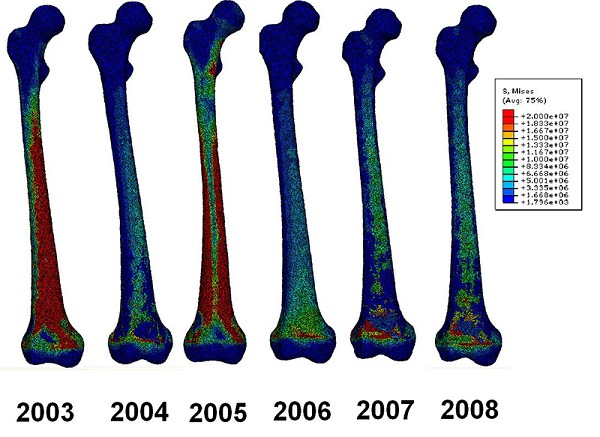
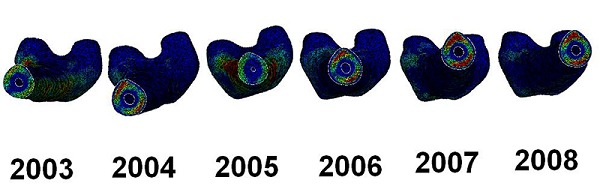
Bone loss and a decrease in bone mineral density is frequently seen in patients with motor neuron lesion due to lack of mechanical stimulation. This causes weakening of the bones and a greater risk of fracture. By using functional electrical stimulation it is possible to activate muscles in the body to produce the necessary muscle force to stimulate muscle growth and potentially decrease the rate of bone loss. A longitudinal study was carried out on a single patient undergoing electrical stimulation over a 6 year period. The patient underwent a CT scan each year and a full three dimensional finite element model for each year was created using Mimics (Materialise) and Abaqus (Simulia) to calculate the risk of fracture under physiologically relevant loading conditions. Using empirical formulas connecting the bone mineral density to the stiffness and ultimate tensile stress of the bone, each element was assigned a unique material property, based on its density. The risk of fracture was estimated by calculating the ratio between the predicted stress and the ultimate tensile stress, should it exceed unity, failure was assumed. The results showed that the number of elements that were predicted to be at risk of failure varied between years.
由于缺乏机械刺激,运动神经元损伤患者经常出现骨质流失和骨矿物质密度降低的情况。这会导致骨骼变弱,骨折风险增加。通过使用功能性电刺激,可以激活体内肌肉以产生必要的肌肉力量,从而刺激肌肉生长并有可能降低骨质流失率。对一名接受了6年电刺激的患者进行了一项纵向研究。该患者每年进行一次CT扫描,并使用Mimics(Materialise公司)和Abaqus(Simulia公司)为每年创建一个完整的三维有限元模型,以计算在生理相关负荷条件下的骨折风险。利用将骨矿物质密度与骨骼刚度和极限拉伸应力联系起来的经验公式,根据每个单元的密度为其赋予独特的材料属性。通过计算预测应力与极限拉伸应力之间的比值来估计骨折风险,如果该比值超过1,则假定发生失效。结果表明,预计有失效风险的单元数量在不同年份有所不同。