Guedes Raul Narciso C, Yack Jayne E
Departamento de Entomologia, Universidade Federal de Viçosa, Viçosa, MG, 36570-900, Brazil.
Department of Biology, Carleton University, 1125 Colonel By Drive, Ottawa, ON, K1S 5B6, Canada.
PLoS One. 2016 Feb 25;11(2):e0150034. doi: 10.1371/journal.pone.0150034. eCollection 2016.
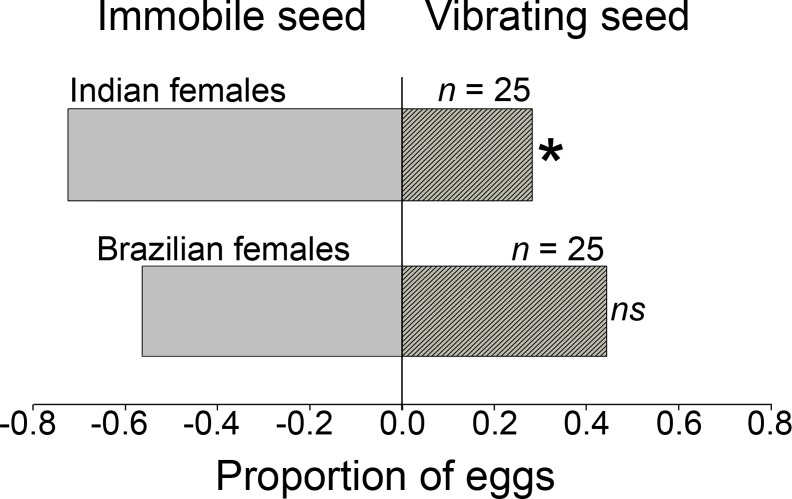
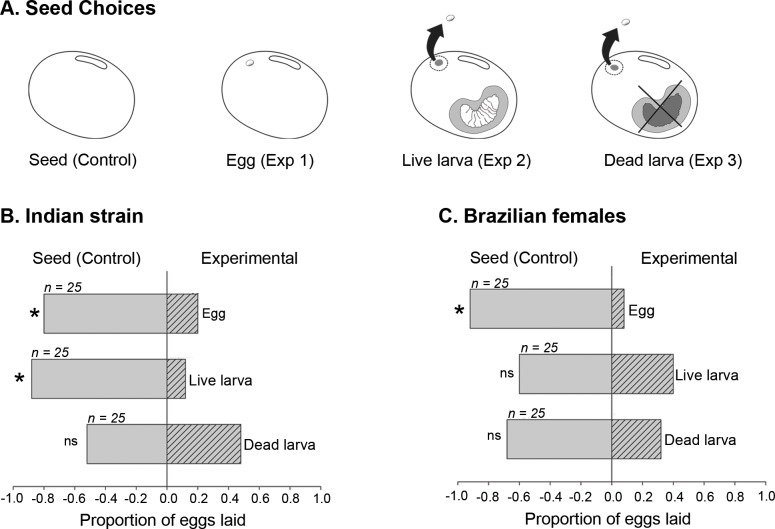
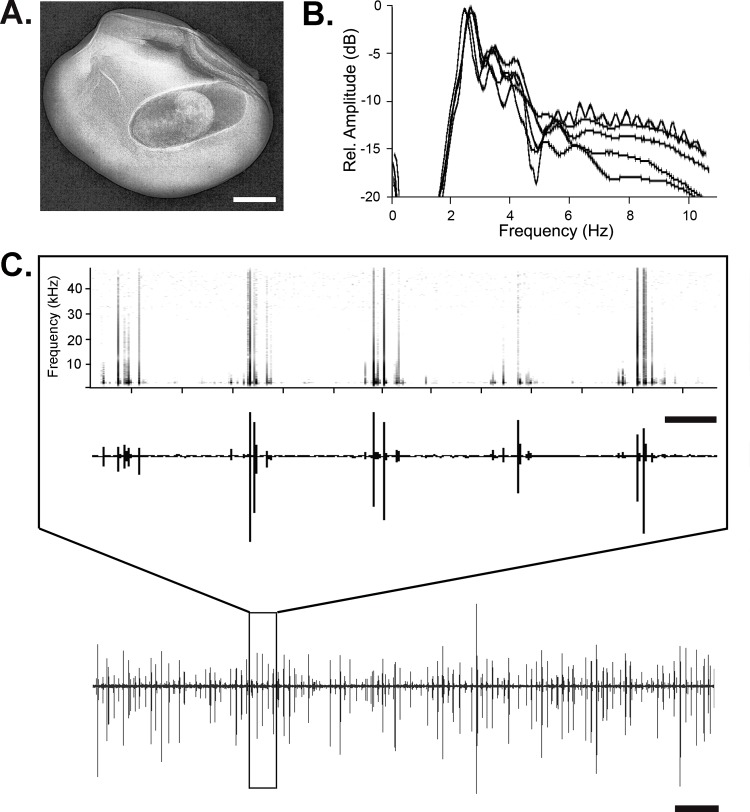
Egg-laying decisions are critical for insects, and particularly those competing for limited resources. Sensory information used by females to mediate egg-laying decisions has been reported to be primarily chemical, but the role of vibration has received little attention. We tested the hypothesis that vibrational cues produced by feeding larvae occupying a seed influences egg-laying decisions amongst female cowpea beetles. This hypothesis is supported by three lines of evidence using two strains of the cowpea beetle (Callosobruchus maculatus), an Indian strain with choosy females and aggressively competing larvae and a Brazilian strain with less choosy females and larvae exhibiting an "accommodating" type of competition. First, in free-choice bioassays of seed selection, choosy Indian females selected control seeds (free of eggs, larvae, or egg-laying marker) over seeds with live larvae (free of eggs and egg-laying marker), but did not discriminate between control seeds and those with dead larvae. In contrast, less choosy Brazilian females showed no preference for seeds containing live or dead larvae over controls. Second, laser-doppler vibrometer recordings confirmed that larvae feeding inside seeds generate vibrations that are available to the female during egg-laying decisions. Third, during dichotomous choice experiments where artificial vibrations approximating those produced by feeding larvae were played back during seed selection, Indian females preferred immobile control seeds over vibrating seeds, but Brazilian females showed no preference. These results support the hypothesis that females use larval vibrations in their egg-laying decisions; whether these vibrations are passive cues exploited by the female, or active signals that 'steer' the behaviour of the female is unknown. We propose that vibration cues and signals could be important for host selection in insects, particularly those laying on substrates where visual or chemical cues may be unreliable. This seems to be the case with females of the cowpea beetle since visual cues are not important and chemical egg-marking does not last more than two weeks, allowing vibration cues to improve discrimination of egg-laying substrate particularly by choosy females.
产卵决策对昆虫至关重要,尤其是那些争夺有限资源的昆虫。据报道,雌性昆虫用于调节产卵决策的感官信息主要是化学信息,但振动的作用却很少受到关注。我们测试了这样一个假设:占据种子的取食幼虫产生的振动线索会影响豇豆象甲雌虫的产卵决策。使用两种豇豆象甲(Callosobruchus maculatus)菌株的三条证据支持了这一假设,一种是印度菌株,其雌虫挑剔,幼虫竞争激烈;另一种是巴西菌株,其雌虫不那么挑剔,幼虫表现出“包容”型竞争。首先,在种子选择的自由选择生物测定中,挑剔的印度雌虫选择对照种子(无卵、幼虫或产卵标记)而不是有活幼虫的种子(无卵和产卵标记),但在对照种子和有死幼虫的种子之间没有区别。相比之下,不那么挑剔的巴西雌虫对含有活幼虫或死幼虫的种子与对照种子没有偏好。其次,激光多普勒振动计记录证实,在种子内取食的幼虫会产生振动,雌虫在产卵决策时可以感知到这些振动。第三,在二分选择实验中,在种子选择过程中回放近似取食幼虫产生的人工振动,印度雌虫更喜欢静止的对照种子而不是振动的种子,但巴西雌虫没有偏好。这些结果支持了这样的假设:雌虫在产卵决策中利用幼虫的振动;这些振动是雌虫利用的被动线索,还是“引导”雌虫行为的主动信号尚不清楚。我们认为,振动线索和信号可能对昆虫的寄主选择很重要,特别是那些在视觉或化学线索可能不可靠的基质上产卵的昆虫。豇豆象甲雌虫似乎就是这种情况,因为视觉线索不重要,化学产卵标记持续时间不超过两周,这使得振动线索能够提高对产卵基质的辨别能力,尤其是对挑剔的雌虫而言。