Messina Sonia, Vita Gian Luca, Sframeli Maria, Mondello Stefania, Mazzone Elena, D'Amico Adele, Berardinelli Angela, La Rosa Matteo, Bruno Claudio, Distefano Maria Grazia, Baranello Giovanni, Barcellona Costanza, Scutifero Marianna, Marcato Sonia, Palmieri Arianna, Politano Luisa, Morandi Lucia, Mongini Tiziana, Pegoraro Elena, D'Angelo Maria Grazia, Pane Marika, Rodolico Carmelo, Minetti Carlo, Bertini Enrico, Vita Giuseppe, Mercuri Eugenio
Department of Neurosciences, University of Messina, Messina, Italy; Nemo Sud Clinical Center for Neuromuscular Diseases, Messina, Italy.
Nemo Sud Clinical Center for Neuromuscular Diseases, Messina, Italy.
Neuromuscul Disord. 2016 Mar;26(3):189-96. doi: 10.1016/j.nmd.2016.01.003. Epub 2016 Feb 2.
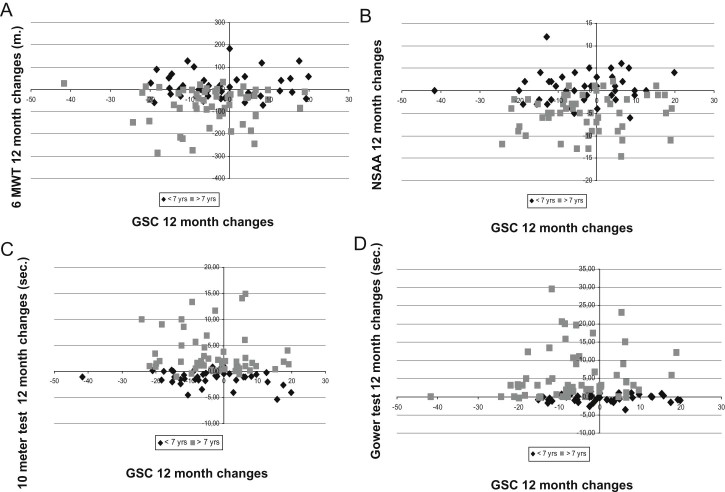
In Duchenne muscular dystrophy (DMD) little has been reported on the association between clinical outcome measures and patient health-related quality of life (HRQOL) tools. Our study evaluated the relationship between 12 month changes on the Generic Core Scales (GCS), the Multidimensional Fatigue Scale and the Neuromuscular Module of the PedsQL(TM) with several outcome measures (6 minute walk test, North Star Ambulatory Assessment and timed items) in ambulatory DMD. Ninety-eight ambulatory DMD in a multicentric setting were included in the study. At baseline, the PedsQL(TM) inventories correlated with almost all the functional measures On the Child Self-Report there was a significant decrease between baseline and 12 months on the PedsQL(TM) GCS and its first domain, in parallel with the decrement in the functional outcome measures. Correlation between the 12 month changes on the PedsQL(TM) inventories and functional measures were almost all negligible. Similar results were obtained on the Parent Proxy-Report. In conclusion, PedsQL(TM) correlates with the level of impairment at baseline, but this does not hold true when 12 month changes are considered. Further studies comparing different tools are needed to better elucidate the complexity of the relationship between HRQOL and functional performances.
在杜氏肌营养不良症(DMD)中,关于临床结局指标与患者健康相关生活质量(HRQOL)工具之间的关联,鲜有报道。我们的研究评估了通用核心量表(GCS)、多维疲劳量表以及儿童生活质量量表(PedsQL™)神经肌肉模块在12个月内的变化与门诊DMD患者的多项结局指标(6分钟步行试验、北极星动态评估和定时项目)之间的关系。本研究纳入了多中心环境下的98例门诊DMD患者。在基线时,PedsQL™量表与几乎所有功能指标相关。在儿童自我报告中,PedsQL™ GCS及其第一个领域在基线和12个月之间有显著下降,这与功能结局指标的下降同时发生。PedsQL™量表在12个月内的变化与功能指标之间的相关性几乎都可以忽略不计。在家长代理报告中也得到了类似的结果。总之,PedsQL™与基线时的损伤程度相关,但在考虑12个月的变化时则不然。需要进一步比较不同工具的研究,以更好地阐明HRQOL与功能表现之间关系的复杂性。