Hodgson Jessica C, Hudson John M
University of Lincoln, UK.
J Neuropsychol. 2017 Mar;11(1):1-13. doi: 10.1111/jnp.12102. Epub 2016 Feb 25.
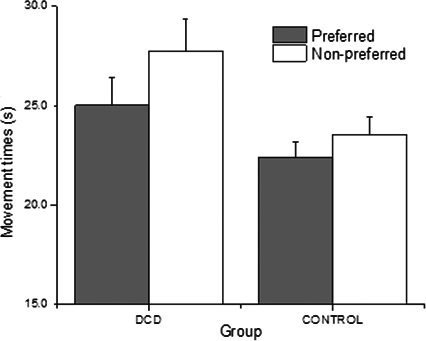
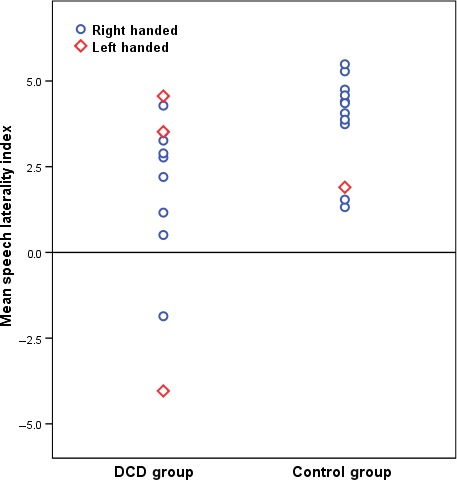
Research using clinical populations to explore the relationship between hemispheric speech lateralization and handedness has focused on individuals with speech and language disorders, such as dyslexia or specific language impairment (SLI). Such work reveals atypical patterns of cerebral lateralization and handedness in these groups compared to controls. There are few studies that examine this relationship in people with motor coordination impairments but without speech or reading deficits, which is a surprising omission given the prevalence of theories suggesting a common neural network underlying both functions. We use an emerging imaging technique in cognitive neuroscience; functional transcranial Doppler (fTCD) ultrasound, to assess whether individuals with developmental coordination disorder (DCD) display reduced left-hemisphere lateralization for speech production compared to control participants. Twelve adult control participants and 12 adults with DCD, but no other developmental/cognitive impairments, performed a word-generation task whilst undergoing fTCD imaging to establish a hemispheric lateralization index for speech production. All participants also completed an electronic peg-moving task to determine hand skill. As predicted, the DCD group showed a significantly reduced left lateralization pattern for the speech production task compared to controls. Performance on the motor skill task showed a clear preference for the dominant hand across both groups; however, the DCD group mean movement times were significantly higher for the non-dominant hand. This is the first study of its kind to assess hand skill and speech lateralization in DCD. The results reveal a reduced leftwards asymmetry for speech and a slower motor performance. This fits alongside previous work showing atypical cerebral lateralization in DCD for other cognitive processes (e.g., executive function and short-term memory) and thus speaks to debates on theories of the links between motor control and language production.
利用临床人群来探究半球言语侧化与利手之间关系的研究主要集中在患有言语和语言障碍的个体上,比如诵读困难或特定语言障碍(SLI)。与对照组相比,这类研究揭示了这些群体中大脑侧化和利手的非典型模式。很少有研究在患有运动协调障碍但无言语或阅读缺陷的人群中考察这种关系,鉴于有理论认为这两种功能存在共同的神经网络,这一疏漏令人惊讶。我们使用认知神经科学中一种新兴的成像技术——功能性经颅多普勒(fTCD)超声,来评估患有发育性协调障碍(DCD)的个体与对照参与者相比,在言语产生方面是否表现出左半球侧化减弱。12名成年对照参与者和12名患有DCD但无其他发育/认知障碍的成年人在接受fTCD成像时执行了一个单词生成任务,以建立言语产生的半球侧化指数。所有参与者还完成了一项电子移 peg 任务以确定手部技能。正如预期的那样,与对照组相比,DCD组在言语产生任务中显示出明显减弱的左侧化模式。运动技能任务的表现显示两组对优势手都有明显偏好;然而,DCD组非优势手的平均移动时间明显更长。这是同类研究中第一项评估DCD患者手部技能和言语侧化的研究。结果揭示了言语的左侧不对称性降低以及运动表现较慢。这与之前显示DCD在其他认知过程(如执行功能和短期记忆)中大脑侧化不典型的研究结果相符,因此涉及到关于运动控制与语言产生之间联系的理论争论。