Mendonca Silvia C, Abel Gary A, Lyratzopoulos Georgios
Cambridge Centre for Health Services Research, Institute of Public Health, University of Cambridge, Cambridge.
Cancer Research UK Health Behaviour Research Centre, Department of Epidemiology and Public Health, University College London, London.
Br J Gen Pract. 2016 Mar;66(644):e171-81. doi: 10.3399/bjgp16X683977.
Some patients with cancer experience multiple pre-diagnostic consultations in primary care, leading to longer time intervals to specialist investigations and diagnosis. Patients with rarer cancers are thought to be at higher risk of such events, but concrete evidence of this is lacking.
To examine the frequency and predictors of repeat consultations with GPs in patients with rarer cancers.
Patient-reported data on pre-referral consultations from three English national surveys of patients with cancer (2010, 2013, and 2014), pooled to maximise the sample size of rarer cancers.
The authors examined the frequency and crude and adjusted odds ratios for ≥3 (versus 1-2) pre-referral consultations by age, sex, ethnicity, level of deprivation, and cancer diagnosis (38 diagnosis groups, including 12 rarer cancers without prior relevant evidence).
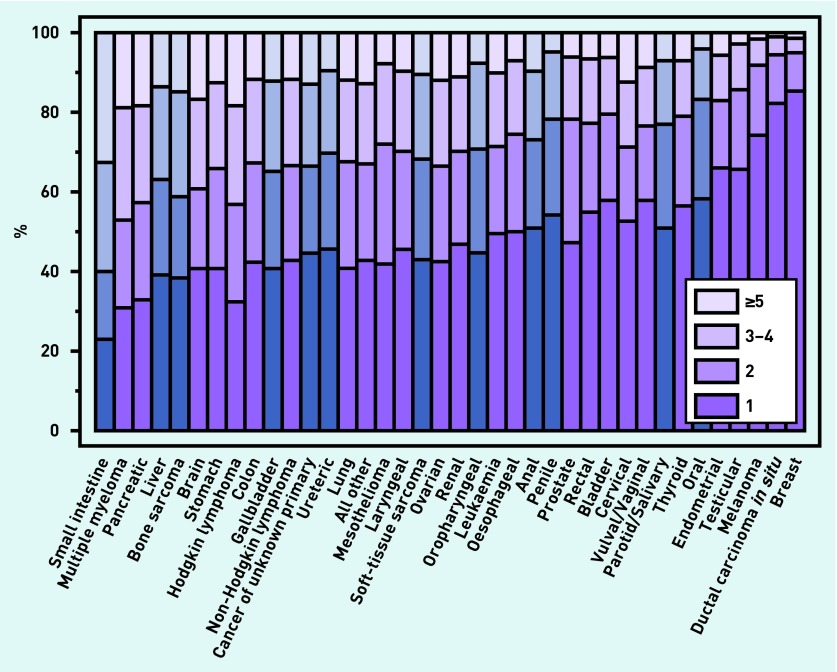
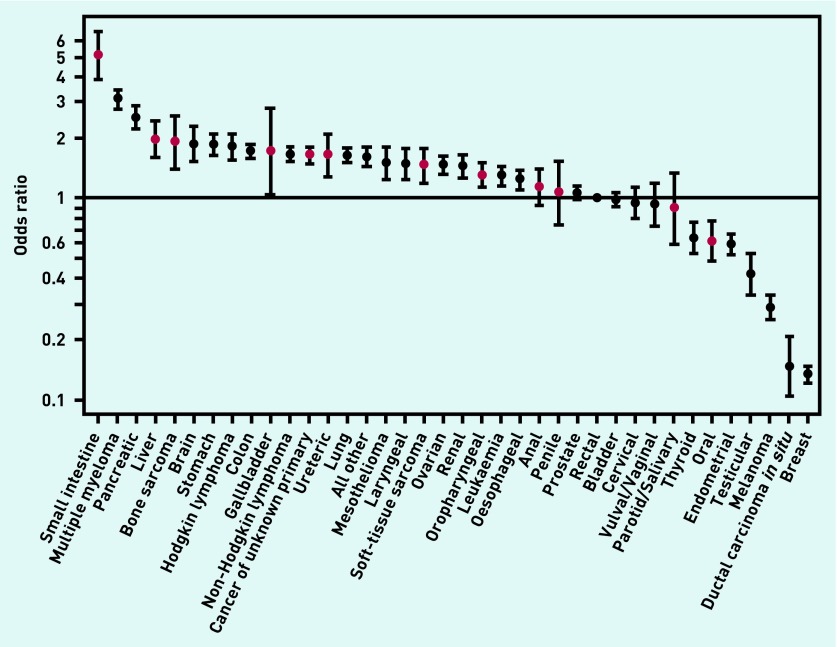
Among 7838 patients with 12 rarer cancers, crude proportions of patients with ≥3 pre-referral consultations ranged from >30.0% to 60.0% for patients with small intestine, bone sarcoma, liver, gallbladder, cancer of unknown primary, soft-tissue sarcoma, and ureteric cancer. The range was 15.0-30.0% for patients with oropharyngeal, anal, parotid, penile, and oral cancer. The overall proportion of responders with any cancer who had ≥3 consultations was 23.4%. Multivariable logistic regression indicated concordant patterns, with strong evidence for variation between rarer cancers (P <0.001).
Patients with rarer cancers experience pre-referral consultations at frequencies suggestive of middle-to-high diagnostic difficulty. The findings can guide the development of new diagnostic interventions and 'safety-netting' approaches for symptomatic presentations encountered in patients with rarer cancers.
一些癌症患者在初级保健机构进行多次诊断前咨询,导致专科检查和诊断的时间间隔延长。人们认为,患罕见癌症的患者发生此类情况的风险更高,但缺乏具体证据。
研究罕见癌症患者与全科医生重复咨询的频率及预测因素。
来自三项英国全国性癌症患者调查(2010年、2013年和2014年)的患者报告的转诊前咨询数据,汇总这些数据以扩大罕见癌症的样本量。
作者按年龄、性别、种族、贫困程度和癌症诊断(38个诊断组,包括12种此前无相关证据的罕见癌症),研究了转诊前≥3次(与1-2次相比)咨询的频率、粗比值比和调整后的比值比。
在7838例患12种罕见癌症的患者中,小肠癌、骨肉瘤、肝癌、胆囊癌、原发灶不明癌、软组织肉瘤及输尿管癌患者转诊前≥3次咨询的粗比例在30.0%以上至60.0%之间。口咽癌、肛门癌、腮腺癌、阴茎癌及口腔癌患者的这一比例范围为15.0%-30.0%。所有癌症患者中咨询≥3次的总体比例为23.4%。多变量逻辑回归显示出一致的模式,有充分证据表明罕见癌症之间存在差异(P<0.001)。
患罕见癌症的患者进行转诊前咨询的频率表明诊断难度为中到高。这些发现可为开发新的诊断干预措施及针对罕见癌症患者出现的症状性表现的“安全网”方法提供指导。