Lee Han-Bin, Kim Jinkwon, Oh Seung-Hun, Kim Sang-Heum, Kim Hyun-Sook, Kim Won-Chan, Kim Soonhag, Kim Ok-Joon
Department of Neurology, CHA Bundang Medical Center, CHA University, Seongnam, South Korea.
Department of Radiology, CHA Bundang Medical Center, CHA University, Seongnam, South Korea.
PLoS One. 2016 Feb 26;11(2):e0150308. doi: 10.1371/journal.pone.0150308. eCollection 2016.
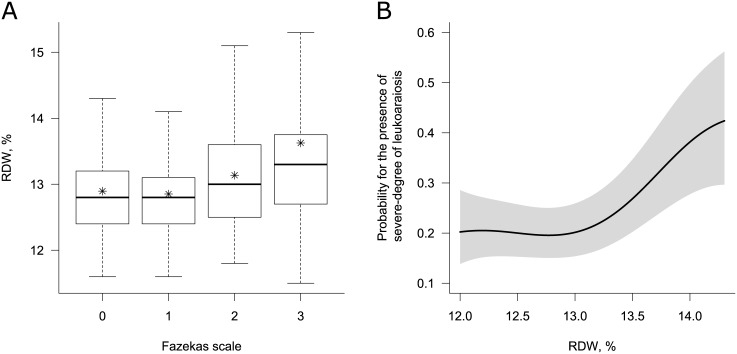
Red blood cell distribution width (RDW) is one of the routine hematologic parameters reported in the complete blood count test, which has been recognized as strong prognostic marker for various medical conditions, especially cardiovascular disease. We evaluated that RDW was also associated with the leukoaraiosis; common radiological finding of brain and that has been strongly associated with risk of stroke and dementia. In the present study, we included 1006 non-stroke individuals who underwent brain MRI and routine complete blood count test including RDW. Fazekas scale was used to measure the severity of leukoaraiosis based on fluid-attenuated inversion recovery image, and the severity was dichotomized to mild-degree (Fazekas scale: 0-1) and severe-degree leukoaraiosis (Fazekas scale: 2-3). Univariate and multivariate logistic regression models were constructed to evaluate independent risk factor for severe-degree of leukoaraiosis. Mean age of 1006 subjects was 64.34 ± 9.11 year, and mean of RDW was 12.97 ± 0.86%. The severe-degree of leukoaraiosis (Fazekas scale ≥ 2) was found in 28.83%. In the multivariate logistic regression, 4th quartile of RDW (> 13.3%) were significantly associated with the presence of severe-degree of leukoaraiosis (adjusted odds ratio, 1.87; 95% confidence interval, 1.20-2.92) compared to the 1st quartile of RDW (< 12.5%). The significance was not changed after adjustments for hemoglobin and other hematologic indices. These findings suggest that RDW is independently associated with severity of leukoaraiosis.
红细胞分布宽度(RDW)是全血细胞计数检测中报告的常规血液学参数之一,已被公认为各种疾病,尤其是心血管疾病的强有力的预后标志物。我们评估了RDW也与脑白质疏松症有关;脑白质疏松症是一种常见的脑部影像学表现,与中风和痴呆风险密切相关。在本研究中,我们纳入了1006名未患中风的个体,这些个体接受了脑部MRI检查和包括RDW在内的常规全血细胞计数检测。基于液体衰减反转恢复图像,使用 Fazekas量表来测量脑白质疏松症的严重程度,并将严重程度分为轻度(Fazekas量表:0-1)和重度脑白质疏松症(Fazekas量表:2-3)。构建单变量和多变量逻辑回归模型以评估重度脑白质疏松症的独立危险因素。1006名受试者的平均年龄为64.34±9.11岁,RDW的平均值为12.9