Schiffman Eric, Ohrbach Richard
J Am Dent Assoc. 2016 Jun;147(6):438-45. doi: 10.1016/j.adaj.2016.01.007. Epub 2016 Feb 26.
In this executive summary, the authors describe a protocol for assessing patients with temporomandibular disorder (TMD). It is based on the Diagnostic Criteria for Temporomandibular Disorders (DC/TMD) for clinical and research applications.
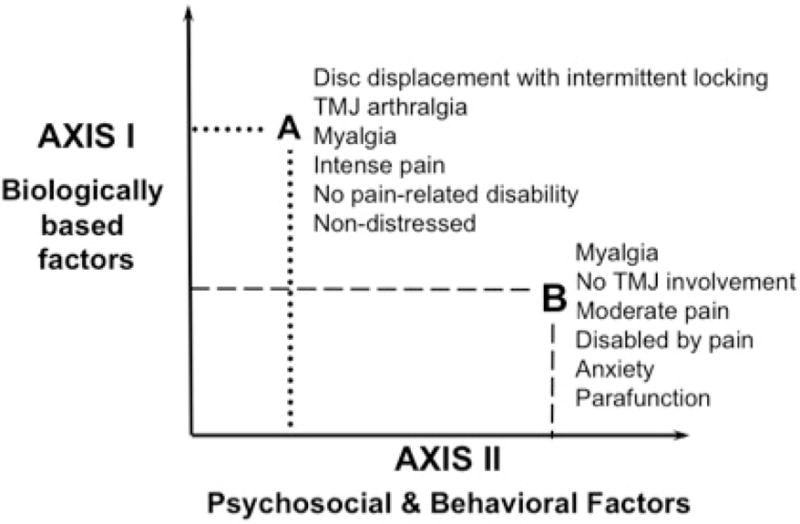
The DC/TMD was developed using published Axis I physical diagnoses for the most common TMDs. Axis I diagnostic criteria were derived from pertinent clinical TMD signs and symptoms. Axis II consists of psychosocial and behavioral questionnaires already in the public domain. A panel of experts vetted and modified the Axis I and Axis II diagnostic protocols. Recommended changes were assessed for diagnostic accuracy by using the Validation Project's data set, which formed the basis for the development of the DC/TMD.
Axis I diagnostic criteria for TMD pain-related disorders have acceptable validity and provide definitive diagnoses for pain involving the temporomandibular joint (TMJ) and masticatory muscles. Axis I diagnostic criteria for the most common TMJ intra-articular disorders are appropriate for screening purposes only. A definitive diagnosis for TMJ intra-articular disorders requires computed tomography or magnetic resonance imaging. Axis II questionnaires provide valid assessment of psychosocial and behavioral factors that can affect management of TMD.
The DC/TMD provides a questionnaire for the pain history in conjunction with validated clinical examination criteria for diagnosing the most common TMDs. In addition, it provides Axis II questionnaires for assessing psychosocial and behavioral factors that may contribute to the onset and perpetuation of the patient's TMD.
The DC/TMD is appropriate for use in clinical and research settings to allow for a comprehensive assessment of patients with TMD.
在本执行摘要中,作者描述了一种评估颞下颌关节紊乱病(TMD)患者的方案。它基于用于临床和研究应用的颞下颌关节紊乱病诊断标准(DC/TMD)。
DC/TMD是利用已发表的针对最常见TMD的轴I体格诊断制定的。轴I诊断标准源自相关的临床TMD体征和症状。轴II由已在公共领域的社会心理和行为问卷组成。一个专家小组对轴I和轴II诊断方案进行了审核和修改。通过使用验证项目的数据集评估推荐更改的诊断准确性,该数据集构成了DC/TMD开发的基础。
TMD疼痛相关疾病的轴I诊断标准具有可接受的效度,并为涉及颞下颌关节(TMJ)和咀嚼肌的疼痛提供明确诊断。最常见的TMJ关节内疾病的轴I诊断标准仅适用于筛查目的。TMJ关节内疾病的明确诊断需要计算机断层扫描或磁共振成像。轴II问卷可有效评估可能影响TMD管理的社会心理和行为因素。
DC/TMD提供了一份疼痛病史问卷以及经过验证的临床检查标准,用于诊断最常见的TMD。此外,它还提供轴II问卷,用于评估可能导致患者TMD发病和持续存在的社会心理和行为因素。
DC/TMD适用于临床和研究环境,以便对TMD患者进行全面评估。