Chin Han-Shiuan, Wu Yong-Pei, Hour Ai-Ling, Hong Chwan-Yang, Lin Yann-Rong
Department of Agronomy, National Taiwan University, Taipei, Taiwan.
Department of Agronomy, Chiayi Agricultural Experiment Station, Taiwan Agricultural Research Institute, Chiayi, Taiwan.
Rice (N Y). 2016 Dec;9(1):8. doi: 10.1186/s12284-016-0080-y. Epub 2016 Feb 27.
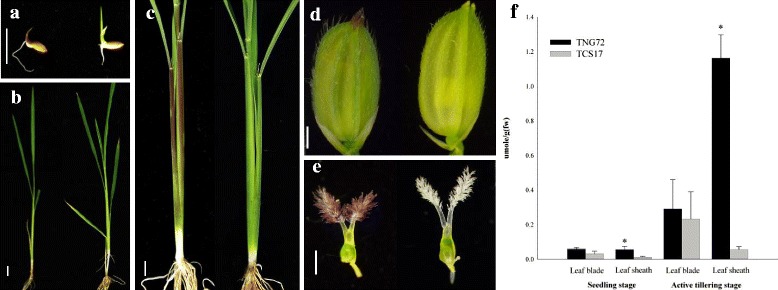
Anthocyanin accumulates in many plant tissues or organs, in rice for example leading to red, purple red and purple phenotypes for protection from damage by biotic and abiotic stresses and for reproduction. Purple leaf, leaf sheath, stigma, pericarp, and apiculus are common in wild rice and landraces and occasionally found in modern cultivars. No gene directly conferring anthocyanin deposited in a purple leaf sheath has yet been isolated by using natural variants. An F2 population derived from ssp. japonica cv. Tainung 72 (TNG72) with purple leaf sheath (PSH) crossed with ssp. indica cv. Taichung Sen 17 (TCS17) with green leaf sheath (GSH) was utilized to isolate a gene conferring leaf sheath color.
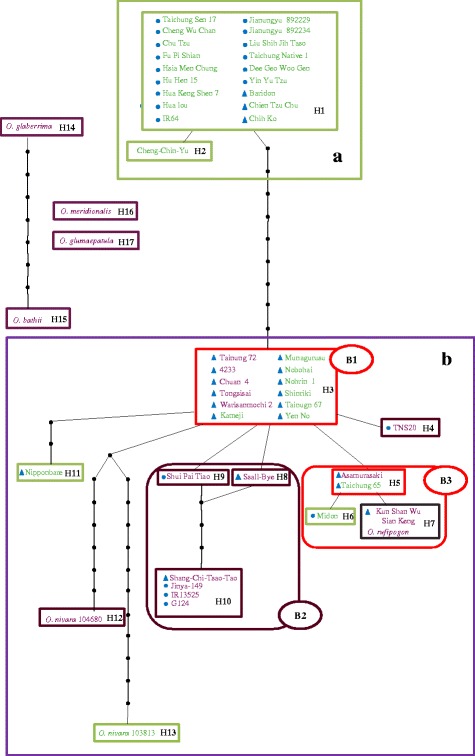
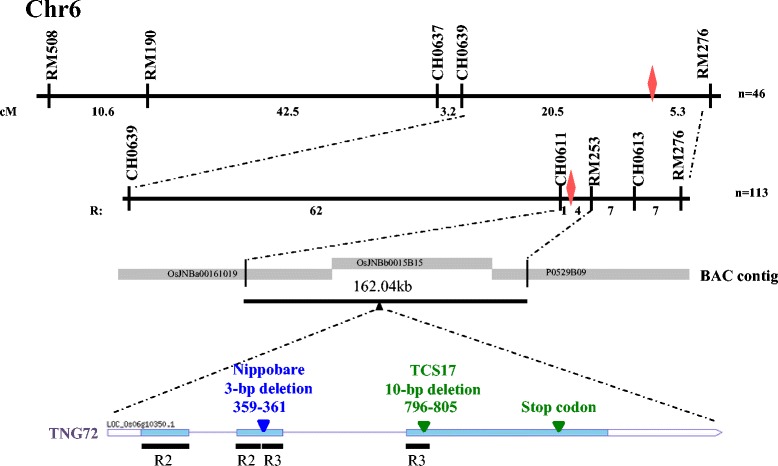
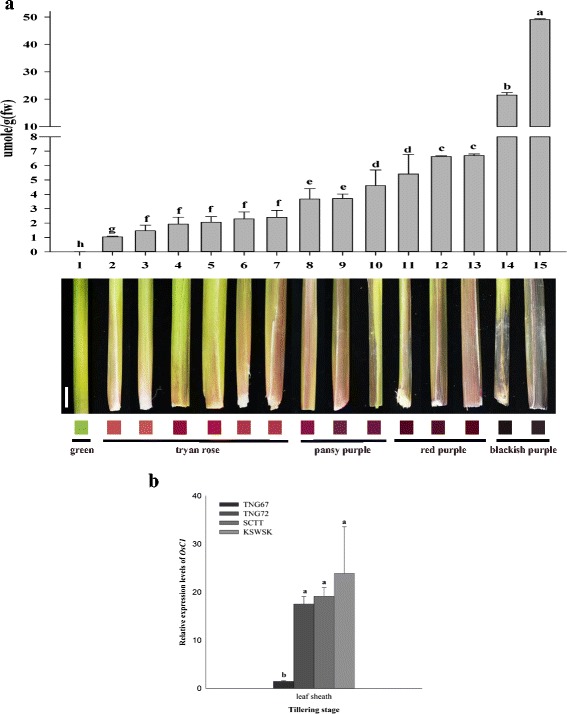
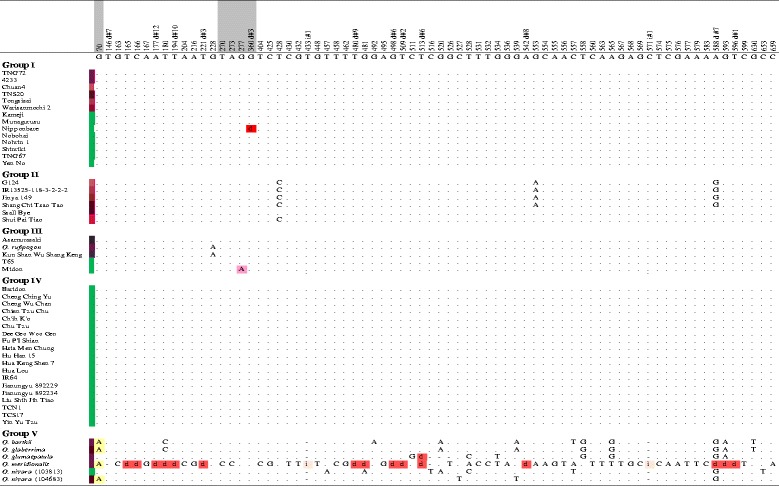
By positional cloning, 10-and 3-bp deletions in the R2R3 Myb domain of OsC1 were uncovered in GSH varieties TCS17 and Nipponbare, respectively. Allelic diversity, rather than gene expression levels of OsC1, might be responsible for anthocyanin accumulation. Parsimony-based analysis of genetic diversity in 50 accessions, including cultivars, landraces, and A-genome wild rice, suggests that independent mutation occurred in Asian, African, South American, and Australian species, while O. meridionalis had a divergent sequence. OsC1 was thought of as a domestication related gene, with up to 90 % reduction of genetic diversity in GSH; however, no values from three tests showed significant differences from neutral expectations, implying that OsC1 had not been subjected to recent selection. Haplotype network analysis revealed that species from different continents formed unique haplotypes with no gene flow. Two major groups of haplotypes corresponding to 10-bp deletion and other sequences were formed in Asian rice, including O. rufipogon, O. nivara and O. sativa. Introgressions of OsC1 between subspecies through natural and artificial hybridization were not rare. Because artificial and natural selection imposed admixture on rice germplasm in Taiwan, the genealogy of OsC1 might not be congruent with the current distribution of alleles through lineage diversification.
OsC1 is responsible for purple leaf sheath, and much new information about OsC1 is provided e.g., new alleles, non-domestication syndrome, and incongruence of genealogy with geographic distribution.
花青素在许多植物组织或器官中积累,例如在水稻中,会导致红色、紫红色和紫色表型,以保护植物免受生物和非生物胁迫的伤害并用于繁殖。紫色叶片、叶鞘、柱头、果皮和颖尖在野生稻和地方品种中很常见,在现代栽培品种中偶尔也会出现。利用自然变异,尚未分离出直接导致花青素沉积在紫色叶鞘中的基因。利用来自具有紫色叶鞘(PSH)的粳稻品种台中72(TNG72)与具有绿色叶鞘(GSH)的籼稻品种台中17(TCS17)杂交产生的F2群体,来分离一个控制叶鞘颜色的基因。
通过定位克隆,在GSH品种TCS17和日本晴中,分别在OsC1的R2R3 Myb结构域中发现了10个碱基对和3个碱基对的缺失。等位基因多样性而非OsC1的基因表达水平,可能是花青素积累的原因。对包括栽培品种、地方品种和A基因组野生稻在内的50份材料进行基于简约法的遗传多样性分析表明,亚洲、非洲、南美和澳大利亚的物种中均发生了独立突变,而南方野生稻具有不同的序列。OsC1被认为是一个与驯化相关的基因,在GSH中其遗传多样性降低了90%;然而,三项测试的结果均未显示与中性预期存在显著差异,这意味着OsC1近期未受到选择。单倍型网络分析表明,来自不同大陆的物种形成了独特的单倍型,且没有基因流。在亚洲水稻(包括普通野生稻、尼瓦拉野生稻和栽培稻)中,形成了与10个碱基对缺失及其他序列相对应的两个主要单倍型组。通过自然和人工杂交,OsC1在亚种间的渗入并不罕见。由于人工和自然选择对台湾水稻种质施加了混合作用,OsC1的谱系可能与当前通过谱系多样化形成的等位基因分布不一致。
OsC1决定紫色叶鞘,并提供了许多关于OsC1的新信息,例如新等位基因、非驯化综合征以及谱系与地理分布的不一致性。