Graziadei Andrea, Masiewicz Pawel, Lapinaite Audrone, Carlomagno Teresa
European Molecular Biology Laboratory, SCB Unit, D-69117 Heidelberg, Germany.
European Molecular Biology Laboratory, SCB Unit, D-69117 Heidelberg, Germany Leibniz University Hannover, Centre for Biomolecular Drug Research, D-30167 Hannover, Germany Helmholtz Centre for Infection Research, Group of Structural Chemistry, D-38124 Braunschweig, Germany.
RNA. 2016 May;22(5):764-72. doi: 10.1261/rna.054320.115. Epub 2016 Feb 29.
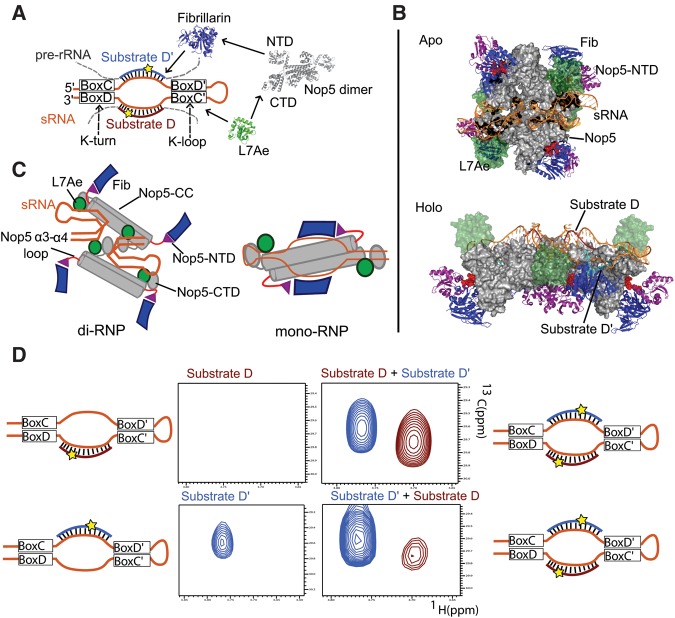
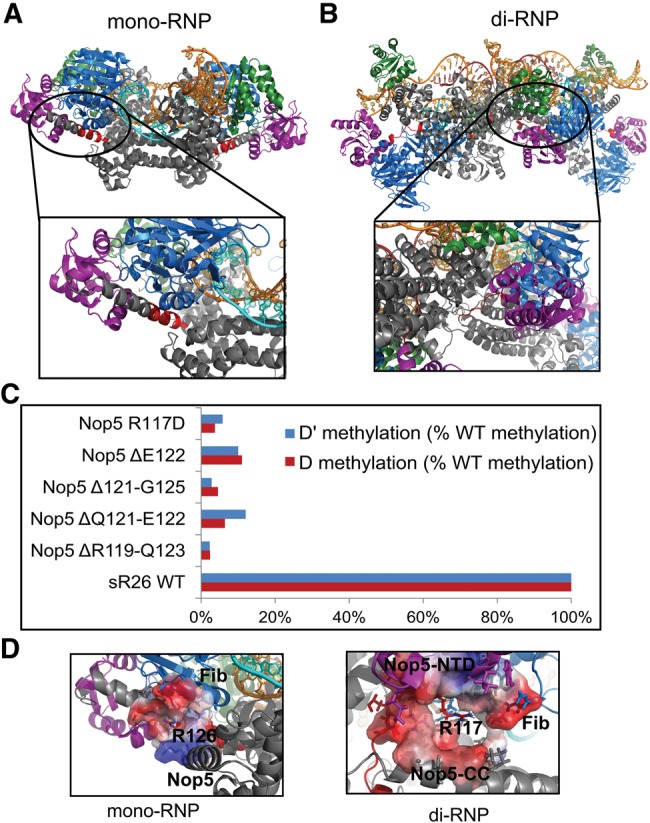
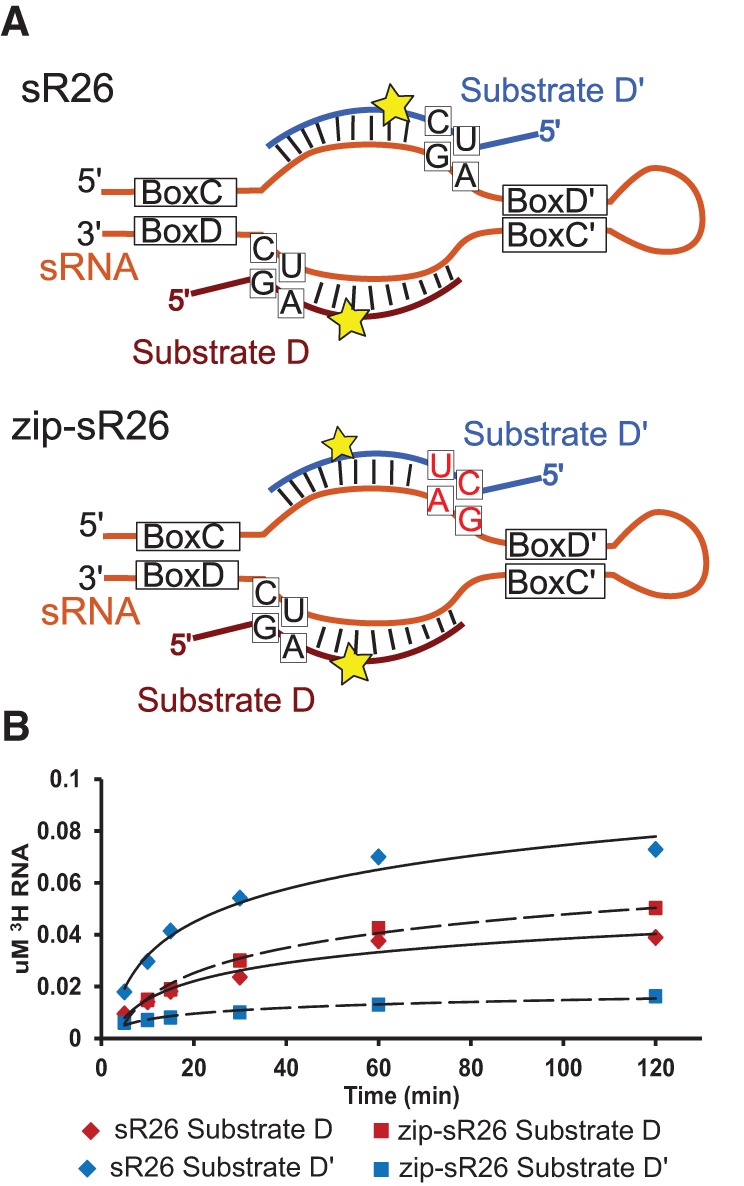
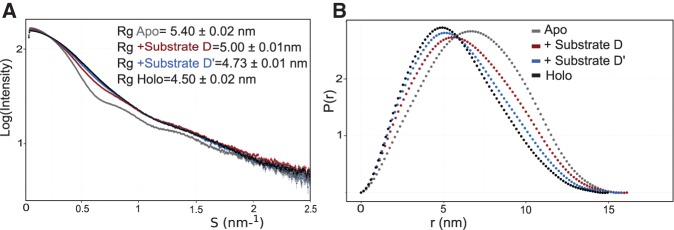
RNA modifications confer complexity to the 4-nucleotide polymer; nevertheless, their exact function is mostly unknown. rRNA 2'-O-ribose methylation concentrates to ribosome functional sites and is important for ribosome biogenesis. The methyl group is transferred to rRNA by the box C/D RNPs: The rRNA sequence to be methylated is recognized by a complementary sequence on the guide RNA, which is part of the enzyme. In contrast to their eukaryotic homologs, archaeal box C/D enzymes can be assembled in vitro and are used to study the mechanism of 2'-O-ribose methylation. In Archaea, each guide RNA directs methylation to two distinct rRNA sequences, posing the question whether this dual architecture of the enzyme has a regulatory role. Here we use methylation assays and low-resolution structural analysis with small-angle X-ray scattering to study the methylation reaction guided by the sR26 guide RNA fromPyrococcus furiosus We find that the methylation efficacy at sites D and D' differ substantially, with substrate D' turning over more efficiently than substrate D. This observation correlates well with structural data: The scattering profile of the box C/D RNP half-loaded with substrate D' is similar to that of the holo complex, which has the highest activity. Unexpectedly, the guide RNA secondary structure is not responsible for the functional difference at the D and D' sites. Instead, this difference is recapitulated by the nature of the first base pair of the guide-substrate duplex. We suggest that substrate turnover may occur through a zip mechanism that initiates at the 5'-end of the product.
RNA修饰赋予了这种4核苷酸聚合物复杂性;然而,它们的确切功能大多仍不为人知。核糖体RNA(rRNA)的2'-O-核糖甲基化集中于核糖体功能位点,对核糖体生物合成很重要。甲基由C/D盒核糖核蛋白颗粒(RNP)转移至rRNA:待甲基化的rRNA序列由引导RNA上的互补序列识别,引导RNA是该酶的一部分。与它们的真核同源物不同,古菌的C/D盒酶可在体外组装,并用于研究2'-O-核糖甲基化的机制。在古菌中,每个引导RNA将甲基化导向两个不同的rRNA序列,这就引发了一个问题,即该酶的这种双重结构是否具有调控作用。在这里,我们使用甲基化分析以及小角X射线散射的低分辨率结构分析,来研究由激烈火球菌的sR26引导RNA引导的甲基化反应。我们发现,位点D和D'处的甲基化效率有很大差异,底物D'的周转比底物D更高效。这一观察结果与结构数据高度相关:半装载底物D'的C/D盒RNP的散射图谱与具有最高活性的全酶复合物相似。出乎意料的是,引导RNA的二级结构并不是D和D'位点功能差异的原因。相反,这种差异由引导-底物双链体第一个碱基对的性质所概括。我们认为,底物周转可能通过一种从产物5'端起始的拉链机制发生。