Marques David A, Lucek Kay, Meier Joana I, Mwaiko Salome, Wagner Catherine E, Excoffier Laurent, Seehausen Ole
Aquatic Ecology and Evolution, Institute of Ecology and Evolution, University of Bern, Bern, Switzerland.
Department of Fish Ecology and Evolution, Centre of Ecology, Evolution & Biogeochemistry, Eawag: Swiss Federal Institute of Aquatic Science and Technology, Kastanienbaum, Switzerland.
PLoS Genet. 2016 Feb 29;12(2):e1005887. doi: 10.1371/journal.pgen.1005887. eCollection 2016 Feb.
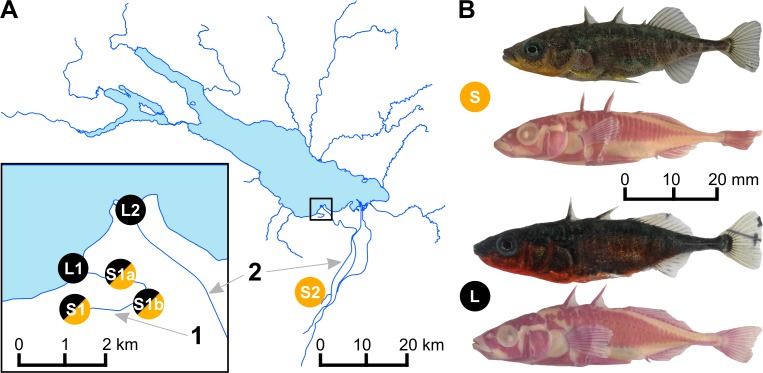
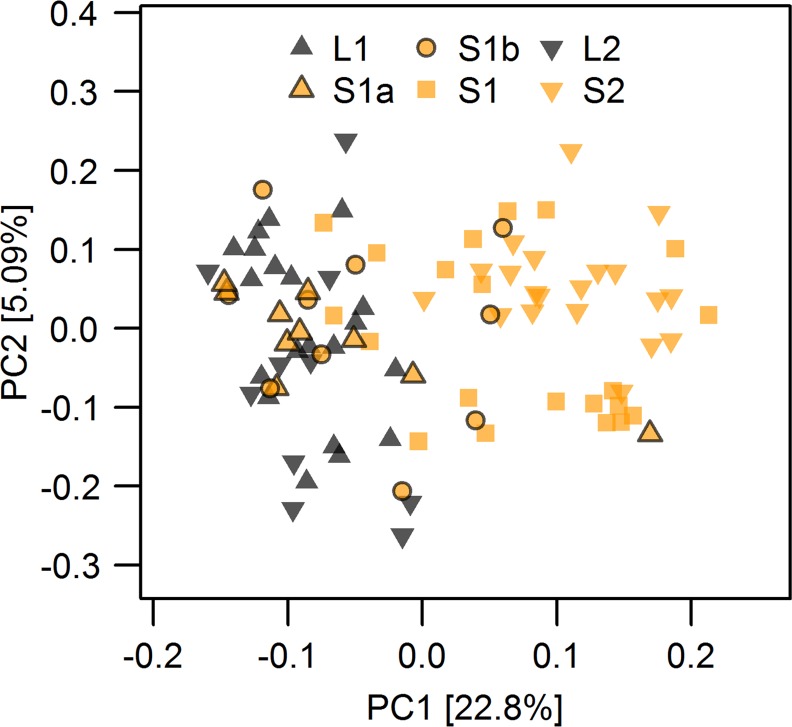
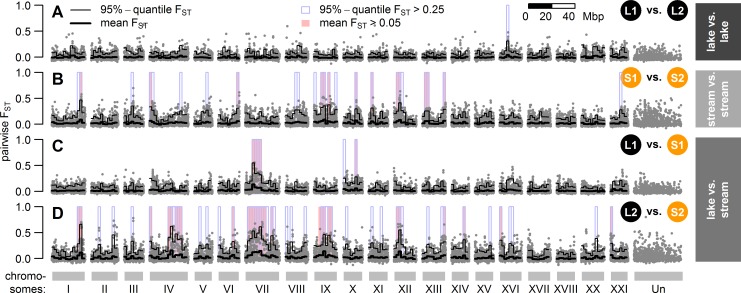
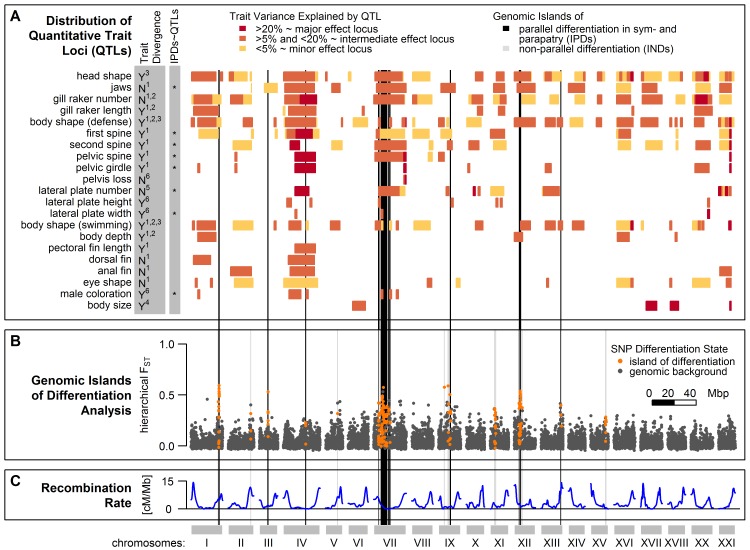
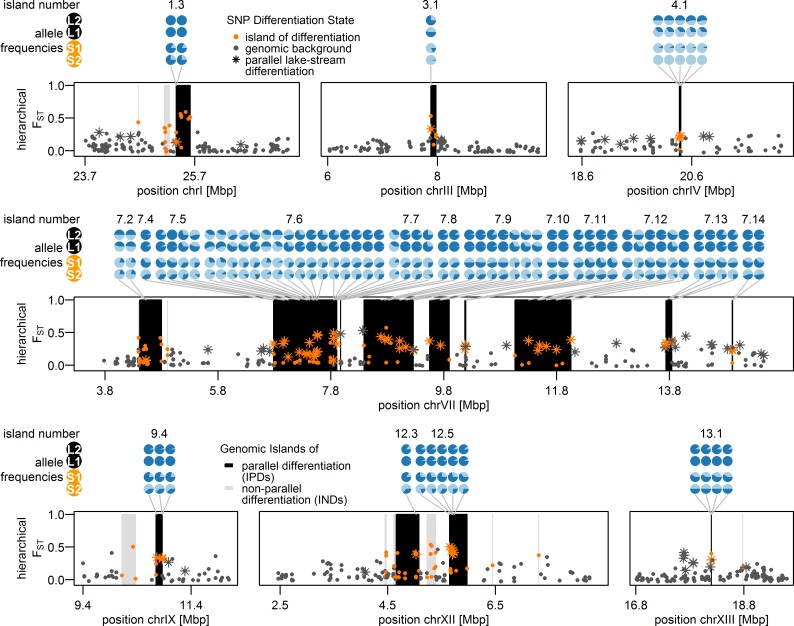
Ecological speciation is the process by which reproductively isolated populations emerge as a consequence of divergent natural or ecologically-mediated sexual selection. Most genomic studies of ecological speciation have investigated allopatric populations, making it difficult to infer reproductive isolation. The few studies on sympatric ecotypes have focused on advanced stages of the speciation process after thousands of generations of divergence. As a consequence, we still do not know what genomic signatures of the early onset of ecological speciation look like. Here, we examined genomic differentiation among migratory lake and resident stream ecotypes of threespine stickleback reproducing in sympatry in one stream, and in parapatry in another stream. Importantly, these ecotypes started diverging less than 150 years ago. We obtained 34,756 SNPs with restriction-site associated DNA sequencing and identified genomic islands of differentiation using a Hidden Markov Model approach. Consistent with incipient ecological speciation, we found significant genomic differentiation between ecotypes both in sympatry and parapatry. Of 19 islands of differentiation resisting gene flow in sympatry, all were also differentiated in parapatry and were thus likely driven by divergent selection among habitats. These islands clustered in quantitative trait loci controlling divergent traits among the ecotypes, many of them concentrated in one region with low to intermediate recombination. Our findings suggest that adaptive genomic differentiation at many genetic loci can arise and persist in sympatry at the very early stage of ecotype divergence, and that the genomic architecture of adaptation may facilitate this.
生态物种形成是指由于自然选择或生态介导的性选择的差异,导致生殖隔离种群出现的过程。大多数关于生态物种形成的基因组研究都调查了异域种群,这使得推断生殖隔离变得困难。少数关于同域生态型的研究集中在经过数千代分化后的物种形成过程的后期阶段。因此,我们仍然不知道生态物种形成早期开始时的基因组特征是什么样的。在这里,我们研究了三刺鱼的洄游湖泊型和定居溪流型生态型之间的基因组分化,这些生态型在一条溪流中同域繁殖,在另一条溪流中邻域繁殖。重要的是,这些生态型在不到150年前才开始分化。我们通过限制性位点相关DNA测序获得了34756个单核苷酸多态性(SNP),并使用隐马尔可夫模型方法确定了分化的基因组岛。与初始生态物种形成一致,我们发现同域和邻域的生态型之间都存在显著的基因组分化。在同域中阻止基因流动的19个分化岛中,所有这些岛在邻域中也有分化,因此可能是由不同栖息地之间的差异选择驱动的。这些岛聚集在控制生态型之间差异性状的数量性状位点中,其中许多集中在一个重组率低至中等的区域。我们的研究结果表明,在生态型分化的早期阶段,许多基因座上的适应性基因组分化可以在同域中出现并持续存在,而且适应的基因组结构可能促进了这一过程。