Schulz Christian, Schütte Kerstin, Kropf Siegfried, Schmitt Friedhelm C, Vasapolli Riccardo, Kliegis Leon M, Riegger Antonia, Malfertheiner Peter
Department of Gastroenterology, Hepatology and Infectious Diseases, Otto-von-Guericke University Magdeburg, Leipziger Str. 44, 39120, Magdeburg, Germany.
Helmholtz Centre for Infection Research, Microbial Interactions and Processes (MINP) Research Group, Braunschweig, Germany.
Trials. 2016 Feb 29;17(1):111. doi: 10.1186/s13063-016-1205-8.
Hepatic encephalopathy (HE) is a clinically significant complication of liver cirrhosis impacting on the patients' quality of life. Minimal hepatic encephalopathy (MHE) is diagnosed by psychometric tests, found in up to 80 % of patients with liver cirrhosis and carries a high risk of progression to overt HE. Continuous therapy with rifaximin in combination with lactulose significantly reduces the risk of overt HE, recurrence of HE and HE-related hospitalizations in randomized, double-blind, placebo-controlled clinical trials. Rifaximin is approved for the therapy of overt HE in Germany. Treatment with lactulose has been shown to improve cognitive functions in patients with liver cirrhosis. Data from prospective clinical trials comparing the efficacy of rifaximin alone against a combination of rifaximin and lactulose in the treatment of MHE are scarce. Changes in the microbiome of the upper and lower gastrointestinal tract as a result of therapy with rifaximin have not yet been addressed in clinical studies.
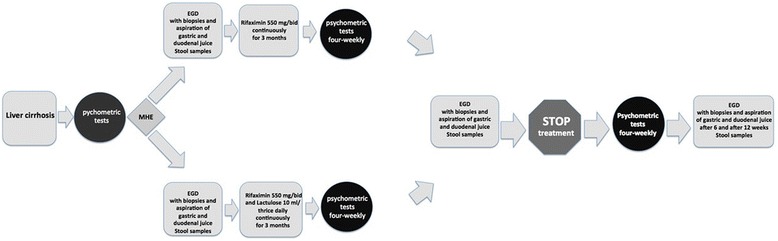
RiMINI is a monocentric exploratory pilot study on 60 patients with MHE as assessed by critical flicker frequency (CFF). Additionally, visual evoked potentials' (VEP) testing, electroencephalography (EEG) and psychometric testing (NCT-A) will be carried out. Patients will be randomized to treatment either with rifaximin alone (550 mg twice daily (bid) continuously for a period of 3 months) or with rifaximin (550 mg bid continuously) in combination with lactulose (30-60 ml daily) for 3 months. An esophagogastroduodenoscopy (EGD) will be performed at baseline, at the end of treatment and 6 and 12 weeks after the end of treatment to obtain gastric and duodenal biopsies and aspirates. The samples will be analyzed for their content of specific bacterial taxae by applying next generation sequencing (NGS) after rRNA isolation to identify the microbiome of the stomach and duodenum, and of the gut, in patients with liver cirrhosis and MHE before and after therapy.
Differences of the effect of antibiotic therapy with rifaximin alone or in combination with lactulose on the clinical course of MHE are assessed.
The trial was registered as DRKS00006359 on March 17th 2015, with the universal trial number U1111-1163-9410 and with EudraCT2013-004414-18 .
肝性脑病(HE)是肝硬化临床上的一种重要并发症,会影响患者的生活质量。轻微肝性脑病(MHE)通过心理测量测试诊断,在高达80%的肝硬化患者中存在,且进展为显性HE的风险很高。在随机、双盲、安慰剂对照的临床试验中,利福昔明联合乳果糖持续治疗可显著降低显性HE、HE复发及HE相关住院的风险。在德国,利福昔明被批准用于治疗显性HE。已证明乳果糖治疗可改善肝硬化患者的认知功能。比较单独使用利福昔明与利福昔明联合乳果糖治疗MHE疗效的前瞻性临床试验数据稀缺。利福昔明治疗后上、下胃肠道微生物群的变化在临床研究中尚未涉及。
RiMINI是一项单中心探索性试点研究,纳入60例经临界闪烁频率(CFF)评估的MHE患者。此外,还将进行视觉诱发电位(VEP)测试、脑电图(EEG)和心理测量测试(NCT-A)。患者将被随机分为两组,一组单独使用利福昔明治疗(550mg,每日两次,持续3个月),另一组使用利福昔明(550mg,每日两次,持续)联合乳果糖(每日30 - 60ml)治疗3个月。在基线、治疗结束时以及治疗结束后6周和12周进行食管胃十二指肠镜检查(EGD),以获取胃和十二指肠活检组织及抽吸物。在分离rRNA后,通过应用下一代测序(NGS)分析样本中特定细菌分类群的含量,以鉴定肝硬化和MHE患者治疗前后胃、十二指肠及肠道的微生物群。
评估单独使用利福昔明或联合乳果糖的抗生素治疗对MHE临床病程影响的差异。
该试验于2015年3月17日注册为DRKS00006359,通用试验编号为U1111 - 1163 - 9410,EudraCT编号为2013 - 004414 - 18。