Gali Sivaranjani, Shetty Vibha, Murthy N S, Marimuthu P
Department of Prosthodontics, Faculty of Dental Sciences, M S Ramaiah University of Applied Sciences, Bengaluru, Karnataka, India.
Division of Research and Patents, M.S Ramaiah Medical College and Hospital, Bengaluru, Karnataka, India.
J Indian Prosthodont Soc. 2015 Jul-Sep;15(3):244-9. doi: 10.4103/0972-4052.161565.
Case-oriented small group discussions (COSGDs) can help students to correlate and integrate the basic science of dental materials into clinical application. We used COSGDs along with didactic lectures in dental material curriculum and hypothesized that case-oriented group discussions would be more effective than traditional lecture alone in terms of performance of students, student perception on the above two teaching methodologies and the feasibility in classes of 2010, 2011 and 2012.
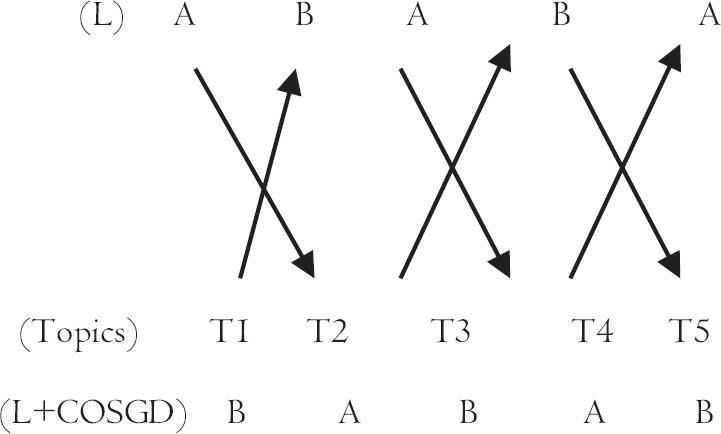
A total of 170 students were taught using both COSGD and didactic lecture in a randomized controlled crossover trial design. Their performance was assessed through multiple-choice questions (MCQs) as part of the formative assessment, and their perception was assessed through Likert scale questionnaire.
The mean difference in the scores between case-oriented group discussions with lecture and didactic lecture showed significant difference only in few topics. Around 94-96% of students perceived COSGD with didactic lecture help them understand theory better; 76-92% of students feel more comfortable asking questions in a group discussion; 89-98% of students feel such discussions motivate them and 91-100% of students agree that discussions make the subject interesting in the respective years of 2010, 2011 and 2012.
Effectiveness of COSGD in terms of scores through MCQs is comparable to traditional lecture. However, most of the students perceive COSGD help them understand the theory better; co-relate clinically; more motivating and interesting than a traditional lecture. Feasibility in institution needs more time and resources to conduct COSGD within the dental material curriculum.
以案例为导向的小组讨论(COSGD)有助于学生将牙科材料的基础科学知识与临床应用相关联并整合起来。我们在牙科材料课程中使用了COSGD并结合了理论讲授,同时假设就2010年、2011年和2012年班级学生的表现、学生对上述两种教学方法的看法以及可行性而言,以案例为导向的小组讨论比单纯的传统讲授更有效。
在一项随机对照交叉试验设计中,共有170名学生同时接受了COSGD和理论讲授。通过多项选择题(MCQ)作为形成性评估的一部分来评估他们的表现,并通过李克特量表问卷来评估他们的看法。
案例导向小组讨论与理论讲授在分数上的平均差异仅在少数主题上显示出显著差异。在2010年、2011年和2012年,约94%-96%的学生认为COSGD结合理论讲授有助于他们更好地理解理论;76%-92%的学生觉得在小组讨论中提问更自在;89%-98%的学生觉得这样的讨论能激励他们,91%-100%的学生同意讨论使该学科在相应年份更有趣。
通过MCQ在分数方面,COSGD的有效性与传统讲授相当。然而,大多数学生认为COSGD有助于他们更好地理解理论;在临床方面建立关联;比传统讲授更具激励性和趣味性。在机构中实施COSGD在牙科材料课程内需要更多时间和资源。