Bahramian Hoda, Mohebbi Simin Z, Khami Mohammad R, Asadi-Lari Mohsen, Shamshiri Ahmad R, Hessari Hossein
Department of Community Oral Health, School of Dentistry, Tehran University of Medical Sciences, Tehran, Iran.
Research Center for Caries Prevention, Dental Research Institute, Department of Community Oral Health, School of Dentistry, Tehran University of Medical Sciences, Tehran, Iran.
Eur J Dent. 2015 Oct-Dec;9(4):542-550. doi: 10.4103/1305-7456.172622.
To evaluate the association between dental service utilization and mental health in an adult population in the context of the socioeconomic status of the participants.
Multi-stage cluster random sampling was performed in Tehran, Iran, in 2011. Data were collected on dental service utilization, barriers of dental visit, self-perceived oral health, mental health, age, gender, education, and wealth status. The complex sample analysis method in SPSS and the survey data analysis menu in STATA were employed for statistical evaluation.
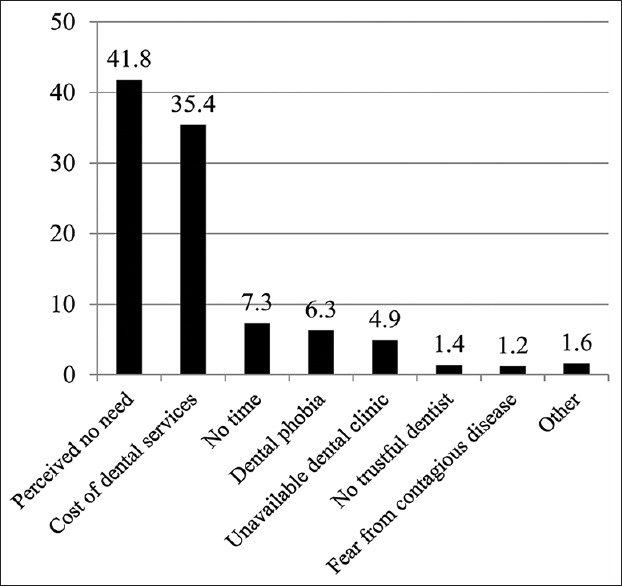
Of 20,320 participants, 25-36% suffered from disorders in at least one of the domains of somatization, anxiety, social dysfunction, and depression. Only 56% of the participants visited a dentist at least once during the last year. The main barriers to a dental visit were "no perceived need" and "high costs." Females, the richest participants, subjects aged 25-64-year-old, and those with poor self-perceived oral health, mental health disorders, and higher education had more visits. The participants who perceived the need but did not visit a dentist due to some reasons mostly comprised females, those aged 25-44-year-old, those with a poor perceived oral health, disordered people in all domains of mental health, and poorer participants.
Dental service utilization was influenced by socioeconomic factors and the mental health status of the adult population after controlling for multiple confounders. Reducing financial hardship and providing health education on the importance of preventive visits may decrease barriers to regular visits in countries with developing oral health systems.
在参与者社会经济地位的背景下,评估成年人群牙科服务利用与心理健康之间的关联。
2011年在伊朗德黑兰进行多阶段整群随机抽样。收集了有关牙科服务利用、看牙障碍、自我感知的口腔健康、心理健康、年龄、性别、教育程度和财富状况的数据。采用SPSS中的复杂样本分析方法和STATA中的调查数据分析菜单进行统计评估。
在20320名参与者中,25% - 36%的人在躯体化、焦虑、社会功能障碍和抑郁至少一个领域存在障碍。在过去一年中,只有56%的参与者至少看过一次牙医。看牙的主要障碍是“无感知需求”和“费用高”。女性、最富有的参与者、年龄在25 - 64岁的人群、自我感知口腔健康差、有心理健康障碍和受过高等教育的人看牙次数更多。那些有需求但因某些原因未看牙医的参与者大多包括女性、年龄在25 - 44岁的人群、自我感知口腔健康差的人、所有心理健康领域有障碍的人以及较贫困的参与者。
在控制多个混杂因素后,成年人群的牙科服务利用受社会经济因素和心理健康状况的影响。在口腔卫生系统发展中的国家,减少经济困难并提供关于预防性就诊重要性的健康教育可能会减少定期就诊的障碍。