Zhang Bo, Song Yi, Jin Jie, Zhou Li-Qun, He Zhi-Song, Shen Cheng, He Qun, Li Jun, Liu Li-Bo, Wang Cong, Chen Xiao-Yu, Fan Yu, Hu Shuai, Zhang Lei, Yu Wei, Han Wen-Ke
Department of Urology, Peking University First Hospital, Beijing, People's Republic of China.
Institute of Urology, Peking University, Beijing, People's Republic of China.
PLoS One. 2016 Mar 1;11(3):e0150193. doi: 10.1371/journal.pone.0150193. eCollection 2016.
Increased plasma fibrinogen is thought to contribute to tumor progression and metastasis. The association of plasma fibrinogen with clinicopathological characteristics, and the optimal cutoff with an ideal predictive value has not been fully determined in patients with upper tract urothelial carcinoma (UTUC). We aimed to investigate the clinical significance of this parameter in a Chinese cohort of patients with UTUC.
A retrospective study was conducted to analyze the clinical data of 184 operable UTUC patients in a Chinese cohort with a high incidence of chronic kidney disease (CKD). An optimal cutoff was set for further analysis according to validated web-based software. The associations of plasma fibrinogen with clinicopathological characteristics and survival were assessed. Multivariate analyses were performed to determine the independent prognostic factors.
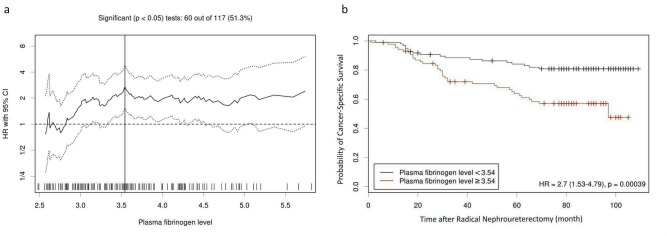
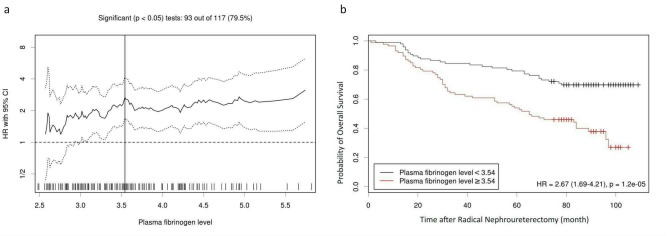
Elevated plasma fibrinogen was significantly associated with tumor necrosis, lymph node involvement, and a higher preoperative CKD stage, pathological tumor stage and grade (all P < 0.05). Kaplan-Meier analysis showed that plasma fibrinogen ≥ 3.54 g/L predicted a poorer overall and cancer-specific survival than < 3.54 g/L (P < 0.001 for both). Multivariate analyses revealed that elevated preoperative plasma fibrinogen was an independent negative prognostic factor for overall survival (HR = 2.026; 95% CI: 1.226-3.349; P = 0.006) and cancer-specific survival (HR = 1.886; 95% CI: 1.019-3.490; P = 0.043).
Increased plasma fibrinogen was an independent prognostic risk factor for poor outcomes in UTUC. This parameter may serve as an effective biomarker with easy accessibility for evaluating prognosis for patients with UTUC.
血浆纤维蛋白原升高被认为与肿瘤进展和转移有关。在上尿路尿路上皮癌(UTUC)患者中,血浆纤维蛋白原与临床病理特征的关联以及具有理想预测价值的最佳临界值尚未完全确定。我们旨在研究这一参数在中国UTUC患者队列中的临床意义。
进行一项回顾性研究,分析中国一个慢性肾脏病(CKD)高发队列中184例可手术的UTUC患者的临床资料。根据经过验证的基于网络的软件设定最佳临界值以进行进一步分析。评估血浆纤维蛋白原与临床病理特征及生存的关联。进行多因素分析以确定独立的预后因素。
血浆纤维蛋白原升高与肿瘤坏死、淋巴结受累以及术前更高的CKD分期、病理肿瘤分期和分级显著相关(所有P<0.05)。Kaplan-Meier分析显示,血浆纤维蛋白原≥3.54 g/L预测的总生存和癌症特异性生存比<3.54 g/L更差(两者均P<0.001)。多因素分析显示,术前血浆纤维蛋白原升高是总生存(HR = 2.026;95%CI:1.226 - 3.349;P = 0.006)和癌症特异性生存(HR = 1.886;95%CI:1.019 - 3.490;P = 0.043)的独立负性预后因素。
血浆纤维蛋白原升高是UTUC患者预后不良的独立预后危险因素。该参数可作为一种易于获取的有效生物标志物,用于评估UTUC患者的预后。