Tian Yuejun, Gong Yuwen, Pang Yangyang, Wang Zhiping, Hong Mei
Institute of Urology, Lanzhou University Second Hospital, Lanzhou University, Lanzhou, Gansu, China.
Drug Discovery Center, School of chemical Biology and Biotechnology, Peking Universtiy Shenzhen Graduate School, Shenzhen, Guangdong, China.
PeerJ. 2016 Jun 21;4:e2144. doi: 10.7717/peerj.2144. eCollection 2016.
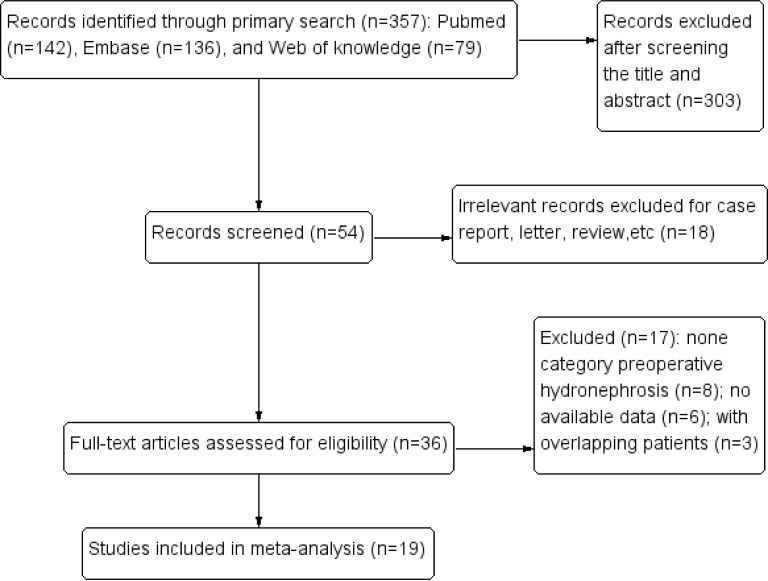
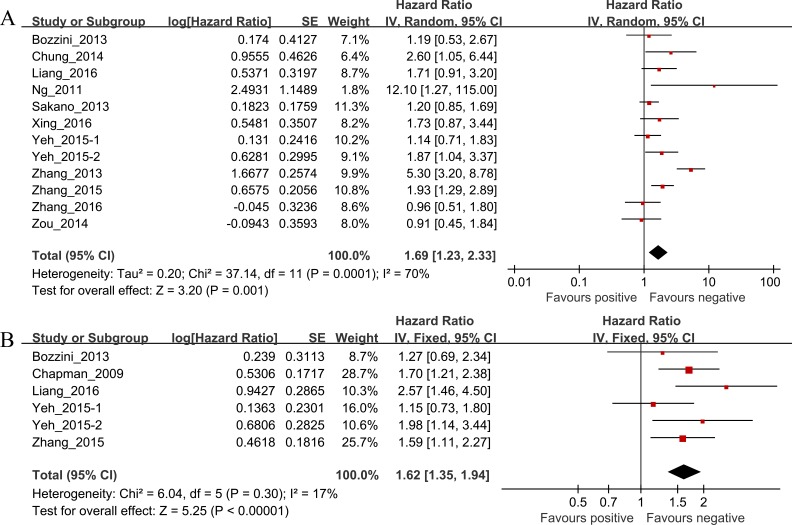
Background. Epidemiological studies have reported various results relating preoperative hydronephrosis to upper tract urothelial carcinoma (UTUC). However, the clinical significance and prognostic value of preoperative hydronephrosis in UTUC remains controversial. The aim of this study was to provide a comprehensive meta-analysis of the extent of the possible association between preoperative hydronephrosis and the risk of UTUC. Methods. We searched PubMed, ISI Web of Knowledge, and Embase to identify eligible studies written in English. Summary odds ratios (ORs) or hazard ratios (HRs) and 95% confidence intervals (CIs) were calculated using fixed-effects or random-effects models. Results. Nineteen relevant studies, which had a total of 5,782 UTUC patients enrolled, were selected for statistical analysis. The clinicopathological and prognostic relevance of preoperative hydronephrosis was evaluated in the UTUC patients. The results showed that all tumor stages, lymph node status and tumor location, as well as the risk of cancer-specific survival (CSS), overall survival (OS), recurrence-free survival (RFS) and metastasis-free survival (MFS) were significantly different between UTUC patients with elevated preoperative hydronephrosis and those with low preoperative hydronephrosis. High preoperative hydronephrosis indicated a poor prognosis. Additionally, significant correlations between preoperative hydronephrosis and tumor grade (high grade vs. low grade) were observed in UTUC patients; however, no significant difference was observed for tumor grading (G1 vs. G2 + G3 and G1 + G2 vs. G3). In contrast, no such correlations were evident for recurrence status or gender in UTUC patients. Conclusions. The results of this meta-analysis suggest that preoperative hydronephrosis is associated with increased risk and poor survival in UTUC patients. The presence of preoperative hydronephrosis plays an important role in the carcinogenesis and prognosis of UTUC.
背景。流行病学研究报告了术前肾积水与上尿路尿路上皮癌(UTUC)之间的各种相关结果。然而,术前肾积水在UTUC中的临床意义和预后价值仍存在争议。本研究的目的是对术前肾积水与UTUC风险之间可能存在的关联程度进行全面的荟萃分析。方法。我们检索了PubMed、ISI Web of Knowledge和Embase,以识别用英文撰写的符合条件的研究。使用固定效应或随机效应模型计算汇总比值比(OR)或风险比(HR)以及95%置信区间(CI)。结果。选取了19项相关研究,共纳入5782例UTUC患者进行统计分析。对UTUC患者术前肾积水的临床病理和预后相关性进行了评估。结果显示,术前肾积水程度较高的UTUC患者与术前肾积水程度较低的患者相比,在所有肿瘤分期、淋巴结状态和肿瘤位置以及癌症特异性生存(CSS)、总生存(OS)、无复发生存(RFS)和无转移生存(MFS)风险方面均存在显著差异。术前肾积水程度高表明预后不良。此外,在UTUC患者中观察到术前肾积水与肿瘤分级(高级别与低级别)之间存在显著相关性;然而,在肿瘤分级方面未观察到显著差异(G1与G2 + G3以及G1 + G2与G3)。相比之下,UTUC患者的复发状态或性别方面未发现此类相关性。结论。本荟萃分析结果表明,术前肾积水与UTUC患者风险增加和生存不良相关。术前肾积水的存在在UTUC的致癌作用和预后中起重要作用。