Murali Karthik, Kang Dongyang, Nazari Hossein, Scianmarello Nicholas, Cadenas Enrique, Tai Yu-Chong, Kashani Amir, Humayun Mark
Department of Biomedical engineering, University of Southern California, Los Angeles, California, United States of America.
Department of Electrical Engineering, California Institute of Technology, Pasadena, California, United States of America.
PLoS One. 2016 Mar 1;11(3):e0149961. doi: 10.1371/journal.pone.0149961. eCollection 2016.
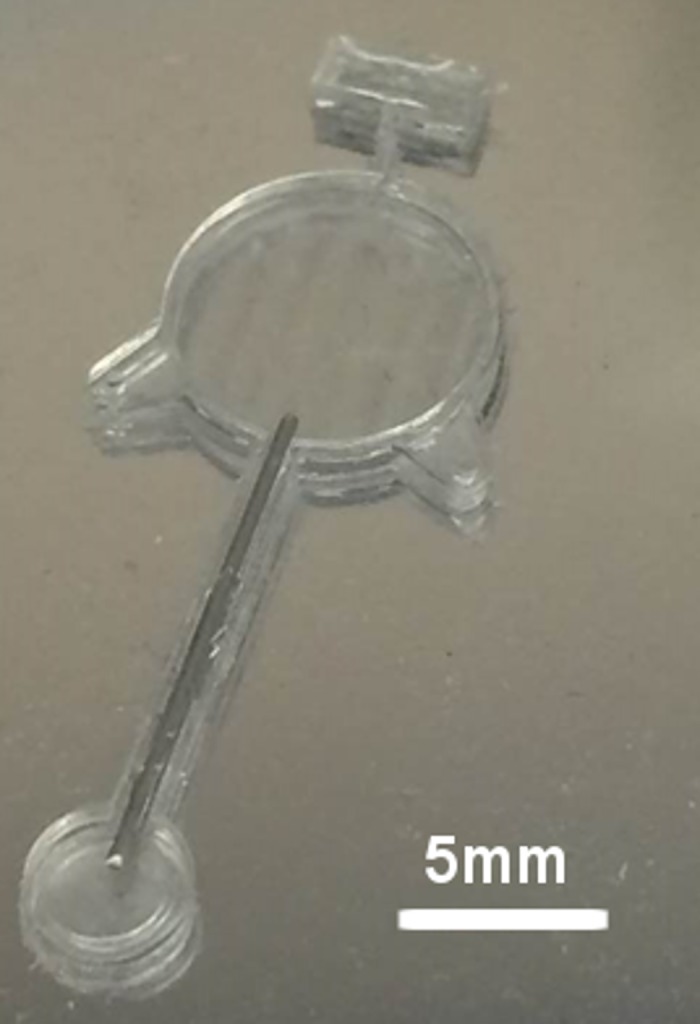
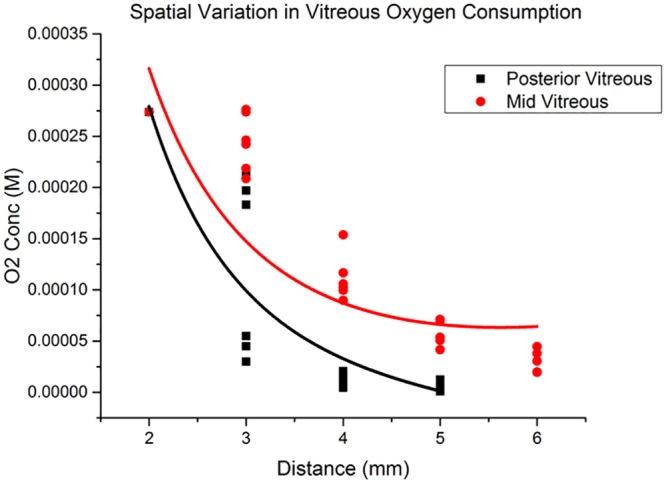
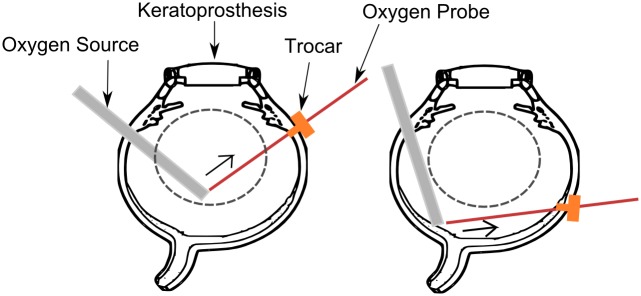
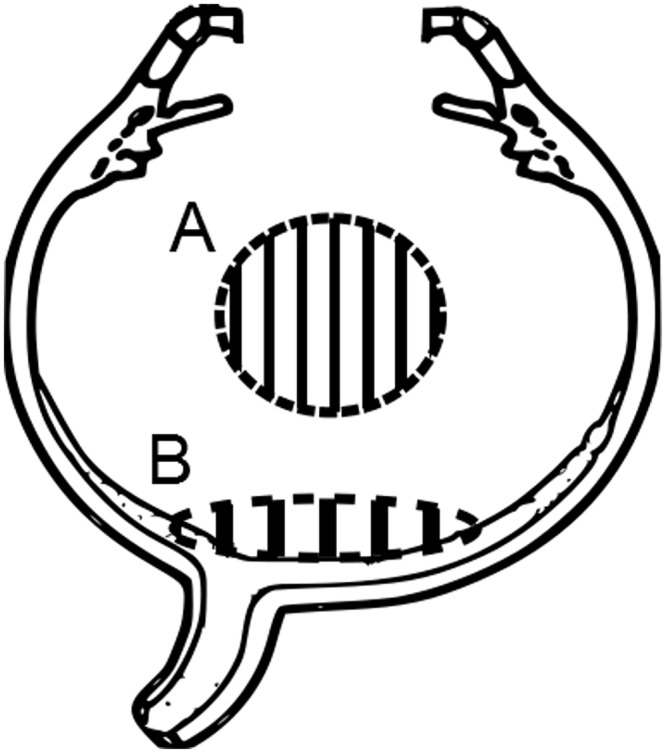
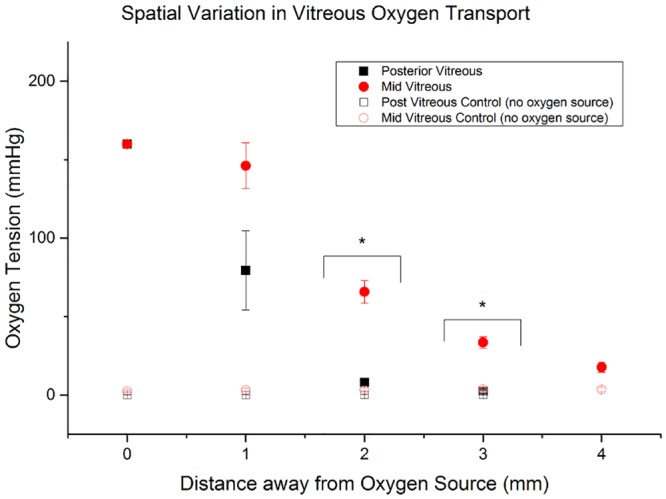
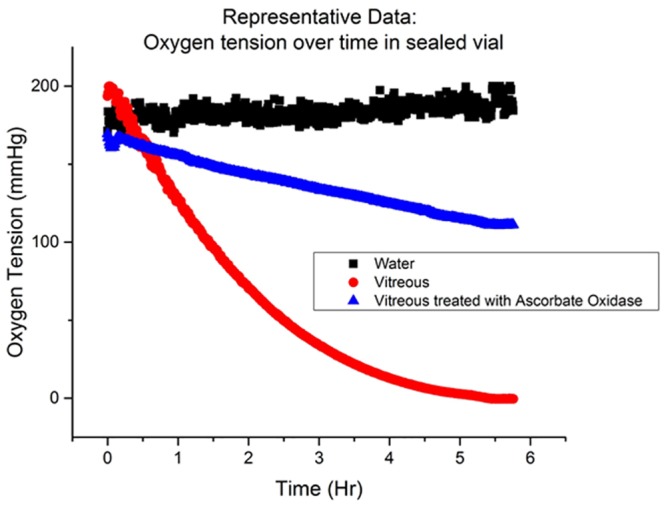
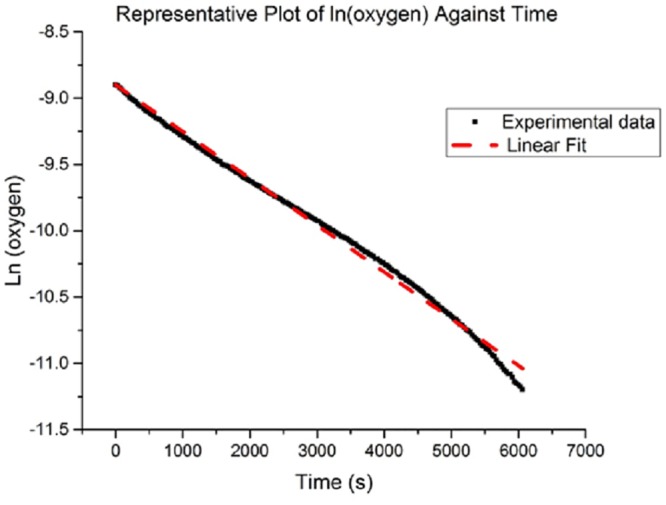
We investigated the spatial variation of vitreous oxygen consumption in enucleated porcine eyes. A custom made oxygen source was fabricated that could be localized to either the mid or posterior vitreous cavity and steady state vitreous oxygen tension was measured as a function of distance from the source using a commercially available probe. The reaction rate constant of ascorbate oxidation was estimated ex vivo by measuring the change in oxygen tension over time using vitreous harvested from porcine eyes. Vitreous ascorbate from mid and posterior vitreous was measured spectrophotometrically. When the oxygen source was placed in either the mid-vitreous (N = 6) or the posterior vitreous (N = 6), we measured a statistically significant decrease in vitreous oxygen tension as a function of distance from the oxygen source when compared to control experiments without an oxygen source; (p<0.005 for mid-vitreous and p<0.018 for posterior vitreous at all distances). The mid-vitreous oxygen tension change was significantly different from the posterior vitreous oxygen tension change at 2 and 3mm distances from the respective oxygen source (p<0.001). We also found a statistically significant lower concentration of ascorbate in the mid-vitreous as compared to posterior vitreous (p = 0.02). We determined the reaction rate constant, k = 1.61 M(-1) s(-1) ± 0.708 M(-1) s(-1) (SE), of the oxidation of ascorbate which was modeled following a second order rate equation. Our data demonstrates that vitreous oxygen consumption is higher in the posterior vitreous compared to the mid-vitreous. We also show spatial variations in vitreous ascorbate concentration.
我们研究了摘除的猪眼中玻璃体氧消耗的空间变化。制作了一种定制的氧源,该氧源可定位在玻璃体腔中部或后部,使用市售探头测量稳态玻璃体氧张力随距该源距离的变化。通过测量从猪眼中采集的玻璃体随时间的氧张力变化,在体外估计抗坏血酸氧化的反应速率常数。用分光光度法测量玻璃体腔中部和后部的玻璃体抗坏血酸含量。当将氧源置于玻璃体腔中部(N = 6)或后部(N = 6)时,与无氧源的对照实验相比,我们测量到玻璃体氧张力随距氧源距离增加而出现统计学上的显著降低;(在所有距离处,玻璃体腔中部p<0.005,玻璃体腔后部p<0.018)。在距各自氧源2毫米和3毫米处,玻璃体腔中部的氧张力变化与玻璃体腔后部的氧张力变化显著不同(p<0.001)。我们还发现,与玻璃体腔后部相比,玻璃体腔中部抗坏血酸浓度在统计学上显著较低(p = 0.02)。我们确定了抗坏血酸氧化的反应速率常数k = 1.61 M(-1) s(-1) ± 0.708 M(-1) s(-1)(标准误),该反应遵循二级速率方程进行建模。我们的数据表明,与玻璃体腔中部相比,玻璃体腔后部的玻璃体氧消耗更高。我们还展示了玻璃体抗坏血酸浓度的空间变化。