Jiménez Daniel, Dorado Hugo, Cock James, Prager Steven D, Delerce Sylvain, Grillon Alexandre, Andrade Bejarano Mercedes, Benavides Hector, Jarvis Andy
Decision and Policy Analysis (DAPA), International Center for Tropical Agriculture (CIAT), Cali, Colombia.
University of Applied Sciences of Western Switzerland (HEIG-VD), Yverdon-les-bains, Switzerland.
PLoS One. 2016 Mar 1;11(3):e0150015. doi: 10.1371/journal.pone.0150015. eCollection 2016.
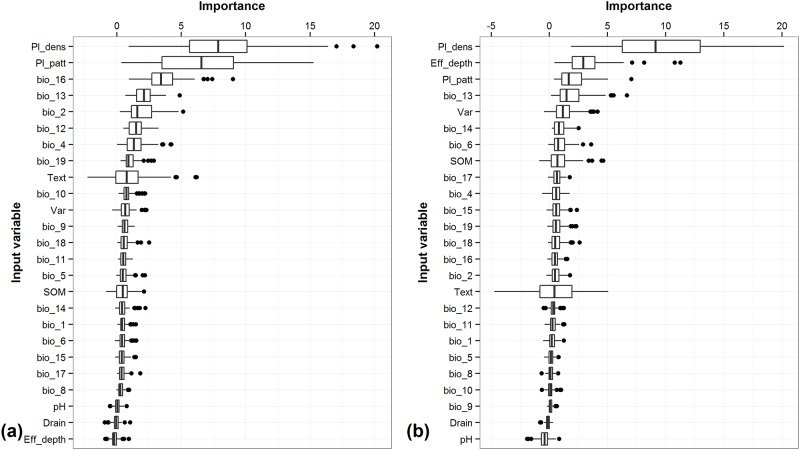
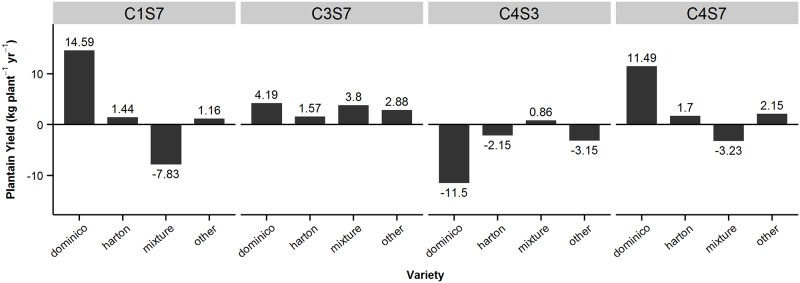
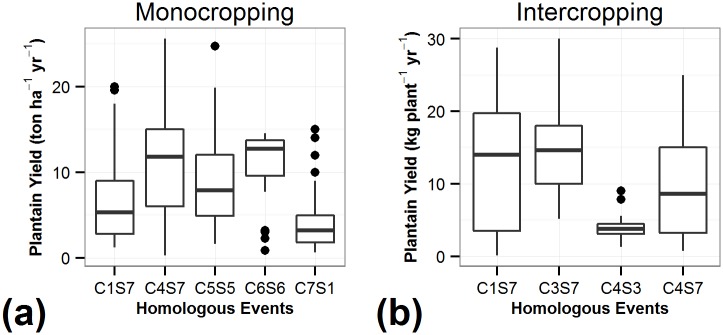
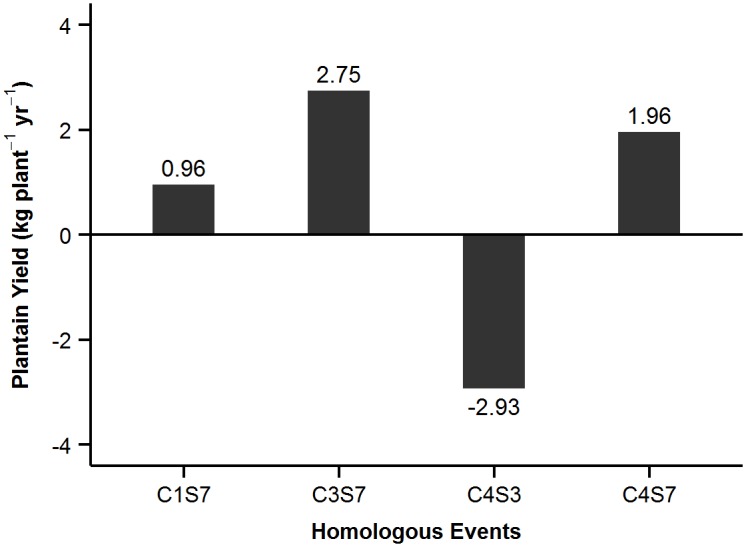
Agriculture research uses "recommendation domains" to develop and transfer crop management practices adapted to specific contexts. The scale of recommendation domains is large when compared to individual production sites and often encompasses less environmental variation than farmers manage. Farmers constantly observe crop response to management practices at a field scale. These observations are of little use for other farms if the site and the weather are not described. The value of information obtained from farmers' experiences and controlled experiments is enhanced when the circumstances under which it was generated are characterized within the conceptual framework of a recommendation domain, this latter defined by Non-Controllable Factors (NCFs). Controllable Factors (CFs) refer to those which farmers manage. Using a combination of expert guidance and a multi-stage analytic process, we evaluated the interplay of CFs and NCFs on plantain productivity in farmers' fields. Data were obtained from multiple sources, including farmers. Experts identified candidate variables likely to influence yields. The influence of the candidate variables on yields was tested through conditional forests analysis. Factor analysis then clustered harvests produced under similar NCFs, into Homologous Events (HEs). The relationship between NCFs, CFs and productivity in intercropped plantain were analyzed with mixed models. Inclusion of HEs increased the explanatory power of models. Low median yields in monocropping coupled with the occasional high yields within most HEs indicated that most of these farmers were not using practices that exploited the yield potential of those HEs. Varieties grown by farmers were associated with particular HEs. This indicates that farmers do adapt their management to the particular conditions of their HEs. Our observations confirm that the definition of HEs as recommendation domains at a small-scale is valid, and that the effectiveness of distinct management practices for specific micro-recommendation domains can be identified with the methodologies developed.
农业研究使用“推荐域”来开发和推广适用于特定环境的作物管理实践。与单个生产地点相比,推荐域的规模较大,而且其涵盖的环境变化通常比农民管理的要少。农民在田间尺度上持续观察作物对管理实践的反应。如果不描述地点和天气情况,这些观察结果对其他农场几乎没有用处。当从农民经验和对照试验中获得的信息所产生的环境条件在由不可控因素(NCFs)定义的推荐域概念框架内得到描述时,这些信息的价值就会提高。可控因素(CFs)指的是农民能够控制的因素。通过结合专家指导和多阶段分析过程,我们评估了可控因素和不可控因素对农民田间大蕉生产力的相互作用。数据来自多个来源,包括农民。专家们确定了可能影响产量的候选变量。通过条件森林分析测试了候选变量对产量的影响。然后,因子分析将在相似不可控因素下产生的收成聚类为同源事件(HEs)。使用混合模型分析了间作大蕉中不可控因素、可控因素与生产力之间的关系。纳入同源事件提高了模型的解释力。单作时的中位数产量较低,而大多数同源事件中偶尔出现高产量,这表明这些农民中的大多数没有采用能够挖掘这些同源事件产量潜力的做法。农民种植的品种与特定的同源事件相关。这表明农民确实会根据其同源事件的特定条件调整管理方式。我们的观察结果证实,将同源事件定义为小规模的推荐域是有效的,并且可以用所开发的方法确定针对特定微观推荐域的不同管理实践的有效性。