Greifzu Franziska, Parthier Daniel, Goetze Bianka, Schlüter Oliver M, Löwel Siegrid
Systems Neuroscience, Bernstein Fokus Neurotechnologie, Johann-Friedrich-Blumenbach-Institut für Zoologie und Anthropologie, Georg-August-Universität, Göttingen, Germany.
European Neuroscience Institute Göttingen, Göttingen, Germany.
PLoS One. 2016 Mar 1;11(3):e0149771. doi: 10.1371/journal.pone.0149771. eCollection 2016.
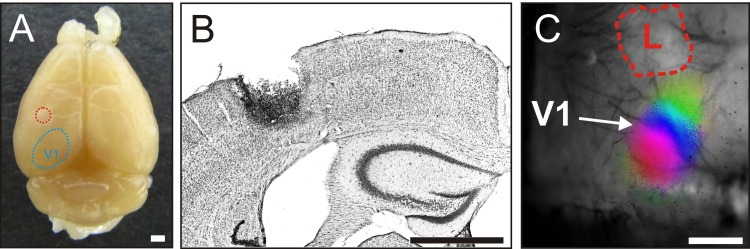
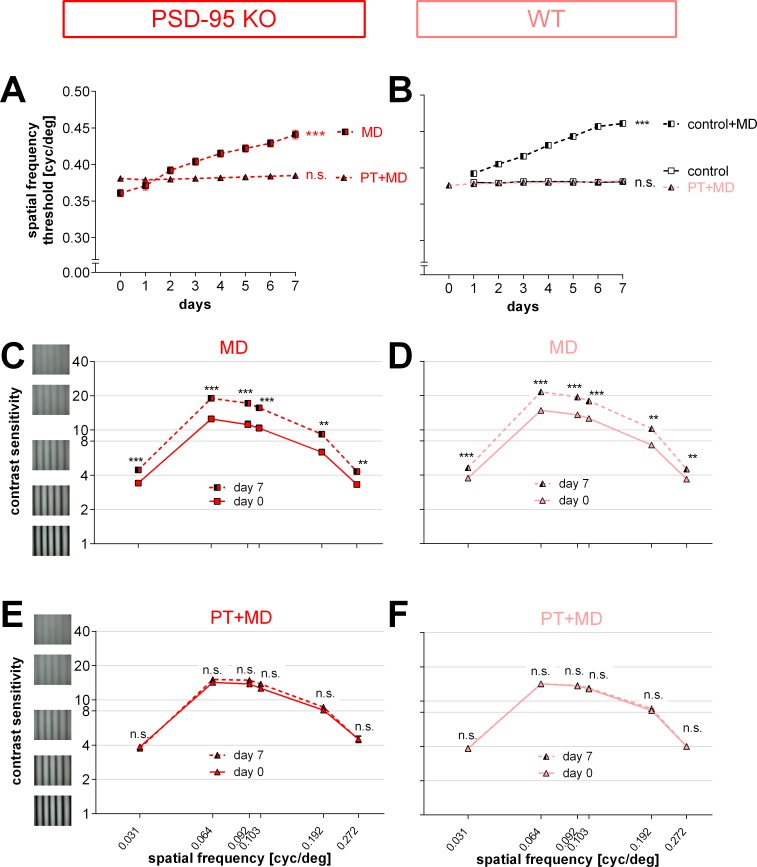
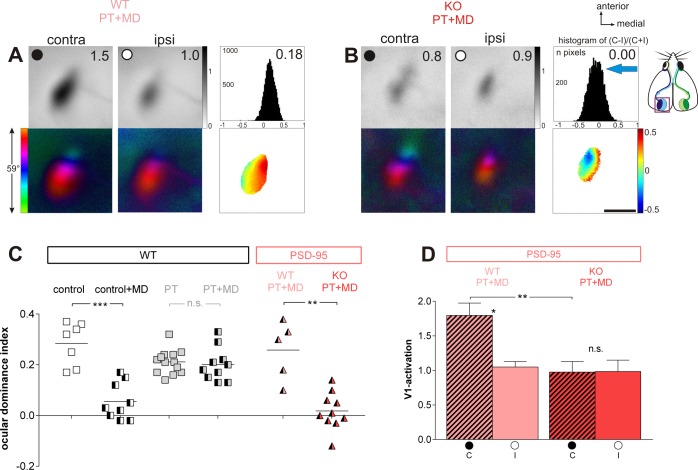
Neuronal plasticity is essential to enable rehabilitation when the brain suffers from injury, such as following a stroke. One of the most established models to study cortical plasticity is ocular dominance (OD) plasticity in the primary visual cortex (V1) of the mammalian brain induced by monocular deprivation (MD). We have previously shown that OD-plasticity in adult mouse V1 is absent after a photothrombotic (PT) stroke lesion in the adjacent primary somatosensory cortex (S1). Exposing lesioned mice to conditions which reduce the inhibitory tone in V1, such as raising animals in an enriched environment or short-term dark exposure, preserved OD-plasticity after an S1-lesion. Here we tested whether modification of excitatory circuits can also be beneficial for preserving V1-plasticity after stroke. Mice lacking postsynaptic density protein-95 (PSD-95), a signaling scaffold present at mature excitatory synapses, have lifelong juvenile-like OD-plasticity caused by an increased number of AMPA (α-amino-3-hydroxy-5-methyl-4-isoxazolepropionic acid) -silent synapses in V1 but unaltered inhibitory tone. In fact, using intrinsic signal optical imaging, we show here that OD-plasticity was preserved in V1 of adult PSD-95 KO mice after an S1-lesion but not in PSD-95 wildtype (WT)-mice. In addition, experience-enabled enhancement of the optomotor reflex of the open eye after MD was compromised in both lesioned PSD-95 KO and PSD-95 WT mice. Basic V1-activation and retinotopic map quality were, however, not different between lesioned PSD-95 KO mice and their WT littermates. The preserved OD-plasticity in the PSD-95 KO mice indicates that V1-plasticity after a distant stroke can be promoted by either changes in excitatory circuitry or by lowering the inhibitory tone in V1 as previously shown. Furthermore, the present data indicate that an increased number of AMPA-silent synapses preserves OD-plasticity not only in the healthy brain, but also in another experimental paradigm of cortical plasticity, namely the long-range influence on V1-plasticity after an S1-lesion.
当大脑遭受损伤时,如中风后,神经元可塑性对于实现康复至关重要。研究皮质可塑性最成熟的模型之一是哺乳动物大脑初级视觉皮层(V1)中的眼优势(OD)可塑性,它由单眼剥夺(MD)诱导产生。我们之前已经表明,在相邻的初级体感皮层(S1)发生光血栓形成(PT)性中风损伤后,成年小鼠V1中的OD可塑性消失。将受损小鼠置于能降低V1抑制性张力的条件下,如在丰富环境中饲养动物或短期黑暗暴露,可在S1损伤后保留OD可塑性。在这里,我们测试了兴奋性回路的改变是否也有利于中风后保留V1可塑性。缺乏突触后致密蛋白95(PSD - 95)的小鼠,PSD - 95是成熟兴奋性突触处存在的一种信号支架,由于V1中AMPA(α - 氨基 - 3 - 羟基 - 5 - 甲基 - 4 - 异恶唑丙酸)沉默突触数量增加,具有终生类似幼年的OD可塑性,但抑制性张力未改变。事实上,使用内在信号光学成像,我们在此表明,成年PSD - 95基因敲除(KO)小鼠在S1损伤后V1中的OD可塑性得以保留,而在PSD - 95野生型(WT)小鼠中则不然。此外,在MD后,受损的PSD - 95 KO小鼠和PSD - 95 WT小鼠中,睁眼的视动反射的经验性增强均受到损害。然而,受损的PSD - 95 KO小鼠与其WT同窝小鼠之间,基本的V1激活和视网膜拓扑图质量并无差异。PSD - 95 KO小鼠中保留的OD可塑性表明,远处中风后的V1可塑性可通过兴奋性回路的变化或如先前所示降低V1中的抑制性张力来促进。此外,目前的数据表明,AMPA沉默突触数量的增加不仅在健康大脑中保留OD可塑性,而且在另一种皮质可塑性实验范式中,即在S1损伤后对V1可塑性的远程影响中也能保留OD可塑性。