Liu Xiaochun, Kambrick Susan, Fu Siqing, Naing Aung, Subbiah Vivek, Blumenschein George R, Glisson Bonnie S, Kies Merrill S, Tsimberidou Apostolia M, Wheler Jennifer J, Zinner Ralph G, Hong David S, Kurzrock Razelle, Piha-Paul Sarina A
Department of Investigational Cancer Therapeutics, University of Texas, MD Anderson Cancer Center, Houston, Texas, USA.
Department of Thoracic/Head & Neck Medical Oncology, University of Texas, MD Anderson Cancer Center, Houston, TX, USA.
Oncotarget. 2016 Apr 26;7(17):23227-38. doi: 10.18632/oncotarget.7594.
Bevacizumab and temsirolimus are active agents in advanced solid tumors. Temsirolimus inhibits mTOR in the PI3 kinase/AKT/mTOR pathway as well as CYP2A, which may be a resistance mechanism for cetuximab. In addition, temsirolimus attenuates upregulation of HIF-1α levels, which may be a resistance mechanism for bevacizumab.
We analyzed safety and responses in 21 patients with advanced solid tumors treated with bevacizumab, cetuximab, and temsirolimus.
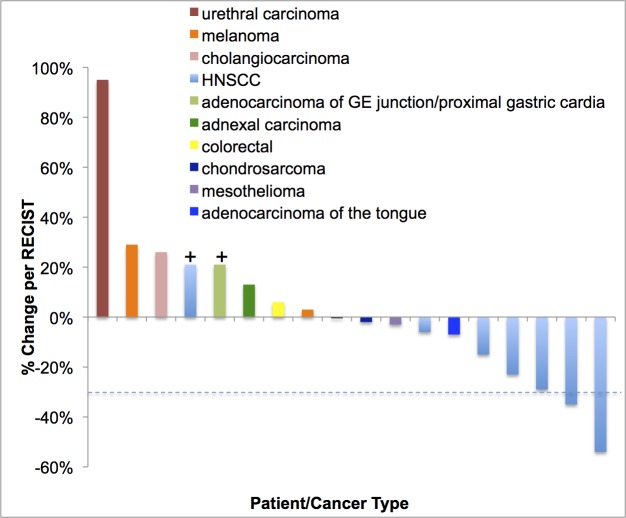
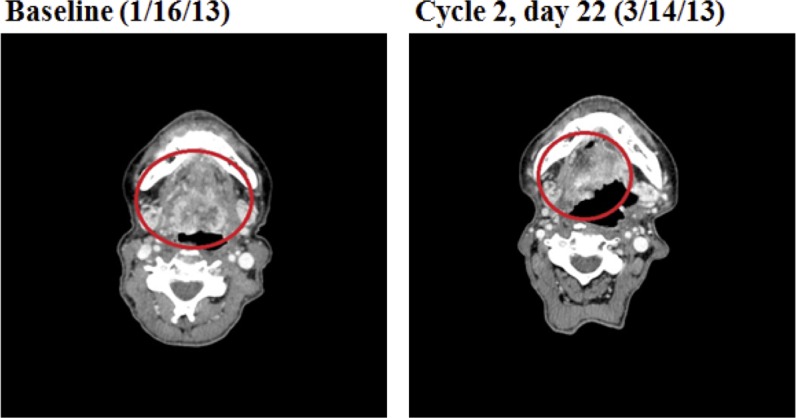
The median age of patients was 60 years (range, 23-80 years). The median number of prior systemic therapies was 3 (range, 1-6). The maximum tolerated dose (MTD) was determined to be bevacizumab 10 mg/kg biweekly, temsirolimus 5 mg weekly and cetuximab 100/75 mg/m2 weekly. Grade 3 or 4 toxicities were seen in 52% of patients with the highest prevalence being hyperglycemia (14%) and hypophosphatemia (14%). Eighteen of the 21 patients were evaluable for response. Three patients were taken off the study before restaging for toxicities. Partial response (PR) was observed in 2/18 patients (11%) and stable disease (SD) lasting ≥ 6 months was observed in 4/18 patients (22%) (total = 6/18 (33%)). In 8 evaluable patients with squamous cell carcinoma of the head and neck (HNSCC) there were partial responses in 2/8 (25%) patients and SD ≥ 6 months in 1/8 (13%) patients (total = 3/8, (38%)).
The combination of bevacizumab, cetuximab, and temsirolimus showed activity in HNSCC; however, there were numerous toxicities reported, which will require careful management for future clinical development.
贝伐单抗和替西罗莫司是晚期实体瘤的有效药物。替西罗莫司可抑制PI3激酶/AKT/mTOR通路中的mTOR以及CYP2A,这可能是西妥昔单抗的耐药机制。此外,替西罗莫司可减弱HIF-1α水平的上调,这可能是贝伐单抗的耐药机制。
我们分析了21例接受贝伐单抗、西妥昔单抗和替西罗莫司治疗的晚期实体瘤患者的安全性和反应。
患者的中位年龄为60岁(范围23 - 80岁)。既往全身治疗的中位次数为3次(范围1 - 6次)。确定的最大耐受剂量(MTD)为贝伐单抗每两周10 mg/kg、替西罗莫司每周5 mg以及西妥昔单抗每周100/75 mg/m²。52%的患者出现3级或4级毒性,其中最常见的是高血糖(14%)和低磷血症(14%)。21例患者中有18例可评估反应。3例患者因毒性在重新分期前退出研究。2/18例患者(11%)观察到部分缓解(PR),4/18例患者(22%)观察到持续≥6个月的疾病稳定(SD)(总计6/18,33%)。在8例可评估的头颈部鳞状细胞癌(HNSCC)患者中,2/8例患者(25%)出现部分缓解,1/8例患者(13%)出现SD≥6个月(总计3/8,38%)。
贝伐单抗、西妥昔单抗和替西罗莫司联合用药在HNSCC中显示出活性;然而,报告了许多毒性反应,这将需要在未来的临床开发中进行仔细管理。