Cancer Biology Laboratory and DBT-AIST International Center for Translational and Environmental Research (DAICENTER), Department of Biosciences and Bioengineering, Indian Institute of Technology Guwahati, Assam 781039, India.
Department of Pharmacology, Yong Loo Lin School of Medicine, National University of Singapore, Singapore 117600, Singapore.
Int J Mol Sci. 2020 May 6;21(9):3285. doi: 10.3390/ijms21093285.
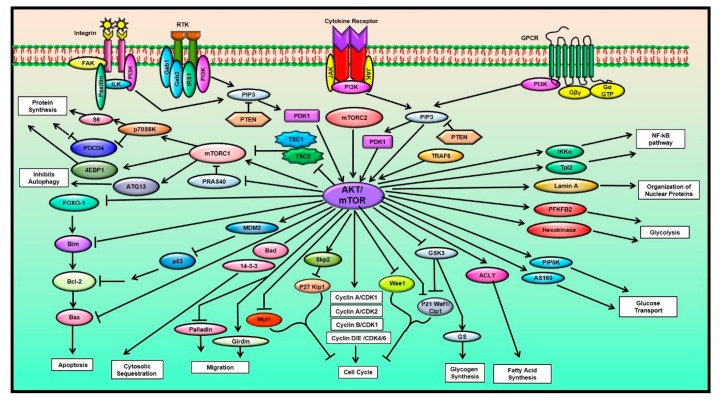
Oral cancer (OC) is a devastating disease that takes the lives of lots of people globally every year. The current spectrum of treatment modalities does not meet the needs of the patients. The disease heterogeneity demands personalized medicine or targeted therapies. Therefore, there is an urgent need to identify potential targets for the treatment of OC. Abundant evidence has suggested that the components of the protein kinase B (AKT)/ mammalian target of rapamycin (mTOR) pathway are intrinsic factors for carcinogenesis. The AKT protein is central to the proliferation and survival of normal and cancer cells, and its downstream protein, mTOR, also plays an indispensable role in the cellular processes. The wide involvement of the AKT/mTOR pathway has been noted in oral squamous cell carcinoma (OSCC). This axis significantly regulates the various hallmarks of cancer, like proliferation, survival, angiogenesis, invasion, metastasis, autophagy, and epithelial-to-mesenchymal transition (EMT). Activated AKT/mTOR signaling is also associated with circadian signaling, chemoresistance and radio-resistance in OC cells. Several miRNAs, circRNAs and lncRNAs also modulate this pathway. The association of this axis with the process of tumorigenesis has culminated in the identification of its specific inhibitors for the prevention and treatment of OC. In this review, we discussed the significance of AKT/mTOR signaling in OC and its potential as a therapeutic target for the management of OC. This article also provided an update on several AKT/mTOR inhibitors that emerged as promising candidates for therapeutic interventions against OC/head and neck cancer (HNC) in clinical studies.
口腔癌(OC)是一种毁灭性疾病,每年在全球夺走许多人的生命。目前的治疗方式不能满足患者的需求。疾病的异质性要求采用个性化药物或靶向治疗。因此,迫切需要确定治疗 OC 的潜在靶点。大量证据表明,蛋白激酶 B(AKT)/哺乳动物雷帕霉素靶蛋白(mTOR)途径的成分是致癌作用的内在因素。AKT 蛋白是正常和癌细胞增殖和存活的核心,其下游蛋白 mTOR 在细胞过程中也起着不可或缺的作用。AKT/mTOR 途径的广泛参与已在口腔鳞状细胞癌(OSCC)中得到注意。该轴显著调节癌症的各种特征,如增殖、存活、血管生成、侵袭、转移、自噬和上皮-间充质转化(EMT)。OC 细胞中 AKT/mTOR 信号的激活也与昼夜信号、化疗耐药和放射耐药有关。几种 miRNA、circRNAs 和 lncRNAs 也调节该途径。该轴与肿瘤发生过程的关联最终确定了其特异性抑制剂,用于预防和治疗 OC。在这篇综述中,我们讨论了 AKT/mTOR 信号在 OC 中的意义及其作为 OC 管理治疗靶点的潜力。本文还介绍了几种 AKT/mTOR 抑制剂的最新进展,这些抑制剂在临床研究中作为针对 OC/头颈部癌症(HNC)的治疗干预的有前途的候选药物出现。