Hassanzadeh Jafar, Asadi-Lari Mohsen, Baghbanian Abdolvahab, Ghaem Haleh, Kassani Aziz, Rezaianzadeh Abbas
Aziz Kassani, Department of Epidemiology, School of Health, Shiraz University of Medical Sciences, Shiraz, Iran,
Croat Med J. 2016 Feb;57(1):58-65. doi: 10.3325/cmj.2016.57.58.
To explore the association(s) between demographic factors, socioeconomic status (SES), social capital, health-related quality of life (HRQoL), and mental health among residents of Tehran, Iran.
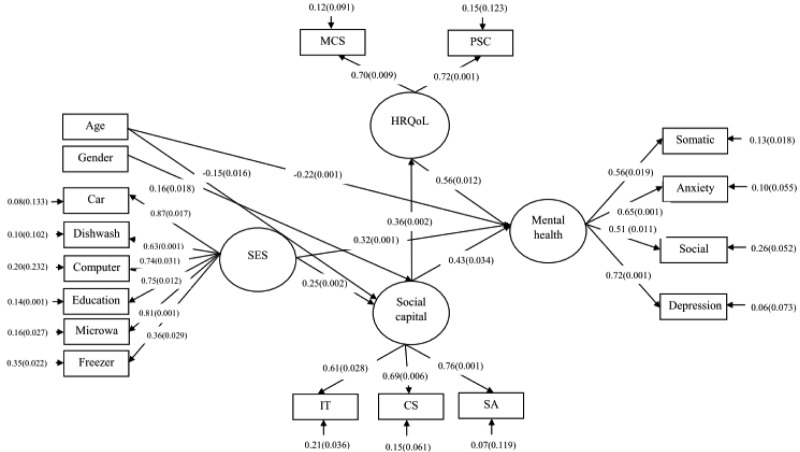
The pooled data (n=31519) were extracted from a population-based survey Urban Health Equity Assessment and Response Tool-2 (Urban HEART-2) conducted in Tehran in 2011. Mental health, social capital, and HRQoL were assessed using the 28-item General Health Questionnaire (GHQ-28), social capital questionnaire, and Short-Form Health Survey (SF-12), respectively. The study used a multistage sampling method. Social capital, HRQoL, and SES were considered as latent variables. The association between these latent variables, demographic factors, and mental health was determined by structural-equation modeling (SEM).
The mean age and mental health score were 44.48±15.87 years and 23.33±11.10 (range, 0-84), respectively. The prevalence of mental disorders was 41.76% (95% confidence interval 41.21-42.30). The SEM model showed that age was directly associated with social capital (P=0.016) and mental health (P=0.001). Sex was indirectly related to mental health through social capital (P=0.018). SES, HRQoL, and social capital were associated both directly and indirectly with mental health status.
This study suggests that changes in social capital and SES can lead to positive changes in mental health status and that individual and contextual determinants influence HRQoL and mental health.
探讨伊朗德黑兰居民的人口统计学因素、社会经济地位(SES)、社会资本、健康相关生活质量(HRQoL)与心理健康之间的关联。
汇总数据(n = 31519)取自2011年在德黑兰进行的一项基于人群的城市健康公平评估与应对工具-2(Urban HEART-2)调查。分别使用28项一般健康问卷(GHQ-28)、社会资本问卷和简短健康调查(SF-12)评估心理健康、社会资本和HRQoL。该研究采用多阶段抽样方法。社会资本、HRQoL和SES被视为潜在变量。通过结构方程模型(SEM)确定这些潜在变量、人口统计学因素与心理健康之间的关联。
平均年龄和心理健康得分分别为44.48±15.87岁和23.33±11.10(范围0 - 84)。精神障碍患病率为41.76%(95%置信区间41.21 - 42.30)。SEM模型显示年龄与社会资本(P = 0.016)和心理健康(P = 0.001)直接相关。性别通过社会资本与心理健康间接相关(P = 0.018)。SES、HRQoL和社会资本与心理健康状况直接和间接相关。
本研究表明社会资本和SES的变化可导致心理健康状况的积极变化,且个体和环境决定因素影响HRQoL和心理健康。