Nasirpour Nastaran, Jafari Kasra, Habibi Asgarabad Mojtaba, Salehi Masoud, Amin-Esmaeili Masoumeh, Rahimi-Movaghar Afarin, Motevalian Seyed Abbas
Department of Epidemiology, School of Public Health, Iran University of Medical Sciences, Tehran, Iran.
Research Center for Addiction and Risky Behaviors (ReCARB), Psychosocial Health Research Institute, Iran University of Medical Sciences, Tehran, Iran.
Front Psychiatry. 2024 Sep 30;15:1427993. doi: 10.3389/fpsyt.2024.1427993. eCollection 2024.
Low socioeconomic status (SES) is identified as a pivotal risk factor for mental health. Objective socioeconomic status (OSS) is measured by tangible resources, whereas subjective social status (SSS) reflects an individual's perception of their OSS. A paucity of literature exists that elucidates the specific psychosocial mechanisms or pathways linking OSS with mental illness via SSS. This research aimed to explore the mediating role of SSS in the OSS-mental health association, utilizing data from the Iranian Mental Health Survey (IranMHS).
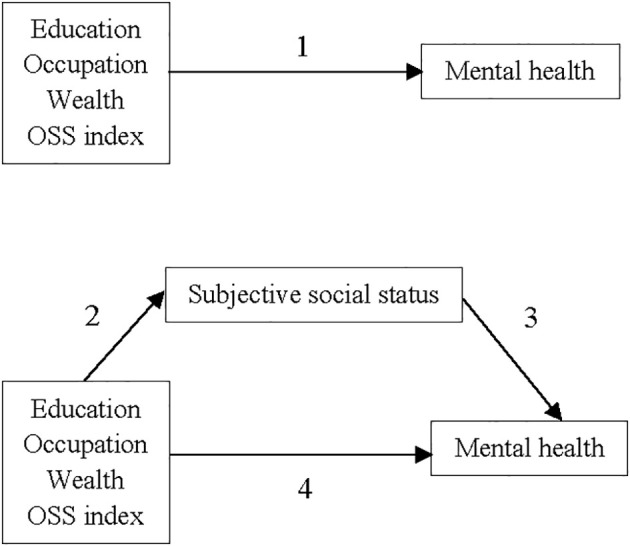
This study is a secondary analysis of data from IranMHS, a national survey conducted in 2011 through face-to-face interviews with 7,886 Iranian adults aged 15-64. As part of the original survey, the General Health Questionnaire-28 (GHQ-28) was randomly administered to half of these participants. We focused our analysis on data from 3,759 participants who completed all items of the GHQ-28. OSS was evaluated using education, occupation, wealth, and a combined OSS index, while SSS was measured using the MacArthur Scale. We examined how SSS mediates the associations between OSS factors and GHQ scores, including its four dimensions-somatic symptoms, anxiety and insomnia, social dysfunction, and severe depression- while adjusting for demographic variables and conducting gender-stratified analyses.
Among the 3759 respondents, 2157 (57.4%) were women, 2110 (56.1%) lived in urban areas, with an average age of 33.1 years (SD=12.1). SSS mediated the associations between wealth and the overall GHQ score (mediation percentage: 92.3%), education (75.4%), OSS index (66.7%), and occupation (34.0%) on the GHQ score. The most significant mediation effects were observed for wealth on the somatic symptoms, social dysfunction, and depression dimensions, with SSS accounting for more than 80% of these associations.
The findings indicate a significant mediating role of SSS in the relationship between OSS and mental health. Enhancing our comprehension of the social determinants that moderate the relationship between objective and subjective socioeconomic status may contribute to a more nuanced understanding of the impact of SES on mental health outcomes.
社会经济地位低下被认为是心理健康的一个关键风险因素。客观社会经济地位通过有形资源来衡量,而主观社会地位反映了个体对其客观社会经济地位的认知。目前鲜有文献阐明通过主观社会地位将客观社会经济地位与精神疾病联系起来的具体心理社会机制或途径。本研究旨在利用伊朗心理健康调查(IranMHS)的数据,探讨主观社会地位在客观社会经济地位与心理健康关联中的中介作用。
本研究是对IranMHS数据的二次分析,该全国性调查于2011年通过对7886名15 - 64岁的伊朗成年人进行面对面访谈开展。作为原始调查的一部分,一般健康问卷28项(GHQ - 28)被随机施用于其中一半的参与者。我们将分析重点放在完成了GHQ - 28所有项目的3759名参与者的数据上。客观社会经济地位通过教育、职业、财富以及综合客观社会经济地位指数进行评估,而主观社会地位则使用麦克阿瑟量表进行测量。我们在调整人口统计学变量并进行性别分层分析的同时,研究了主观社会地位如何在客观社会经济地位因素与GHQ得分之间起中介作用,包括其四个维度——躯体症状、焦虑和失眠、社会功能障碍以及重度抑郁。
在3759名受访者中,2157名(57.4%)为女性,2110名(56.1%)居住在城市地区,平均年龄为33.1岁(标准差 = 12.1)。主观社会地位在财富与总体GHQ得分(中介百分比:92.3%)、教育(75.4%)、客观社会经济地位指数(66.7%)以及职业(34.0%)与GHQ得分之间的关联中起中介作用。在躯体症状、社会功能障碍和抑郁维度上,观察到财富的中介效应最为显著,主观社会地位在这些关联中占比超过80%。
研究结果表明主观社会地位在客观社会经济地位与心理健康的关系中起显著的中介作用。加强对调节客观和主观社会经济地位之间关系的社会决定因素的理解,可能有助于更细致入微地理解社会经济地位对心理健康结果的影响。