Jung Maria, Pützer Svenja, Gevensleben Heidrun, Meller Sebastian, Kristiansen Glen, Dietrich Dimo
Institute of Pathology, University Hospital Bonn, Sigmund-Freud-Str. 25, 53127 Bonn, Germany.
Department of Otolaryngology, Head and Neck Surgery, University Hospital Bonn, Bonn, Germany.
Clin Epigenetics. 2016 Mar 1;8:24. doi: 10.1186/s13148-016-0192-7. eCollection 2016.
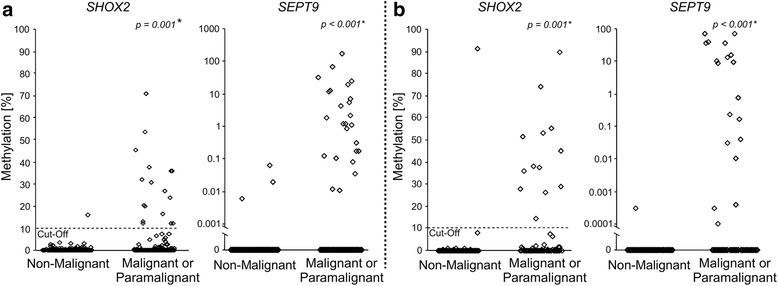
Cytology remains the gold standard for the detection of malignant cells in ascites. However, its sensitivity is limited. The aim of this study was to evaluate DNA methylation biomarkers for the differential diagnosis of benign (ascites in patients without malignancy), malignant (ascites in cancer patients directly caused by malignancy), and paramalignant (ascites in cancer patients caused by comorbidities but not by malignancy) ascites.
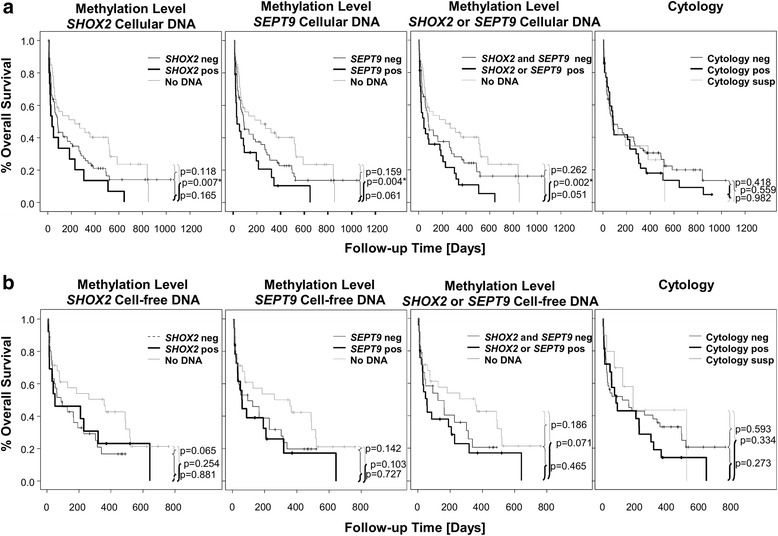
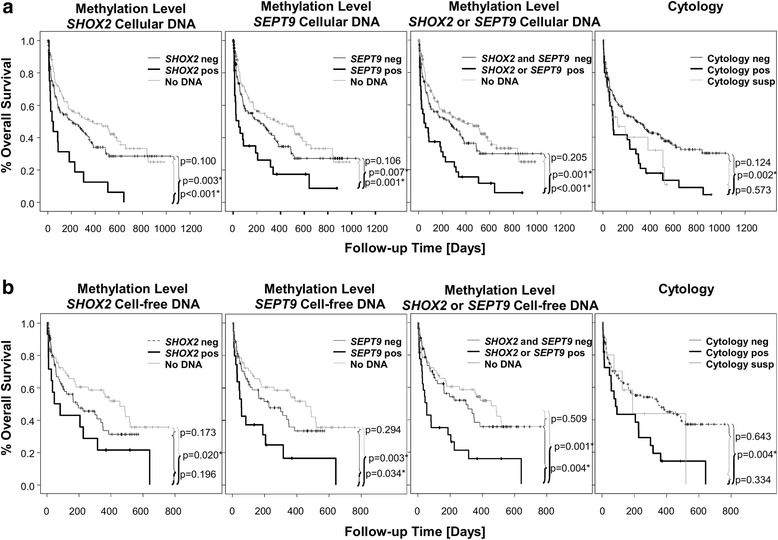
A cohort of 283 patients (134 cancer patients, 149 patients with benign diseases) presenting with ascites was prospectively enrolled. Ascites was evaluated by means of cytopathological investigation and DNA methylation of SHOX2 and SEPT9 in the cell-free and cellular fraction. DNA methylation in bisulfite-converted DNA was determined using quantitative methylation specific real-time PCR. Cytopathological and DNA methylation results were evaluated with regard to diagnosis and overall survival (OS).
Patients with positive DNA methylation had a poor overall survival compared to methylation-negative patients (hazard ratio: HR = 1.97, p = 0.001). In multivariate survival analysis, DNA methylation was an independent prognostic parameter (p = 0.003) together with age (HR = 1.03, p < 0.001) and the presence of malignant disease (HR = 1.87, p < 0.001). The combination of methylation with cytopathological analyses led to a 42 % increase in the detection rate of malignant ascites, resulting in 37 % positively diagnosed cancer patients and a specificity of 97 %. Among cancer patients, patients with DNA methylation-positive ascites showed an adverse clinical course (HR = 1.63, p = 0.039).
DNA methylation testing adds diagnostic and prognostic information and might constitute an effective ancillary method for the differential diagnosis of malignant, paramalignant, and benign ascites.
细胞学检查仍是检测腹水中恶性细胞的金标准。然而,其敏感性有限。本研究的目的是评估DNA甲基化生物标志物,用于鉴别诊断良性腹水(无恶性肿瘤患者的腹水)、恶性腹水(癌症患者直接由恶性肿瘤引起的腹水)和准恶性腹水(癌症患者由合并症而非恶性肿瘤引起的腹水)。
前瞻性纳入了283例出现腹水的患者队列(134例癌症患者,149例良性疾病患者)。通过细胞病理学检查以及游离细胞和细胞成分中SHOX2和SEPT9的DNA甲基化对腹水进行评估。使用定量甲基化特异性实时PCR测定亚硫酸氢盐转化DNA中的DNA甲基化。根据诊断和总生存期(OS)评估细胞病理学和DNA甲基化结果。
与DNA甲基化阴性的患者相比,DNA甲基化阳性的患者总生存期较差(风险比:HR = 1.97,p = 0.001)。在多因素生存分析中,DNA甲基化与年龄(HR = 1.03,p < 0.001)和恶性疾病的存在(HR = 1.87,p < 0.001)一起是独立的预后参数(p = 0.003)。甲基化与细胞病理学分析相结合使恶性腹水的检出率提高了42%,确诊癌症患者的比例为37%,特异性为97%。在癌症患者中,DNA甲基化阳性腹水的患者临床病程较差(HR = 1.63,p = 0.039)。
DNA甲基化检测增加了诊断和预后信息,可能构成一种有效的辅助方法,用于鉴别诊断恶性、准恶性和良性腹水。