Guichard Paul, Gönczy Pierre
Department of Cell Biology, University of Geneva, Geneva, Switzerland.
Swiss Institute for Experimental Cancer Research (ISREC), School of Life Sciences, Swiss Federal Institute of Technology (EPFL), Lausanne, Switzerland.
Cilia. 2016 Mar 1;5:9. doi: 10.1186/s13630-016-0031-7. eCollection 2016.
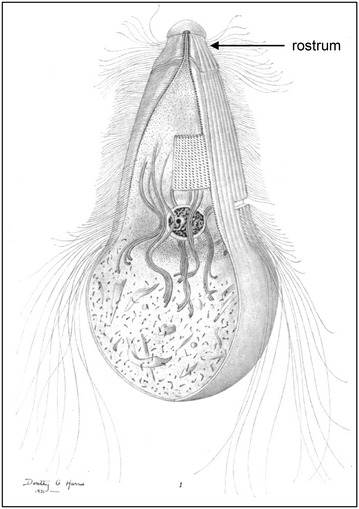
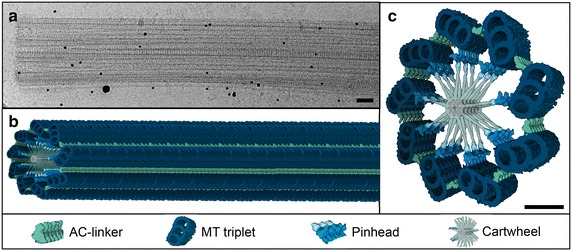
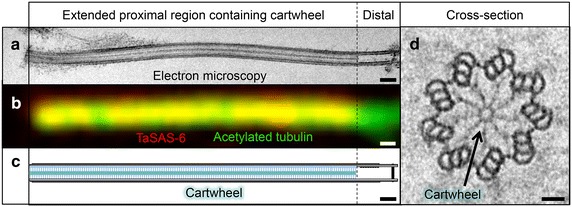
Trichonympha is a symbiotic flagellate of many species of termites and of the wood-feeding cockroach. Remarkably, this unicellular organism harbors up to over ten thousand flagella on its surface, which serve to propel it through the viscous environment of the host hindgut. In the 1960s, analysis of resin-embedded Trichonympha samples by electron microscopy revealed that the basal bodies that give rise to these flagella are exceptionally long, with a proximal, cartwheel-bearing, region some 50 times longer than that of regular centrioles. In recent years, this salient feature has prompted the analysis of the 3D architecture of Trichonympha basal bodies in the native state using cryo-electron tomography. The resulting ~40 Å resolution map of the basal body proximal region revealed a number of novel features that may be conserved in centrioles of other systems. These include proximal-distal polarity of the pinhead structure that links the cartwheel to centriolar microtubules, as well as of the linker between the A and the C microtubules. Moreover, this work demonstrated that the cartwheel is made of stacked ring-like structures that likely each comprise 18 molecules of SAS-6 proteins.
披发虫是多种白蚁和食木蟑螂的共生鞭毛虫。值得注意的是,这种单细胞生物表面有多达一万多条鞭毛,用于推动它在宿主后肠的粘性环境中移动。20世纪60年代,通过电子显微镜对树脂包埋的披发虫样本进行分析发现,产生这些鞭毛的基体异常长,其近端带有车轮状结构的区域比普通中心粒长约50倍。近年来,这一显著特征促使人们利用冷冻电子断层扫描技术对天然状态下披发虫基体的三维结构进行分析。由此得到的基体近端区域约40埃分辨率图谱揭示了一些可能在其他系统的中心粒中保守的新特征。这些特征包括连接车轮状结构与中心粒微管的针头结构的近端 - 远端极性,以及A微管和C微管之间连接体的极性。此外,这项研究表明车轮状结构由堆叠的环状结构组成,每个环状结构可能包含18个SAS - 6蛋白分子。