Lei Mingxing, Li Jianjie, Liu Yaosheng, Jiang Weigang, Liu Shubin, Zhou Shiguo
Department of Orthopedic Surgery, Affiliated Hospital of Academy of Military Medical Sciences, Beijing, China.
Department of Pulmonary Neoplasms Internal Medicine, Affiliated Hospital of Academy of Military Medical Sciences, Beijing, China.
Spine (Phila Pa 1976). 2016 Sep 15;41(18):1469-1476. doi: 10.1097/BRS.0000000000001538.
A retrospective study.
This study aims to develop a new scoring system that can guild surgeons to select the best candidates for decompressive surgery in patients with metastatic spinal cord compression (MSCC).
Predicting survival and functional outcome is essential when selecting the individual treatment for patients with MSCC. The criteria for identifying MSCC patients who are most likely to benefit from decompressive surgery remain unclear.
We retrospectively analyzed 12 preoperative characteristics for postoperative survival in a series of 206 patients with MSCC who were operated with decompressive surgery and spine stabilization. Characteristics significantly associated with survival in the multivariate analysis were included in the scoring system. Postoperative function outcome was also analyzed on the basis of the scoring system.
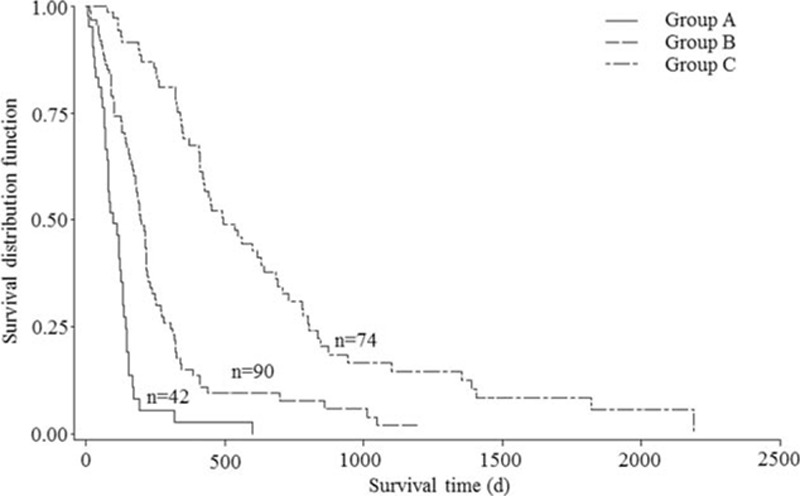
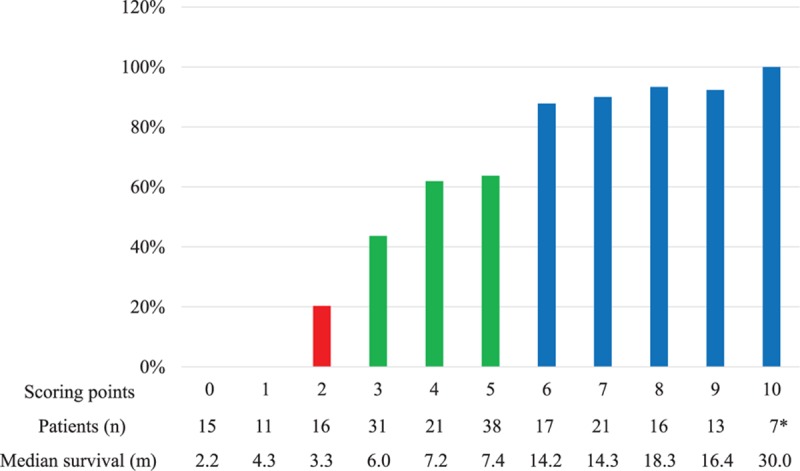
According to the multivariate analysis, primary site (P < 0.01), preoperative ambulatory status (P < 0.01), visceral metastases (P < 0.01), preoperative chemotherapy (P = 0.02), and bone metastasis at cancer diagnosis (P = 0.03) had a significant impact on postoperative survival and were included in the scoring system. According to the prognostic scores, which ranged from 0 to 10 points, three risk groups were designed: 0 to 2, 3 to 5, and 6 to 10 points. The corresponding 6 months survival rates were 8.2%, 56.5%, and 91.5%, respectively (P < 0.01), and postoperative ambulatory rates were 35.7%, 73.3%, and 95.9%, respectively (P < 0.01).
We present a new scoring system for predicting survival and function outcome of MSCC patients after surgical decompression and spine stabilization. This new scoring system can help surgeons select the best candidates for surgical treatment.
一项回顾性研究。
本研究旨在开发一种新的评分系统,以指导外科医生为转移性脊髓压迫(MSCC)患者选择减压手术的最佳候选人。
在为MSCC患者选择个体化治疗时,预测生存和功能结局至关重要。确定最有可能从减压手术中获益的MSCC患者的标准仍不明确。
我们回顾性分析了206例行减压手术和脊柱稳定手术的MSCC患者的12项术前特征与术后生存情况。多因素分析中与生存显著相关的特征被纳入评分系统。还基于该评分系统分析了术后功能结局。
根据多因素分析,原发部位(P<0.01)、术前活动状态(P<0.01)、内脏转移(P<0.01)、术前化疗(P = 0.02)和癌症诊断时的骨转移(P = 0.03)对术后生存有显著影响,并被纳入评分系统。根据0至10分的预后评分,设计了三个风险组:0至2分、3至5分和6至10分。相应的6个月生存率分别为8.2%、56.5%和91.5%(P<0.01),术后活动率分别为35.7%、73.3%和95.9%(P<0.01)。
我们提出了一种新的评分系统,用于预测MSCC患者手术减压和脊柱稳定术后的生存和功能结局。这种新的评分系统可以帮助外科医生选择手术治疗的最佳候选人。
4级。