Mazzanti Andrea, Maragna Riccardo, Faragli Alessandro, Monteforte Nicola, Bloise Raffaella, Memmi Mirella, Novelli Valeria, Baiardi Paola, Bagnardi Vincenzo, Etheridge Susan P, Napolitano Carlo, Priori Silvia G
Molecular Cardiology, IRCCS Salvatore Maugeri Foundation, Pavia, Italy.
Department of Statistics and Quantitative Methods, University of Milan-Bicocca, Milan, Italy.
J Am Coll Cardiol. 2016 Mar 8;67(9):1053-1058. doi: 10.1016/j.jacc.2015.12.033.
Long QT syndrome type 3 (LQT3) is a lethal disease caused by gain-of-function mutations in the SCN5A gene, coding for the alpha-subunit of the sodium channel NaV1.5. Mexiletine is used to block late sodium current and to shorten QT interval in LQT3 patients.
The aim of this study was to determine whether mexiletine prevents arrhythmic events (arrhythmic syncope, aborted cardiac arrest, or sudden cardiac death) in LQT3 patients.
The endpoint of this retrospective cohort study, which studied consecutive LQT3 patients who were referred to our center and treated with mexiletine, was to evaluate the antiarrhythmic efficacy of mexiletine by comparing the number of arrhythmic events per patient and the annual rate of arrhythmic events during observation periods of equal duration before and after the beginning of therapy with mexiletine.
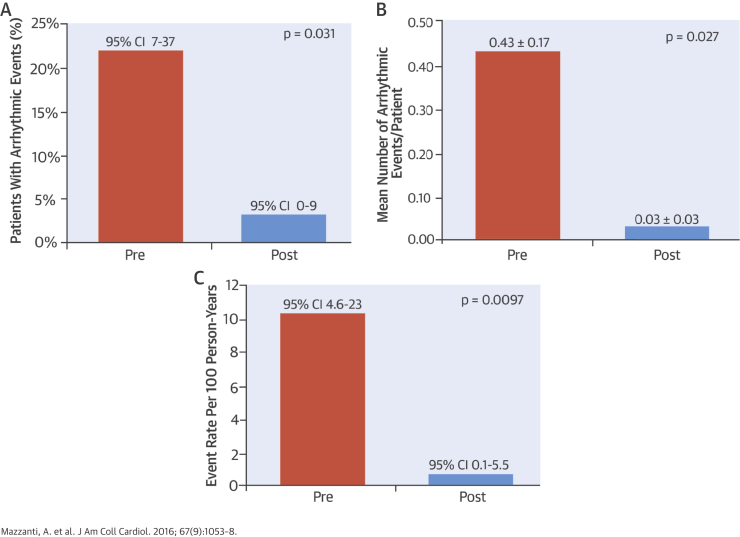
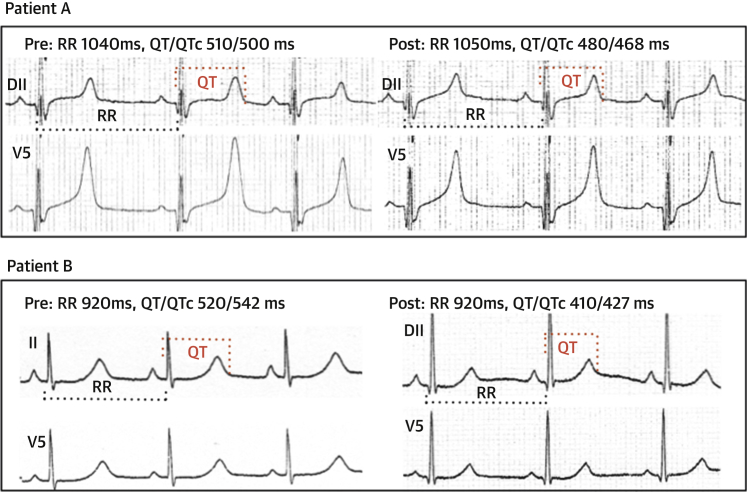
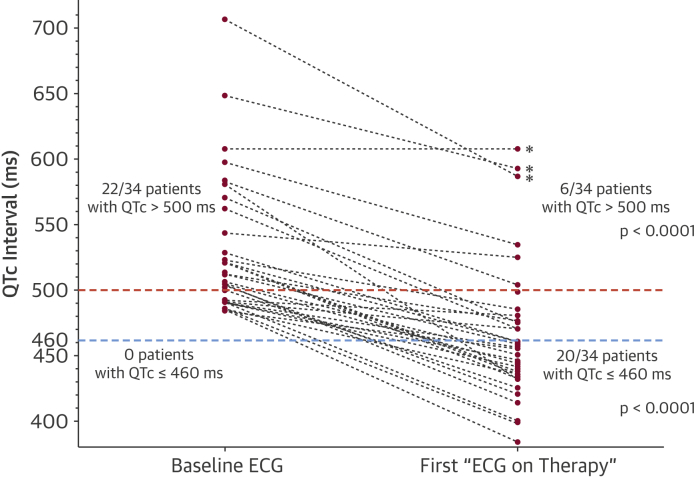
The study population comprised 34 LQT3 patients, 19 (56%) of whom were male. The median age at beginning of treatment with mexiletine was 22 years, and median QTc interval before therapy 509 ms. The median duration of oral mexiletine therapy was 36 months, at an average daily dose of 8 ± 0.5 mg/kg. Mexiletine significantly shortened QTc (by 63 ± 6 ms; p < 0.0001) and reduced the percentage of patients with arrhythmic events (from 22% to 3%; p = 0.031), the mean number of arrhythmic events per patient (from 0.43 ± 0.17 to 0.03 ± 0.03; p = 0.027), and the annual rate of arrhythmic events (from 10.3% to 0.7%; p = 0.0097).
Besides shortening QTc interval, mexiletine caused a major reduction of life-threatening arrhythmic events in LQT3 patients, thus representing an efficacious therapeutic strategy.
3型长QT综合征(LQT3)是一种由SCN5A基因突变导致功能获得性改变引起的致死性疾病,该基因编码钠通道NaV1.5的α亚基。美西律用于阻断晚期钠电流并缩短LQT3患者的QT间期。
本研究旨在确定美西律是否能预防LQT3患者的心律失常事件(心律失常性晕厥、心脏骤停未遂或心源性猝死)。
这项回顾性队列研究的终点是,对转诊至本中心并接受美西律治疗的连续LQT3患者进行研究,通过比较美西律治疗开始前后等时长观察期内每位患者的心律失常事件数量和心律失常事件年发生率,来评估美西律的抗心律失常疗效。
研究人群包括34例LQT3患者,其中19例(56%)为男性。开始使用美西律治疗时的中位年龄为22岁,治疗前的中位QTc间期为509毫秒。口服美西律治疗的中位持续时间为36个月,平均每日剂量为8±0.5毫克/千克。美西律显著缩短了QTc(缩短63±6毫秒;p<0.0001),并降低了发生心律失常事件的患者百分比(从22%降至3%;p=0.031)、每位患者的平均心律失常事件数量(从0.43±0.17降至0.03±0.03;p=0.027)以及心律失常事件年发生率(从10.3%降至0.7%;p=0.0097)。
除了缩短QTc间期外,美西律还显著减少了LQT3患者危及生命的心律失常事件,因此是一种有效的治疗策略。