
苹果潜隐球形病毒载体促进开花及高温脱毒可加速苹果和梨的育种进程
Promotion of Flowering by Apple Latent Spherical Virus Vector and Virus Elimination at High Temperature Allow Accelerated Breeding of Apple and Pear.
作者信息
Yamagishi Norioko, Li Chunjiang, Yoshikawa Nobuyuki
机构信息
Plant Pathology Laboratory, Faculty of Agriculture, Iwate University Morioka, Japan.
出版信息
Front Plant Sci. 2016 Feb 25;7:171. doi: 10.3389/fpls.2016.00171. eCollection 2016.
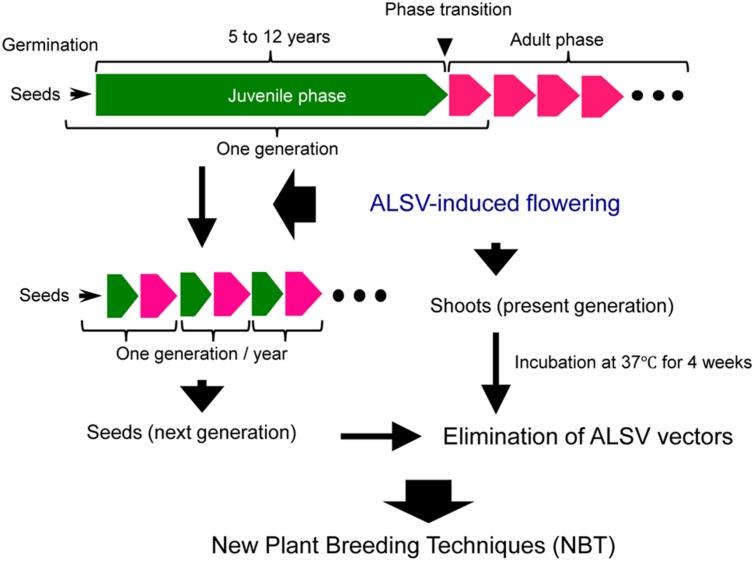
Plant viral vectors are superior tools for genetic manipulation, allowing rapid induction or suppression of expression of a target gene in plants. This is a particularly effective technology for use in breeding fruit trees, which are difficult to manipulate using recombinant DNA technologies. We reported previously that if apple seed embryos (cotyledons) are infected with an Apple latent spherical virus (ALSV) vector (ALSV-AtFT/MdTFL1) concurrently expressing the Arabidopsis thaliana florigen (AtFT) gene and suppressing the expression of the apple MdTFL1-1 gene, the period prior to initial flowering (generally lasts 5-12 years) will be reduced to about 2 months. In this study, we examined whether or not ALSV vector technology can be used to promote flowering in pear, which undergoes a very long juvenile period (germination to flowering) similar to that of apple. The MdTFL1 sequence in ALSV-AtFT/MdTFL1 was replaced with a portion of the pear PcTFL1-1 gene. The resulting virus (ALSV-AtFT/PcTFL1) and ALSV-AtFT/MdTFL1 were used individually for inoculation to pear cotyledons immediately after germination in two inoculation groups. Those inoculated with ALSV-AtFT/MdTFL1 and ALSV-AtFT/PcTFL1 then initiated flower bud formation starting one to 3 months after inoculation, and subsequently exhibited continuous flowering and fruition by pollination. Conversely, Japanese pear exhibited extremely low systemic infection rates when inoculated with ALSV-AtFT/MdTFL1, and failed to exhibit any induction of flowering. We also developed a simple method for eliminating ALSV vectors from infected plants. An evaluation of the method for eliminating the ALSV vectors from infected apple and pear seedlings revealed that a 4-week high-temperature (37°C) incubation of ALSV-infected apples and pears disabled the movement of ALSV to new growing tissues. This demonstrates that only high-temperature treatment can easily eliminate ALSV from infected fruit trees. A method combining the promotion of flowering in apple and pear by ALSV vector with an ALSV elimination technique is expected to see future application as a new plant breeding technique that can significantly shorten the breeding periods of apple and pear.
植物病毒载体是基因操作的优良工具,可在植物中快速诱导或抑制靶基因的表达。这是一种特别有效的技术,适用于难以使用重组DNA技术进行操作的果树育种。我们之前报道过,如果苹果种子胚(子叶)感染了同时表达拟南芥成花素(AtFT)基因并抑制苹果MdTFL1-1基因表达的苹果潜隐球形病毒(ALSV)载体(ALSV-AtFT/MdTFL1),初始开花前的时期(通常持续5至12年)将缩短至约2个月。在本研究中,我们研究了ALSV载体技术是否可用于促进梨的开花,梨与苹果一样,经历很长的幼年期(从发芽到开花)。将ALSV-AtFT/MdTFL1中的MdTFL1序列替换为梨PcTFL1-1基因的一部分。在两个接种组中,将所得病毒(ALSV-AtFT/PcTFL1)和ALSV-AtFT/MdTFL1在梨种子发芽后立即分别接种到梨子叶上。接种ALSV-AtFT/MdTFL1和ALSV-AtFT/PcTFL1的植株在接种后1至3个月开始形成花芽,随后通过授粉实现连续开花和结果。相反,日本梨接种ALSV-AtFT/MdTFL1时系统感染率极低,且未表现出任何开花诱导。我们还开发了一种从受感染植物中消除ALSV载体的简单方法。对从受感染的苹果和梨幼苗中消除ALSV载体的方法进行评估发现,将感染ALSV的苹果和梨在37°C高温下培养4周会使ALSV无法向新的生长组织移动。这表明仅通过高温处理就能轻松从受感染的果树上消除ALSV。将ALSV载体促进苹果和梨开花的方法与ALSV消除技术相结合的方法有望作为一种新的植物育种技术得到未来应用,该技术可显著缩短苹果和梨的育种周期。


 Zotero 插件