Yang Yunxing, Wang Jianfeng, Fu Ying, Ruan Zhi, Yu Yunsong
From the Department of Infectious Diseases, Sir Run Run Shaw Hospital, School of Medicine, Zhejiang University, Hangzhou, Zhejiang, China.
Medicine (Baltimore). 2016 Mar;95(9):e2937. doi: 10.1097/MD.0000000000002937.
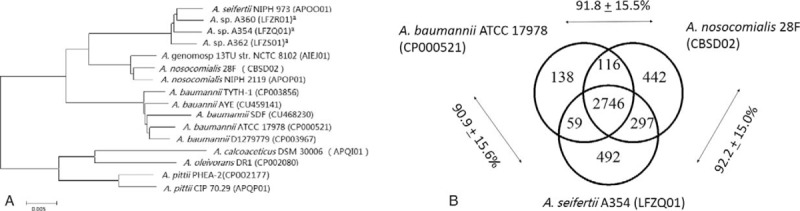
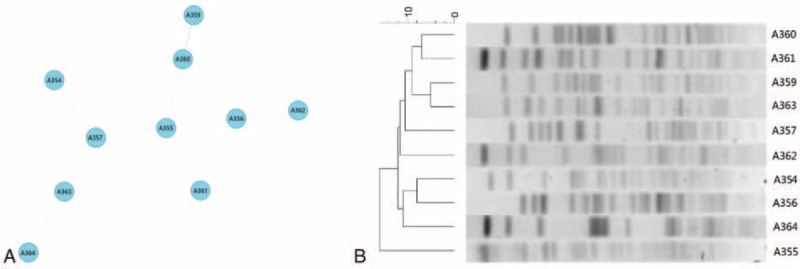
Clinical infections caused by Acinetobacter spp. have increasing public health concerns because of their global occurrence and ability to acquire multidrug resistance. Acinetobacter calcoaceticus-Acinetobacter baumannii (ACB) complex encompasses A. calcoaceticus, A. baumannii, A. pittii (formerly genomic species 3), and A nosocomial (formerly genomic species 13TU), which are predominantly responsible for clinical pathogenesis in the Acinetobacter genus. In our previous study, a putative novel species isolated from 385 non-A. baumannii spp. strains based on the rpoB gene phylogenetic tree was reported. Here, the putative novel species was identified as A. seifertii based on the whole-genome phylogenetic tree. A. seifertii was recognized as a novel member of the ACB complex and close to A. baumannii and A. nosocomials. Furthermore, we studied the characteristics of 10 A. seifertii isolates, which were distributed widely in 6 provinces in China and mainly caused infections in the elderly or children. To define the taxonomic status and characteristics, the biochemical reactions, antimicrobial susceptibility testing, pulsed field gel electrophoresis (PFGE), multilocus sequence typing (MLST), and whole-genome sequence analysis were performed. The phenotypic characteristics failed to distinguish A. serfertii from other species in the ACB complex. Most of the A. seifertii isolates were susceptible to antibiotics commonly used for nosocomial Acinetobacter spp. infections, but one isolate (strain A362) was resistant to ampicillin/sulbactam, ceftazidime and amikacin. The different patterns of MLST and PFGE suggested that the 10 isolates were not identical and lacked clonal relatedness. Our study reported for the first time the molecular epidemiological and genomic features of widely disseminated A. seifertii in China. These observations could enrich the knowledge of infections caused by non-A. baumannii and may provide a scientific basis for future clinical treatment.
不动杆菌属引起的临床感染因其在全球的出现以及获得多重耐药性的能力而日益引起公众对健康的关注。醋酸钙不动杆菌 - 鲍曼不动杆菌(ACB)复合体包括醋酸钙不动杆菌、鲍曼不动杆菌、皮氏不动杆菌(以前的基因组种3)和医院不动杆菌(以前的基因组种13TU),它们是不动杆菌属临床发病机制的主要原因。在我们之前的研究中,报道了一种基于rpoB基因系统发育树从385株非鲍曼不动杆菌菌株中分离出的假定新物种。在此,基于全基因组系统发育树,该假定新物种被鉴定为西弗特不动杆菌。西弗特不动杆菌被认为是ACB复合体的一个新成员,与鲍曼不动杆菌和医院不动杆菌关系密切。此外,我们研究了10株西弗特不动杆菌分离株的特征,这些分离株在中国6个省份广泛分布,主要引起老年人或儿童感染。为了确定分类地位和特征,进行了生化反应、抗菌药敏试验、脉冲场凝胶电泳(PFGE)、多位点序列分型(MLST)和全基因组序列分析。表型特征无法将西弗特不动杆菌与ACB复合体中的其他物种区分开来。大多数西弗特不动杆菌分离株对医院感染常见的不动杆菌属抗生素敏感,但有一株分离株(菌株A362)对氨苄西林/舒巴坦、头孢他啶和阿米卡星耐药。不同的MLST和PFGE模式表明这10株分离株并不相同,也没有克隆相关性。我们的研究首次报道了中国广泛传播的西弗特不动杆菌的分子流行病学和基因组特征。这些观察结果可以丰富对非鲍曼不动杆菌引起感染的认识,并可能为未来的临床治疗提供科学依据。