Ricciardi Alessandra, Visitsunthorn Kittipos, Dalton John P, Ndao Momar
Department of Microbiology & Immunology, McGill University, Montreal, QC, Canada.
National Reference Center for Parasitology, Research Institute of the McGill University Health Center, Montreal, QC, Canada.
BMC Infect Dis. 2016 Mar 5;16:112. doi: 10.1186/s12879-016-1444-z.
Schistosomiasis is the most important human helminth infection due to its impact on public health. The clinical manifestations are chronic and significantly decrease an individual's quality of life. Infected individuals suffer from long-term organ pathologies including fibrosis which eventually leads to organ failure. The development of a vaccine against this parasitic disease would contribute to a long-lasting decrease in disease spectrum and transmission.
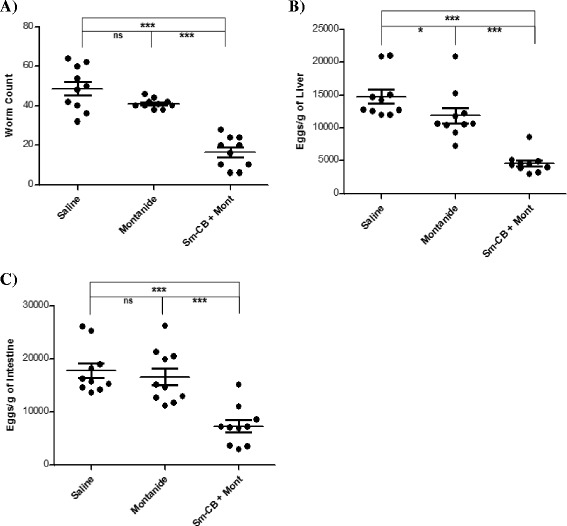
Our group has chosen Schistosoma mansoni (Sm) cathepsin B, a peptidase involved in parasite feeding, as a prospective vaccine candidate. Our experimental formulation consisted of recombinant Sm-cathepsin B formulated in Montanide ISA 720 VG, a squalene based adjuvant containing a mannide mono-oleate emulsifier. Parasitological burden was assessed by determining adult worm, hepatic egg, and intestinal egg numbers in each mouse. Serum was used in ELISAs to evaluate production of antigen-specific antibodies, and isolated splenocytes were stimulated with the antigen for the analysis of cytokine secretion levels.
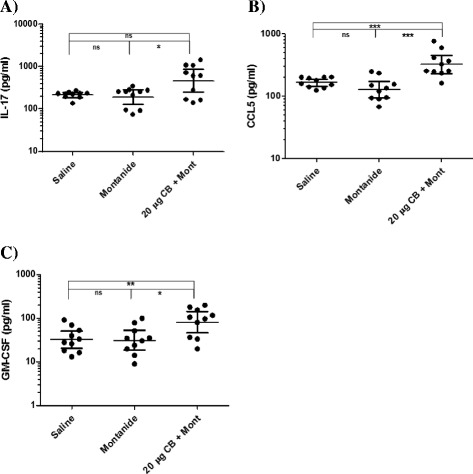
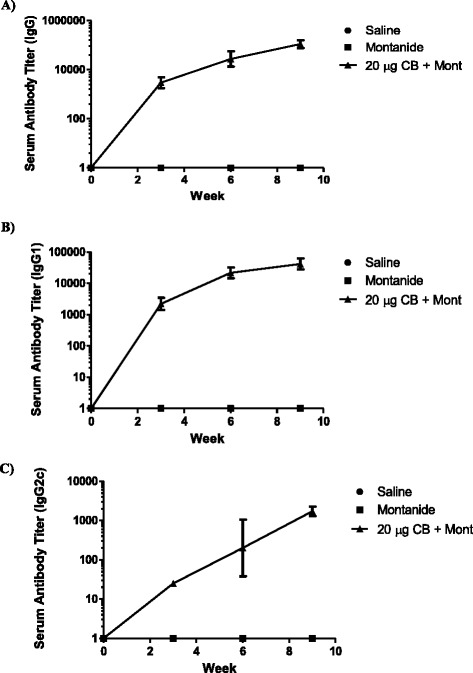
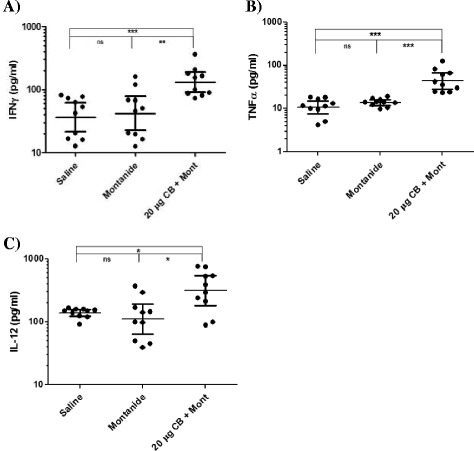
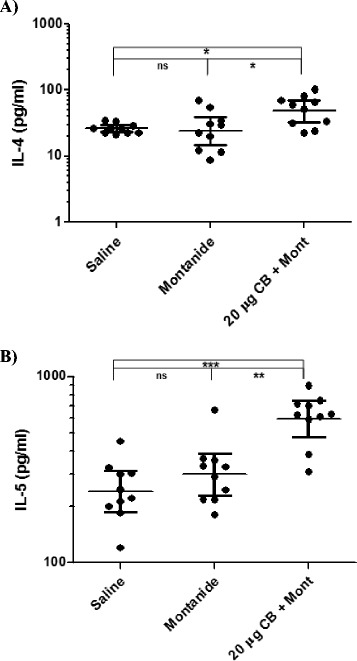
The Sm-cathepsin B and Montanide formulation conferred protection against a challenge infection by significantly reducing all forms of parasitological burdens. Worm burden, hepatic egg burden and intestinal egg burden were decreased by 60%, 6%, and 56%, respectively in immunized animals compared to controls (P = 0.0002, P < 0.0001, P = 0.0009, respectively). Immunizations with the vaccine elicited robust production of Sm-cathepsin B specific antibodies (endpoint titers = 122,880). Both antigen-specific IgG1 and IgG2c titers were observed, with the former having more elevated titers. Furthermore, splenocytes isolated from the immunized animals, compared to control animals, secreted higher levels of key Th1 cytokines, IFN-γ, IL-12, and TNF-α, as well as the Th2 cytokines IL-5 and IL-4 when stimulated with recombinant Sm-cathepsin B. The Th17 cytokine IL-17, the chemokine CCL5, and the growth factor GM-CSF were also significantly increased in the immunized animals compared to the controls.
The formulation tested in this study was able to significantly reduce all forms of parasite burden, stimulate robust production of antigen-specific antibodies, and induce a mixed Th1/Th2 response. These results highlight the potential of Sm-cathepsin B/Montanide ISA 720 VG as a vaccine candidate against schistosomiasis.
血吸虫病因其对公共卫生的影响,是最重要的人类蠕虫感染。其临床表现具有慢性特征,会显著降低个体的生活质量。受感染个体长期遭受包括纤维化在内的器官病变折磨,最终导致器官衰竭。研发针对这种寄生虫病的疫苗将有助于长期减少疾病范围和传播。
我们的研究团队选择了曼氏血吸虫(Sm)组织蛋白酶B,一种参与寄生虫摄取营养的肽酶,作为潜在的疫苗候选物。我们的实验制剂由重组Sm组织蛋白酶B与Montanide ISA 720 VG混合而成,Montanide ISA 720 VG是一种基于角鲨烯的佐剂,含有单油酸甘露糖醇乳化剂。通过测定每只小鼠体内的成虫数量、肝内虫卵数量和肠内虫卵数量来评估寄生虫负荷。利用酶联免疫吸附测定(ELISA)检测血清中抗原特异性抗体的产生,并用抗原刺激分离的脾细胞以分析细胞因子分泌水平。
Sm组织蛋白酶B与Montanide制剂通过显著降低所有形式的寄生虫负荷,对攻击感染提供了保护。与对照组相比,免疫动物的虫负荷、肝内虫卵负荷和肠内虫卵负荷分别降低了60%、6%和56%(P值分别为0.0002、<0.0001、0.0009)。用该疫苗免疫引发了Sm组织蛋白酶B特异性抗体的强劲产生(终点效价 = 122,880)。观察到了抗原特异性IgG1和IgG2c效价,前者效价更高。此外,与对照动物相比,从免疫动物分离的脾细胞在用重组Sm组织蛋白酶B刺激时,分泌更高水平的关键Th1细胞因子,即干扰素-γ(IFN-γ)、白细胞介素-12(IL-12)和肿瘤坏死因子-α(TNF-α),以及Th2细胞因子白细胞介素-5(IL-5)和白细胞介素-4(IL-4)。与对照组相比,免疫动物中Th17细胞因子白细胞介素-17、趋化因子CCL5和生长因子粒细胞-巨噬细胞集落刺激因子(GM-CSF)也显著增加。
本研究中测试的制剂能够显著降低所有形式的寄生虫负荷,刺激抗原特异性抗体的强劲产生,并诱导混合的Th1/Th2反应。这些结果突出了Sm组织蛋白酶B/Montanide ISA 720 VG作为抗血吸虫病疫苗候选物的潜力。