Houlder Emma L, da Silva Lucas Ferreira, van Diepen Angela, Amaral Murilo Sena, Wilson R Alan, Hokke Cornelis H, Roestenberg Meta, Bakker Wilfried A M
Leiden University Center for Infectious Diseases, Leiden University Medical Center, Leiden, The Netherlands.
Harvard Medical School, Boston, Massachusetts, United States of America.
PLoS Negl Trop Dis. 2025 Jun 2;19(6):e0012956. doi: 10.1371/journal.pntd.0012956. eCollection 2025 Jun.
Schistosomiasis is caused by infection with worms of the genus Schistosoma including S. mansoni. Over 200 million people are infected, sterile immunity does not naturally develop, and no vaccine is available. This could be a critical tool to achieve control and elimination. Numerous candidates have been tested in pre-clinical models, but there is not yet an approved vaccine.
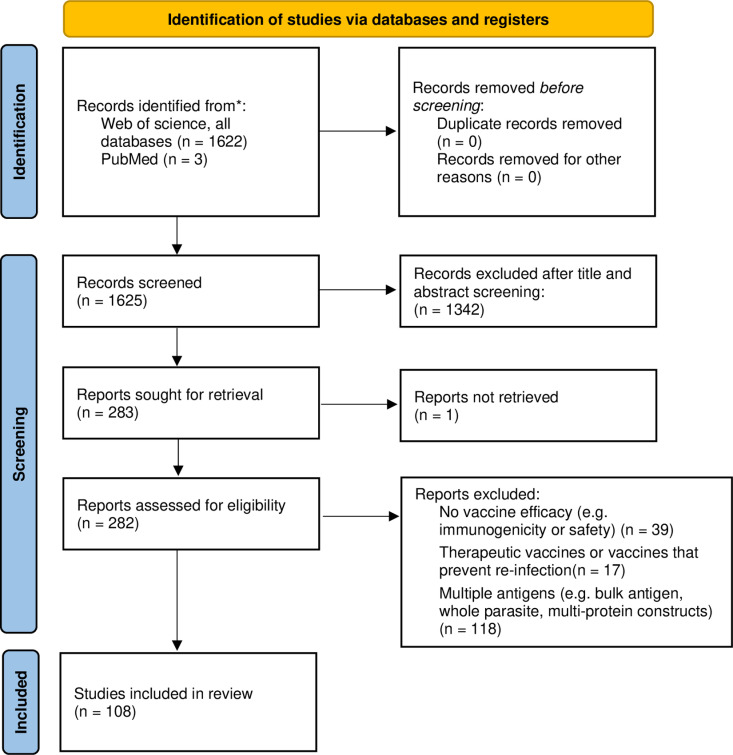
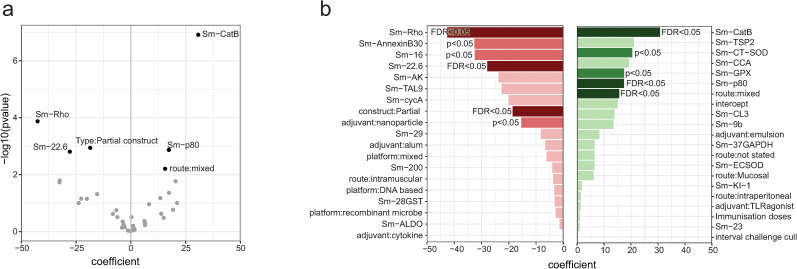
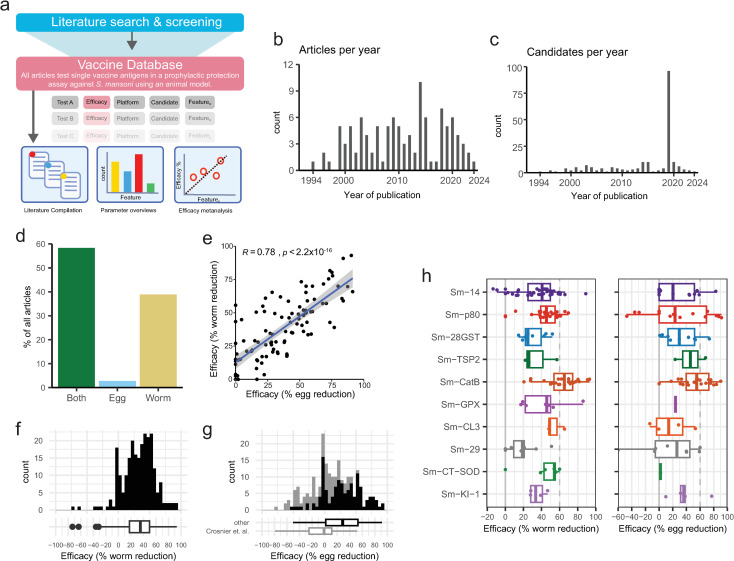
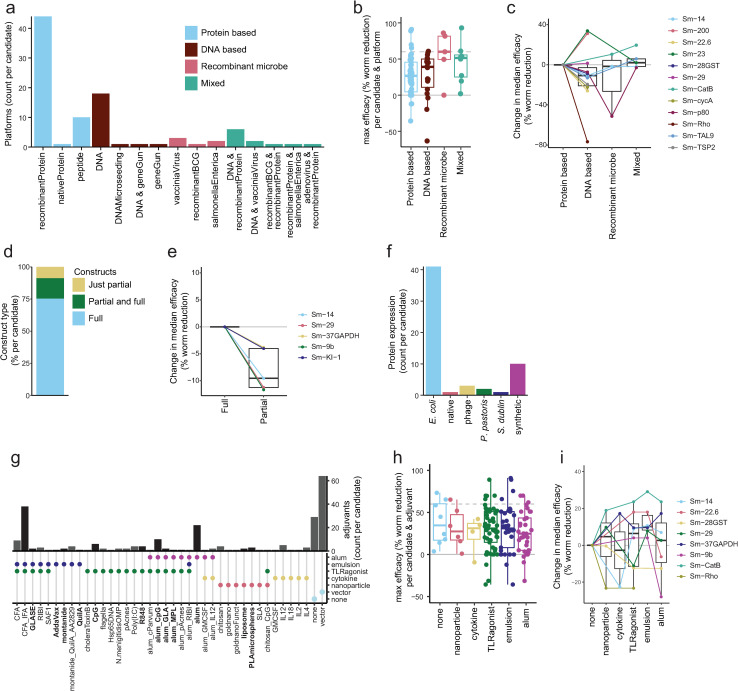
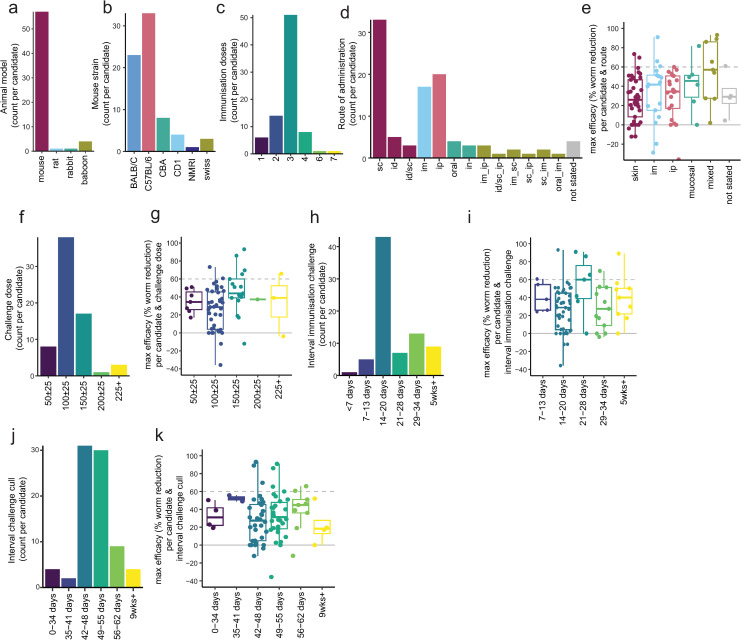
METHODOLOGY/PRINCIPAL FINDINGS: We conducted a scoping review using a keyword search on Web of Science and a MeSH term search on PubMed. Articles were screened and included if they tested a defined vaccine candidate in a pre-clinical protection assay against S. mansoni between 1994-2024. Vaccine formulation, study design, and efficacy parameters from all articles were extracted. This data was summarised graphically, with the influence of different parameters appraised. A total of 141 candidate antigens were tested in 108 articles over the last 30 years, with most antigens tested only once and three (Sm-CatB, Sm-p80, and Sm-14) tested over 20 times. The median protective efficacy against worms was 35%. 10 antigens achieved over 60% efficacy, and only two (Sm-p80 and Sm-CatB) over 90%. Large variations in efficacy were observed with all repeatedly tested antigens, likely attributable to differing formulations and study designs. The effect of these varying parameters on the resultant efficacy was evaluated.
A few vaccine candidates have achieved promising efficacy in pre-clinical studies. Most vaccines tested however have efficacy that falls short of that required for an impactful schistosomiasis vaccine. The diversity in study designs makes comparing vaccine targets a challenge. Use of consistent and optimized vaccine formulation (including adjuvant and platform) and study design parameters is critical to expedite the development of a schistosome vaccine.
血吸虫病是由感染包括曼氏血吸虫在内的血吸虫属蠕虫引起的。超过2亿人受到感染,机体不会自然产生无菌免疫,且尚无可用疫苗。这可能是实现控制和消除血吸虫病的关键工具。众多候选疫苗已在临床前模型中进行了测试,但尚未有获批的疫苗。
方法/主要发现:我们通过在Web of Science上进行关键词搜索以及在PubMed上进行医学主题词搜索开展了一项范围综述研究。筛选并纳入了1994年至2024年间在针对曼氏血吸虫的临床前保护试验中测试了特定疫苗候选物的文章。提取了所有文章的疫苗配方、研究设计和疗效参数。这些数据以图形方式进行了总结,并评估了不同参数的影响。在过去30年里,108篇文章中总共测试了141种候选抗原,大多数抗原仅测试了一次,有三种(曼氏血吸虫组织蛋白酶B、曼氏血吸虫p80和曼氏血吸虫14)测试了20次以上。对蠕虫的中位保护效力为35%。10种抗原的效力超过60%,只有两种(曼氏血吸虫p80和曼氏血吸虫组织蛋白酶B)超过90%。在所有反复测试的抗原中均观察到效力存在很大差异,这可能归因于不同的配方和研究设计。评估了这些不同参数对最终效力的影响。
少数疫苗候选物在临床前研究中取得了有前景的效力。然而,大多数测试的疫苗效力未达到有效血吸虫病疫苗所需的水平。研究设计的多样性使得比较疫苗靶点具有挑战性。使用一致且优化的疫苗配方(包括佐剂和平台)以及研究设计参数对于加快血吸虫疫苗的开发至关重要。