Cherian Gita, Quezada Nathalie
Department of Animal and Rangeland Sciences, Oregon State University, Corvallis, OR 97331 USA.
J Anim Sci Biotechnol. 2016 Mar 3;7:15. doi: 10.1186/s40104-016-0075-y. eCollection 2016.
The current study was conducted to evaluate egg quality and egg yolk fatty acids and immunoglobulin (IgY) content from laying hens fed full fat camelina or flax seed.
A total of 75, 48-week-old Lohman brown hens were randomly allocated to 3 treatments, with 5 replicates containing 5 laying hens each replicate. The hens were fed corn-soybean basal diet (Control), or Control diet with 10 % of full fat camelina (Camelina) or flax seed (Flax) for a period of 16 wk. Hen production performance egg quality, egg yolk lipids, fatty acids and IgY were determined every 28 d during the experimental period.
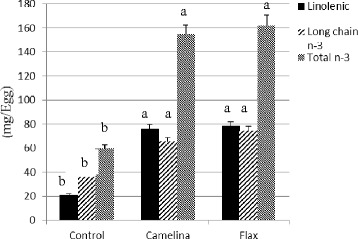
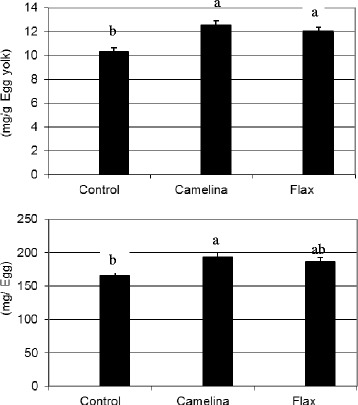
Egg production was higher in hens fed Camelina and Flax than in Control hens (P < 0.05). Egg weight and albumen weight was lowest in eggs from hens fed Camelina (P < 0.05). Shell weight relative to egg weight (shell weight %), and shell thickness was lowest in eggs from hens fed Flax (P < 0.05). No difference was noted in Haugh unit, yolk:albumen ratio, and yolk weight. Significant increase in α-linolenic (18:3 n-3), docosapentaenoic (22:5 n-3) and docoshexaenoic (22:6 n-3) acids were observed in egg yolk from hens fed Camelina and Flax. Total n-3 fatty acids constituted 1.19 % in Control eggs compared to 3.12 and 3.09 % in Camelina and Flax eggs, respectively (P < 0.05). Eggs from hens fed Camelina and Flax had the higher IgY concentration than those hens fed Control diet when expressed on a mg/g of yolk basis (P < 0.05). Although the egg weight was significantly lower in Camelina-fed hens, the total egg content of IgY was highest in eggs from hens fed Camelina (P < 0.05).
The egg n-3 fatty acid and IgY enhancing effect of dietary camelina seed warrants further attention into the potential of using camelina as a functional feed ingredient in poultry feeding.
本研究旨在评估饲喂全脂亚麻荠或亚麻籽的蛋鸡的蛋品质、蛋黄脂肪酸和免疫球蛋白(IgY)含量。
将75只48周龄的罗曼褐蛋鸡随机分为3组,每组5个重复,每个重复5只蛋鸡。蛋鸡分别饲喂玉米-大豆基础日粮(对照组),或添加10%全脂亚麻荠(亚麻荠组)或亚麻籽(亚麻籽组)的对照日粮,为期16周。在试验期间,每28天测定蛋鸡的生产性能、蛋品质、蛋黄脂质、脂肪酸和IgY。
饲喂亚麻荠和亚麻籽的蛋鸡产蛋量高于对照组蛋鸡(P < 0.05)。饲喂亚麻荠的蛋鸡所产鸡蛋的蛋重和蛋白重最低(P < 0.05)。饲喂亚麻籽的蛋鸡所产鸡蛋的蛋壳重与蛋重之比(蛋壳重量百分比)和蛋壳厚度最低(P < 0.05)。哈氏单位、蛋黄:蛋白比例和蛋黄重无显著差异。在饲喂亚麻荠和亚麻籽的蛋鸡所产蛋黄中,α-亚麻酸(18:3 n-3)、二十二碳五烯酸(22:5 n-3)和二十二碳六烯酸(22:6 n-3)显著增加。对照组鸡蛋中总n-3脂肪酸占1.19%,而亚麻荠组和亚麻籽组鸡蛋中分别为3.12%和3.09%(P < 0.05)。以每克蛋黄计,饲喂亚麻荠和亚麻籽的蛋鸡所产鸡蛋的IgY浓度高于饲喂对照日粮的蛋鸡(P < 0.05)。尽管饲喂亚麻荠的蛋鸡所产鸡蛋的蛋重显著较低,但饲喂亚麻荠的蛋鸡所产鸡蛋中IgY的总含量最高(P < 0.05)。
日粮中亚麻荠籽对鸡蛋n-3脂肪酸和IgY的增强作用值得进一步关注亚麻荠作为家禽饲料中功能性饲料成分的潜力。