Ubhi Harveen Kaur, Kotz Daniel, Michie Susan, van Schayck Onno C P, Sheard David, Selladurai Abiram, West Robert
Cancer Research UK Health Behaviour Research Centre, University College London, London WC1E 6BT, UK; Department of Family Medicine, CAPHRI School for Public Health and Primary Care, Maastricht University Medical Centre, Maastricht, The Netherlands.
Cancer Research UK Health Behaviour Research Centre, University College London, London WC1E 6BT, UK; Department of Family Medicine, CAPHRI School for Public Health and Primary Care, Maastricht University Medical Centre, Maastricht, The Netherlands; Institute of General Practice, Medical Faculty of the Heinrich-Heine, University Düsseldorf, Düsseldorf, Germany.
Addict Behav. 2016 Jul;58:175-81. doi: 10.1016/j.addbeh.2016.02.026. Epub 2016 Feb 18.
Smartphone applications (apps) offer a potentially cost-effective and a wide-reach aid to smoking cessation. In 2012, a content analysis of smoking cessation apps suggested that most apps did not adopt behaviour change techniques (BCTs), which according to previous research had suggested would promote higher success rates in quitting smoking. This study examined whether or not, this situation had changed by 2014 for free smoking cessation apps available in the Apple App Store. It also compared the use of engagement and ease-of-use features between the two time points.
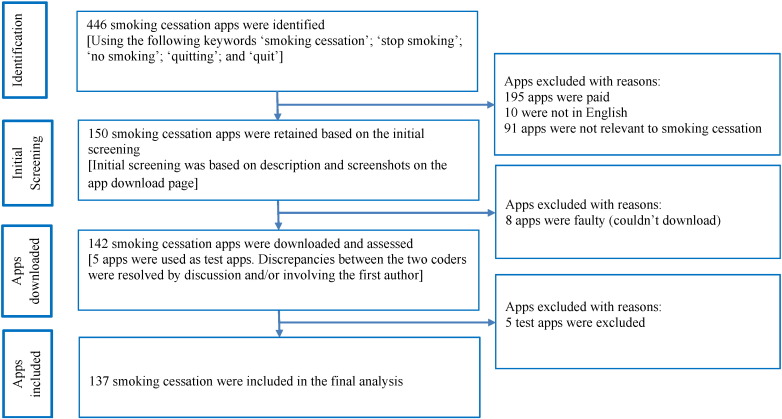
137 free apps available in the Apple App Sore in 2014 were coded using an established framework for the presence or absence of evidence-based BCTs, and engagement and ease-of-use features. The results from the 2014 data were compared with a similar exercise conducted on 83 free apps available in 2012.
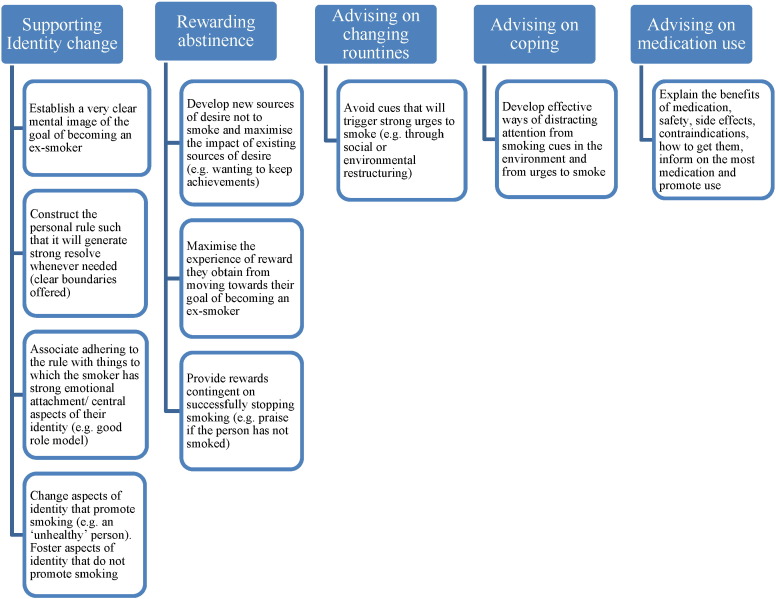
BCTs supporting identity change, rewarding abstinence and advising on changing routines were less prevalent in 2014 as compared with 2012 (14.6% vs. 42.2%, 18.2% vs. 48.2%, and 17.5% vs. 24.1%, respectively). Advice on coping with cravings and advice on the use of stop-smoking medication were more prevalent in 2014 as compared with 2012 (27.7% vs. 20.5% and 14.6% vs 3.6%, respectively). The use of recognised engagement features was less common in 2014 than in 2012 (45.3% vs. 69.6%) while ease-of-use features remained very high (94.5% vs. 82.6%).
There was little evidence of improvement in the use of evidence-based BCTs in free smoking cessation iPhone-based apps between 2012 and 2014.
智能手机应用程序(应用)为戒烟提供了一种潜在的经济高效且覆盖面广的辅助手段。2012年,一项针对戒烟应用的内容分析表明,大多数应用未采用行为改变技术(BCTs),而此前的研究表明,采用这些技术会提高戒烟成功率。本研究调查了到2014年苹果应用商店中免费戒烟应用的这种情况是否有所改变。同时还比较了两个时间点在参与度和易用性功能方面的使用情况。
采用一个既定框架,对2014年苹果应用商店中137款免费应用进行编码,以确定是否存在循证行为改变技术以及参与度和易用性功能。将2014年的数据结果与2012年对83款免费应用进行的类似分析结果进行比较。
与2012年相比,2014年支持身份改变、奖励戒烟和改变日常习惯建议的行为改变技术的应用占比更低(分别为14.6%对42.2%、18.2%对48.2%、17.5%对24.1%)。2014年应对渴望的建议和使用戒烟药物的建议比2012年更为普遍(分别为27.7%对20.5%、14.6%对3.6%)。2014年公认的参与度功能的应用占比低于2012年(45.3%对69.6%),而易用性功能的应用占比仍然很高(94.5%对82.6%)。
几乎没有证据表明2012年至2014年间基于iPhone的免费戒烟应用在循证行为改变技术的使用上有所改进。