Dhana Klodian, van Rosmalen Joost, Vistisen Dorte, Ikram M Arfan, Hofman Albert, Franco Oscar H, Kavousi Maryam
Department of Epidemiology, Erasmus Medical Center, PO Box 2040, 3000 CA, Rotterdam, The Netherlands.
Department of Biostatistics, Erasmus Medical Center, Rotterdam, The Netherlands.
Eur J Epidemiol. 2016 Jun;31(6):583-92. doi: 10.1007/s10654-016-0131-0. Epub 2016 Mar 8.
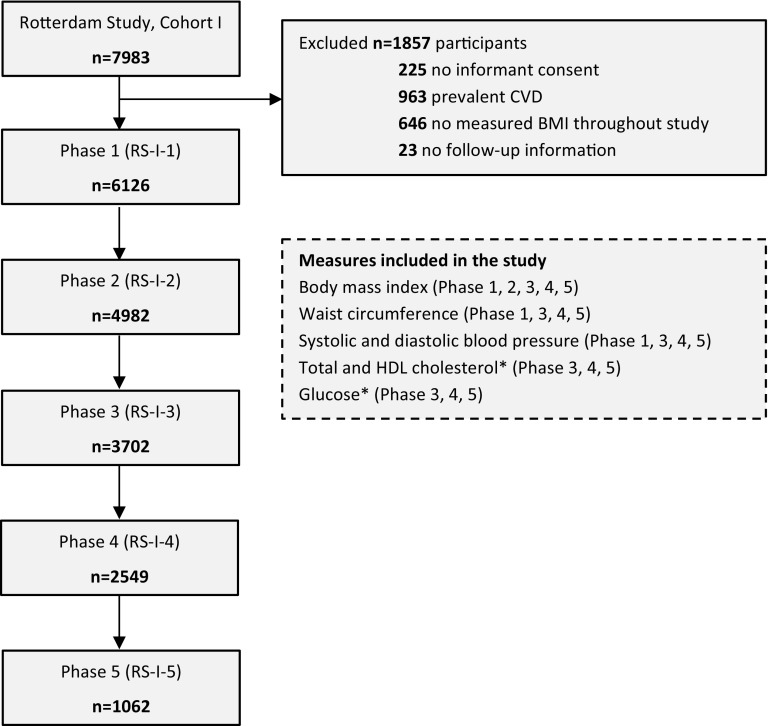
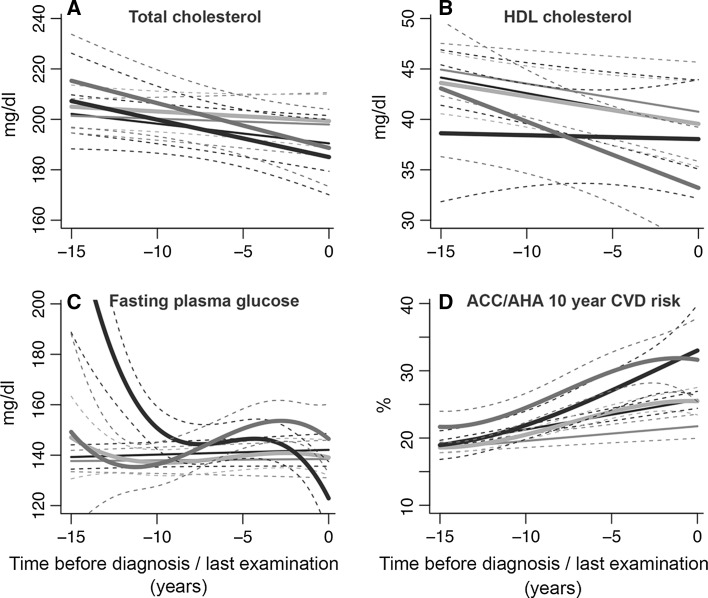
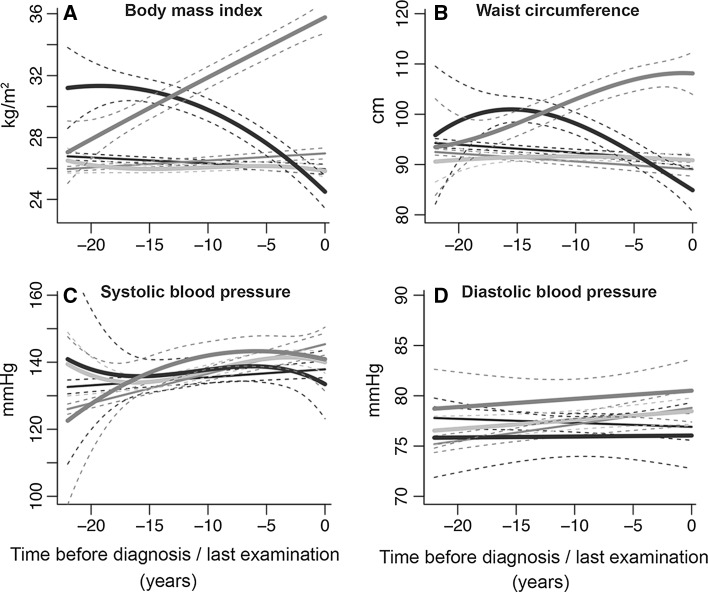
Patients with cardiovascular disease (CVD) are a heterogeneous group regarding their body mass index (BMI) levels at the time of diagnosis. To address the heterogeneity of CVD, we examined the trajectories of change in body mass index (BMI) and in other cardio-metabolic risk factors before CVD diagnosis. The study included 6126 participants from the prospective population-based Rotterdam Study, followed over 22 years with clinical examinations every 4 years. Latent class trajectory analysis and mixed-effect models were used to develop trajectories of BMI and other cardio-metabolic risk factors respectively. During follow-up, 1748 participants developed CVD, among whom we identified 3 distinct BMI trajectories. The majority of participants (n = 1534, 87.8 %) had steady BMI levels during follow-up, comprising the "stable weight" group. This group showed decrease in mean high-density lipoprotein (HDL) cholesterol over time. The second group, the "progressive weight gain" group (n = 112, 6.4 %), showed a progressive increase in BMI levels. In this group, mean waist circumference increased, mean HDL cholesterol decreased and mean fasting glucose levels were fluctuating over follow-up. In the third group, the "progressive weight loss" group (n = 102, 5.8 %), BMI levels decreased during follow-up. This group showed a decrease in mean waist circumference and in fasting glucose. In conclusion, the majority of individuals who developed CVD had a stable weight during follow-up, suggesting that BMI alone is not a good indicator for identifying middle-aged and elderly individuals at high risk of CVD. Waist circumference, HDL cholesterol, and glucose trajectories differed between the identified BMI subgroups, further highlighting that CVD is a heterogeneous disease with different pathophysiological pathways.
心血管疾病(CVD)患者在诊断时的体重指数(BMI)水平存在异质性。为了应对CVD的异质性,我们研究了BMI以及其他心血管代谢风险因素在CVD诊断前的变化轨迹。该研究纳入了来自基于人群的前瞻性鹿特丹研究的6126名参与者,每4年进行一次临床检查,随访22年。分别使用潜在类别轨迹分析和混合效应模型来确定BMI和其他心血管代谢风险因素的轨迹。在随访期间,1748名参与者患上了CVD,我们在其中确定了3种不同的BMI轨迹。大多数参与者(n = 1534,87.8%)在随访期间BMI水平稳定,构成“体重稳定”组。该组的平均高密度脂蛋白(HDL)胆固醇随时间下降。第二组为“渐进性体重增加”组(n = 112,6.4%),其BMI水平呈渐进性上升。在该组中,平均腰围增加,平均HDL胆固醇下降,平均空腹血糖水平在随访期间波动。第三组为“渐进性体重减轻”组(n = 102,5.8%),其BMI水平在随访期间下降。该组的平均腰围和空腹血糖均下降。总之,大多数患上CVD的个体在随访期间体重稳定,这表明仅BMI并不是识别中老年CVD高危个体的良好指标。在已确定的BMI亚组之间,腰围、HDL胆固醇和血糖轨迹有所不同,这进一步凸显了CVD是一种具有不同病理生理途径的异质性疾病。