Department of Epidemiology, University of Michigan School of Public Health, Ann Arbor, Michigan, USA.
Institute of Health Sciences, College of Health Science, Korea University, Seoul, Republic of Korea.
Environ Health Perspect. 2023 Aug;131(8):87004. doi: 10.1289/EHP12351. Epub 2023 Aug 8.
Per- and polyfluoroalkyl substances (PFAS) are associated with less favorable blood lipid profiles in epidemiological studies. However, little is known about the potential role of PFAS in longitudinal changes in lipids among midlife women even though women become more susceptible to metabolic alterations during the menopausal transition.
To examine associations of serum PFAS concentrations with longitudinal trajectories of blood total cholesterol, low-density lipoprotein (LDL) cholesterol, high-density lipoprotein (HDL) cholesterol, and triglycerides in midlife women undergoing menopausal transition.
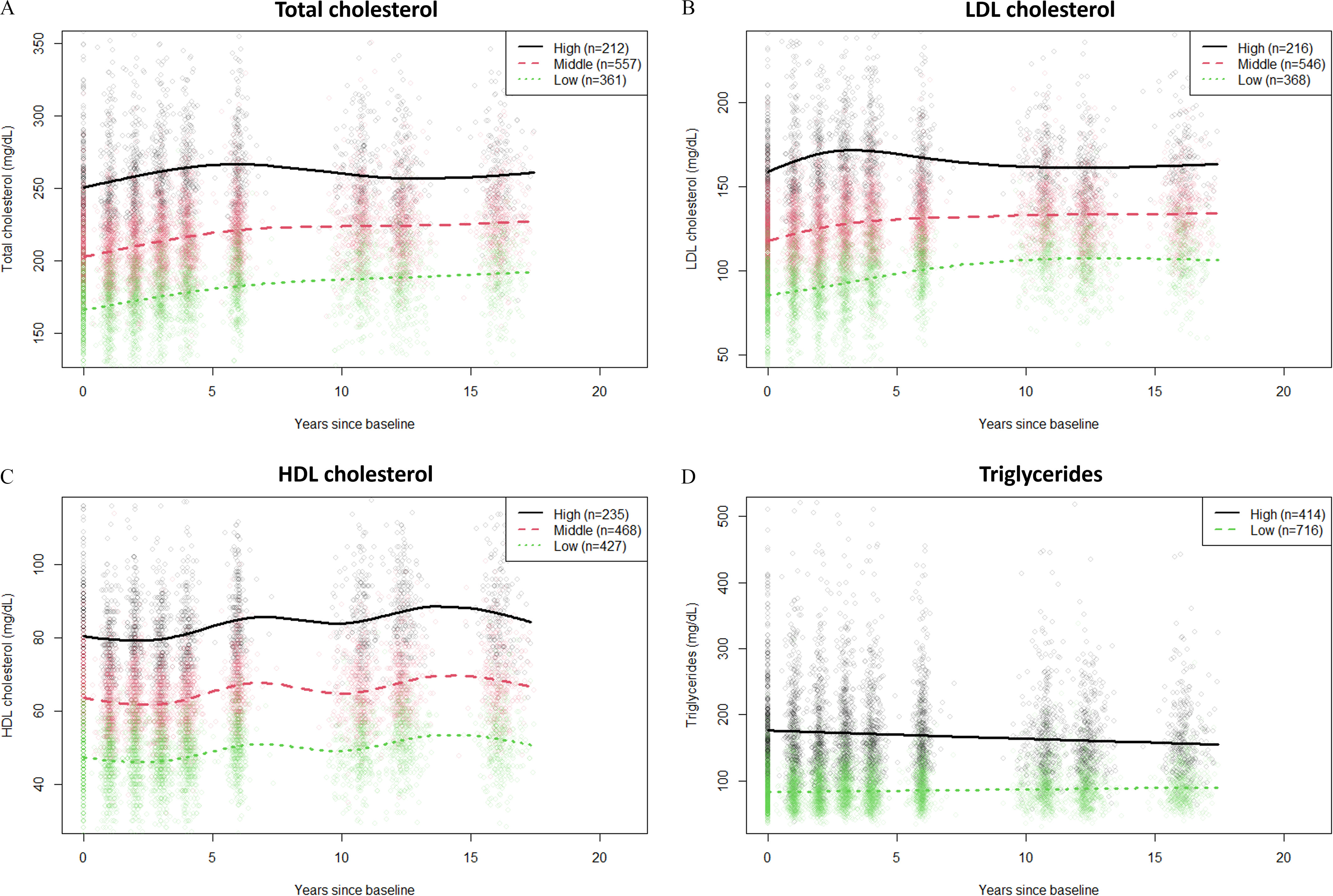
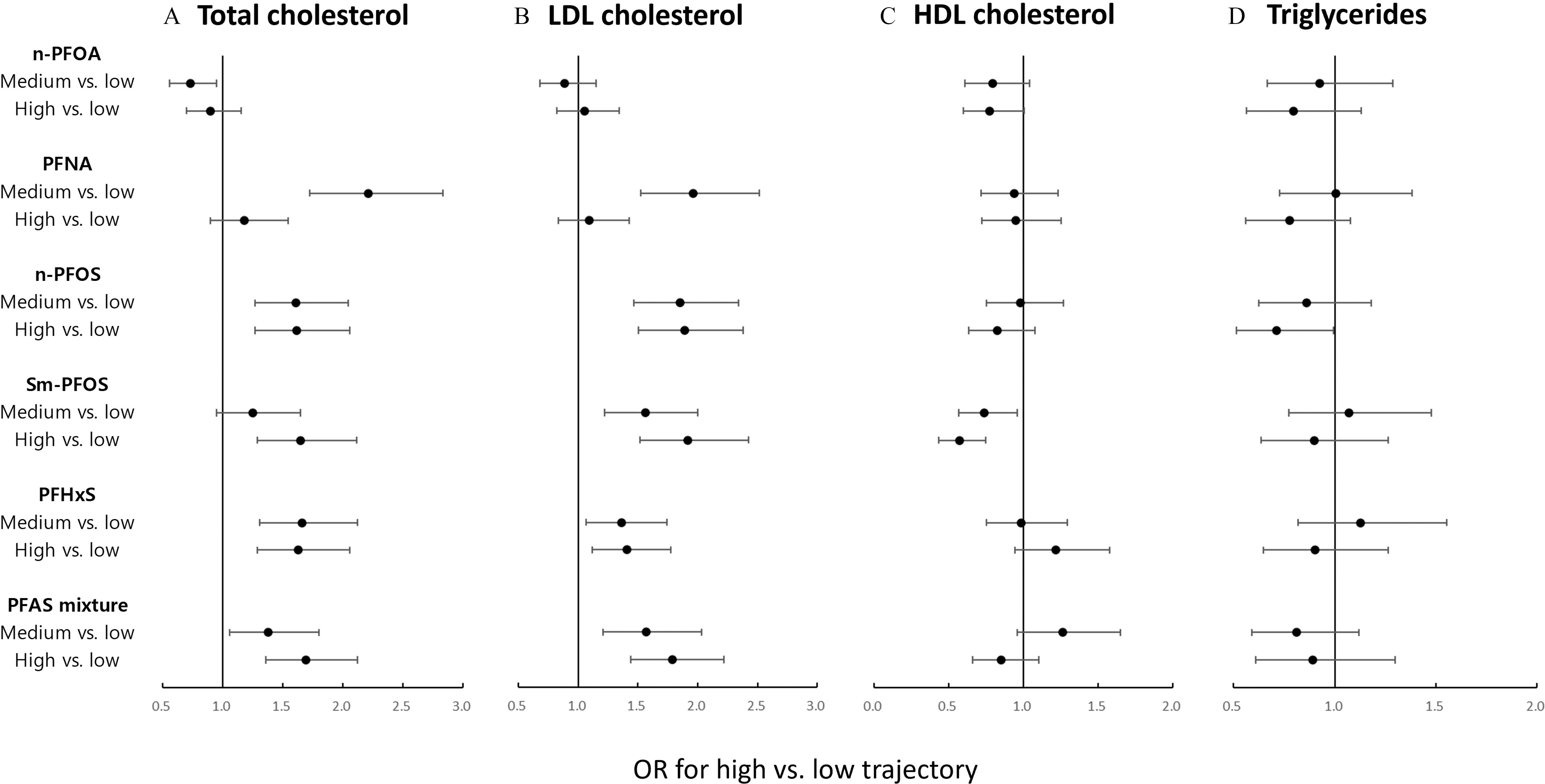
The sample included 1,130 women from the Study of Women's Health Across the Nation 45-56 y of age at baseline (1999-2000). We measured serum PFAS concentrations including linear perfluorooctanoic acid (n-PFOA), perfluorononanoic acid (PFNA), linear and branched perfluorooctanesulfonic acid (n-PFOS and Sm-PFOS, respectively), and perfluorohexanesulfonic acid (PFHxS) at baseline. We used -means clustering to identify subgroups with different patterns of PFAS mixture. Blood lipids were measured annually or biannually through 2016 with an average follow-up of 14.8 y. We identified longitudinal trajectories of each lipid using latent class growth models. We used multinomial log-linear models adjusted for covariates to estimate odds ratios (ORs) and 95% confidence intervals (CIs) of lipid trajectory classes by PFAS and their mixtures.
Three distinct trajectories (low, middle, high) of total, LDL, and HDL cholesterol and two distinct trajectories (low and high) of triglycerides were identified. n-PFOS, Sm-PFOS, and PFHxS were positively associated with total and LDL cholesterol trajectories. n-PFOS was inversely associated with triglycerides trajectories. PFAS mixtures (high vs. low) showed positive associations with total and LDL cholesterol trajectories (high vs. low), showing ORs (95% CIs) of 1.69 (95% CI: 1.36, 2.12) and 1.79 (95% CI: 1.44, 2.22), respectively.
Concentrations of serum PFAS were positively associated with trajectories of total and LDL cholesterol, providing a line of evidence supporting adverse effects of PFAS on lipid homeostasis. https://doi.org/10.1289/EHP12351.
在流行病学研究中,全氟和多氟烷基物质(PFAS)与血脂谱较差有关。然而,尽管女性在绝经过渡期间更容易发生代谢改变,但关于 PFAS 在中年女性血脂纵向变化中的潜在作用知之甚少。
研究血清 PFAS 浓度与处于绝经过渡阶段的中年女性血液总胆固醇、低密度脂蛋白(LDL)胆固醇、高密度脂蛋白(HDL)胆固醇和甘油三酯纵向轨迹之间的关联。
本研究样本包括来自妇女健康研究的 1130 名年龄在 45-56 岁的女性,这些女性在基线时(1999-2000 年)参加了国家研究。我们测量了血清 PFAS 浓度,包括线性全氟辛酸(n-PFOA)、全氟壬酸(PFNA)、线性和支链全氟辛烷磺酸(n-PFOS 和 Sm-PFOS)和全氟己烷磺酸(PFHxS)。我们使用均数聚类来识别具有不同 PFAS 混合物模式的亚组。通过 2016 年的每年或每两年一次的血液脂质测量,平均随访时间为 14.8 年。我们使用潜在类别增长模型来识别每种脂质的纵向轨迹。我们使用调整了协变量的多变量逻辑线性模型来估计 PFAS 和其混合物的脂质轨迹类别的比值比(OR)和 95%置信区间(CI)。
确定了总胆固醇、LDL 胆固醇和 HDL 胆固醇的三个不同轨迹(低、中、高)和甘油三酯的两个不同轨迹(低和高)。n-PFOS、Sm-PFOS 和 PFHxS 与总胆固醇和 LDL 胆固醇轨迹呈正相关。n-PFOS 与甘油三酯轨迹呈负相关。PFAS 混合物(高 vs. 低)与总胆固醇和 LDL 胆固醇轨迹呈正相关,OR(95%CI)分别为 1.69(95%CI:1.36,2.12)和 1.79(95%CI:1.44,2.22)。
血清 PFAS 浓度与总胆固醇和 LDL 胆固醇轨迹呈正相关,为 PFAS 对脂质动态平衡产生不良影响提供了证据。https://doi.org/10.1289/EHP12351.