Hu S, Qiu N, Liu Y, Zhao H, Gao D, Song R, Ma M
National Research and Development Center for Egg Processing, College of Food Science and Technology, Huazhong Agricultural University, Wuhan, Hubei 430070, P. R. China.
National Research and Development Center for Egg Processing, College of Food Science and Technology, Huazhong Agricultural University, Wuhan, Hubei 430070, P. R. China
Poult Sci. 2016 May;95(5):1137-44. doi: 10.3382/ps/pew033. Epub 2016 Mar 8.
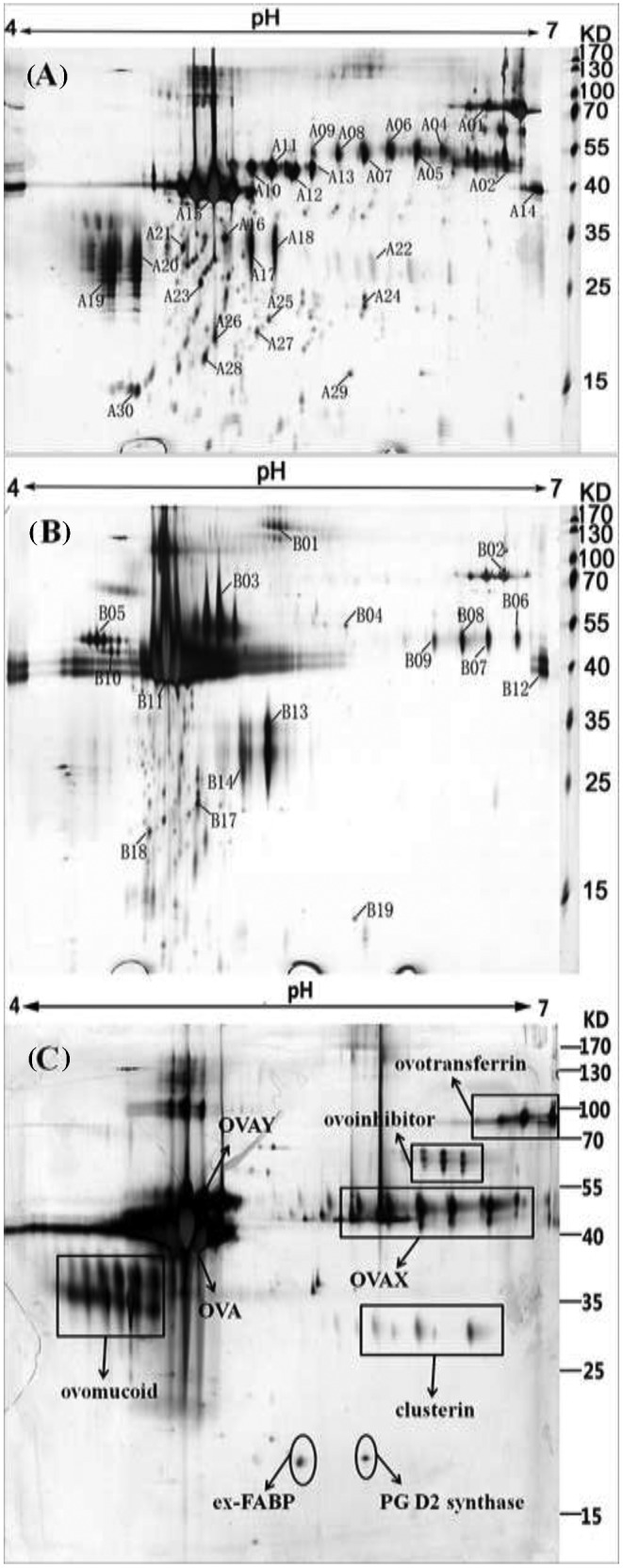
A proteomic study of egg white proteins from 2 major poultry species, namely quail (Coturnix coturnix) and duck (Anas platyrhynchos), was performed with comparison to those of chicken (Gallus gallus) through 2-dimensional polyacrylamide gel electrophoresis (2-DE) analysis. By using matrix-assisted laser desorption/ionization time-of-flight tandem mass spectrometry (MALDI-TOF MS/MS), 29 protein spots representing 10 different kinds of proteins as well as 17 protein spots designating 9 proteins were successfully identified in quail and duck egg white, respectively. This report suggested a closer relationship between quail and chicken egg white proteome patterns, whereas the duck egg white protein distribution on the 2-DE map was more distinct. In duck egg white, some well-known major proteins, such as ovomucoid, clusterin, extracellular fatty acid-binding protein precursor (ex-FABP), and prostaglandin D2 synthase (PG D2 synthase), were not detected, while two major protein spots identified as "deleted in malignant brain tumors 1" protein (DMBT1) and vitellogenin-2 were found specific to duck in the corresponding range on the 2-DE gel map. These interspecies diversities may be associated with the egg white protein functions in cell defense or regulating/supporting the embryonic development to adapt to the inhabiting environment or reproduction demand during long-term evolution. The findings of this work will give insight into the advantages involved in the application on egg white proteins from various egg sources, which may present novel beneficial properties in the food industry or related to human health.
对鹌鹑(Coturnix coturnix)和鸭(Anas platyrhynchos)这两种主要家禽的蛋清蛋白进行了蛋白质组学研究,并通过二维聚丙烯酰胺凝胶电泳(2-DE)分析与鸡(Gallus gallus)的蛋清蛋白进行比较。通过基质辅助激光解吸/电离飞行时间串联质谱(MALDI-TOF MS/MS),分别在鹌鹑和鸭蛋清中成功鉴定出代表10种不同蛋白质的29个蛋白点以及代表9种蛋白质的17个蛋白点。本报告表明鹌鹑和鸡蛋清蛋白质组模式之间的关系更为密切,而鸭蛋清蛋白在2-DE图谱上的分布更为独特。在鸭蛋清中,未检测到一些著名的主要蛋白质,如卵类粘蛋白、簇集素、细胞外脂肪酸结合蛋白前体(ex-FABP)和前列腺素D2合酶(PG D2合酶),而在2-DE凝胶图谱的相应范围内,发现两个主要蛋白点被鉴定为“恶性脑肿瘤1缺失”蛋白(DMBT1)和卵黄生成素-2,它们是鸭所特有的。这些种间差异可能与蛋清蛋白在细胞防御或调节/支持胚胎发育以适应长期进化过程中的栖息环境或繁殖需求的功能有关。这项工作的发现将有助于深入了解各种蛋类来源的蛋清蛋白应用所具有的优势,这些优势可能在食品工业或与人类健康相关方面呈现出新的有益特性。